
Is the Belief That Humans Are Naturally Evil and Greedy True?
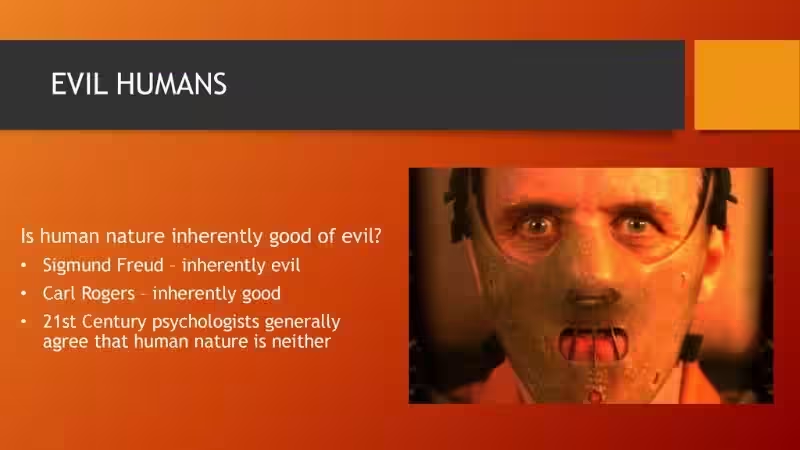
The age-old question of human nature – are we inherently good or evil? – continues to spark passionate debate. This article explores the belief that humans are naturally evil and greedy, examining the philosophical and scientific perspectives that both support and challenge this view. Understanding this perspective is crucial to comprehending our societal structures, moral development, and potential for both cooperation and conflict.
- The Philosophical Roots of Inherent Evil
- The Biological and Psychological Counterarguments
- Societal Structures and the Amplification of Evil
- A More Nuanced View of Human Nature
-
Frequently Asked Questions: Are Humans Inherently Evil and Greedy?
- Is it true that humans are naturally evil and greedy?
- What evidence supports the idea of inherent human goodness?
- What evidence suggests humans are inherently selfish or evil?
- Doesn't the existence of crime and conflict prove inherent human evil?
- So, what's the conclusion? Are we inherently good or evil?
The Philosophical Roots of Inherent Evil
The idea of humanity's inherent wickedness has deep roots in philosophy and theology. Philosophers like Thomas Hobbes famously argued that, in a "state of nature," without societal constraints, human life would be "solitary, poor, nasty, brutish, and short." Hobbes's pessimistic view, rooted in the concept of inherent selfishness, emphasized the necessity of a strong, controlling state to prevent society from collapsing into chaos.
This perspective is often contrasted with that of Jean-Jacques Rousseau, who believed that humans are naturally compassionate and good, corrupted only by the artificial constructs of civilization. Rousseau's view posited that societal inequalities and the class system erode our innate goodness, leading to conflict and exploitation. This fundamental disagreement highlights the inherent complexity of the question: Is our capacity for evil a natural characteristic, or a product of our social environment?
The "Lord of the Flies" Argument
Often cited as evidence supporting the inherent evil view is William Golding's novel, Lord of the Flies. The book depicts a group of British schoolboys stranded on a desert island who descend into savagery and violence in the absence of adult supervision. This fictional example is frequently used to illustrate the argument that underlying human nature is inherently aggressive and prone to brutality. However, the validity of this argument is debated, as the boys' behavior is also influenced by fear, isolation, and lack of structure — factors absent in typical social settings.
The Biological and Psychological Counterarguments
While philosophical arguments can be compelling, biological and psychological research offers a more nuanced perspective. Evolutionary biology suggests that cooperation, rather than pure self-interest, has been crucial for human survival and success. Humans exhibit levels of cooperation exceeding those of other primates, pointing to a potentially innate predisposition for social interaction and mutual aid. This naturally occurring cooperation challenges the simplistic notion of humanity as purely self-serving and greedy.
Recent studies in developmental psychology also challenge the inherently evil view. Research indicates that young children possess a rudimentary understanding of morality and fairness, suggesting an innate moral compass that guides their behavior before extensive social conditioning takes place. This suggests that our capacity for empathy and moral judgment isn't solely learned, but may have a biological basis.
Classic social psychology experiments, such as the Milgram obedience experiment and the Stanford prison experiment, were initially interpreted as evidence of human capacity for cruelty under pressure. However, these experiments have since been subjected to extensive criticism regarding their methodology and ethical implications, raising doubts about their conclusions. These experiments' inherent limitations and potential biases complicate their use as definitive evidence of inherent human depravity.
Societal Structures and the Amplification of Evil
The argument for inherently evil human nature often overlooks the critical role of societal structures in shaping individual behavior. While humans are undoubtedly capable of cruelty, the scale and nature of atrocities throughout history are often linked to specific social and political contexts. The horrors of the Khmer Rouge regime in Cambodia or the North Korean gulags weren't spontaneous eruptions of inherent evil; they were systematically created and enabled by specific societal structures.
The emergence of large-scale, hierarchical societies, coinciding with the development of agriculture and urbanization, is a critical factor. The concentration of wealth and power, coupled with complex social structures, created conditions that allowed for systematic oppression, slavery, and large-scale violence. These systems allowed for the amplification of aggression and the normalization of cruelty on an unprecedented scale.
The Role of Inequality
Extreme economic inequality is a crucial element in this amplification. When vast disparities in wealth and power exist, they create an environment where exploitation and conflict become more likely. History shows a strong correlation between social inequality and violence, suggesting that the structure of society, rather than inherent human nature, is a significant driver of conflict and cruelty.
A More Nuanced View of Human Nature
In conclusion, while acknowledging the undeniably dark aspects of human history, it's crucial to question the simplistic notion that humans are naturally evil and greedy. The evidence suggests a more complex picture, one that acknowledges our capacity for both cooperation and aggression. While inherent predispositions may exist, they are significantly shaped and amplified by our social environment and the structures of the societies we create. The focus should shift from inherent traits to understanding how societal structures, particularly those that create and perpetuate extreme inequality, can foster conflict, violence, and suffering. Attributing evil solely to inherent human nature ignores the crucial role of context and societal influence in shaping human behavior. Instead of accepting a predetermined nature, we must acknowledge our capacity for both good and evil, and work to create societies that encourage cooperation, fairness, and justice.
Frequently Asked Questions: Are Humans Inherently Evil and Greedy?
The question of whether humans are inherently good or evil is a complex one, debated for centuries across philosophy, psychology, and other disciplines. There's no simple yes or no answer.
Is it true that humans are naturally evil and greedy?
This is a simplification of a much more nuanced debate. While human history contains countless examples of cruelty, greed, and violence, it also showcases remarkable acts of kindness, compassion, and selflessness. Attributing these behaviors solely to an inherent "evil" nature ignores the significant impact of social, cultural, and environmental factors. Philosophers like Thomas Hobbes argued for an inherently selfish human nature, requiring strong societal controls. However, Jean-Jacques Rousseau countered that humans are inherently good, corrupted by societal structures. Modern perspectives suggest a more complex interplay between innate predispositions and external influences.
What evidence supports the idea of inherent human goodness?
Evidence supporting inherent goodness includes observations of prosocial behavior in young children, even before significant social learning. Children often display empathy, cooperation, and a sense of fairness. Evolutionary biology also suggests humans evolved cooperative strategies for survival. While aggression exists, our level of cooperation surpasses many other primates. Furthermore, some simpler, more egalitarian societies exhibit less large-scale violence than complex, stratified societies, suggesting that social structures significantly influence our behavior.
What evidence suggests humans are inherently selfish or evil?
The historical record is replete with examples of violence, war, genocide, and exploitation. Social psychology experiments, while sometimes criticized for methodological limitations, have explored the extent to which situational factors can influence individuals to behave in cruel or unethical ways. The sheer scale of atrocities in some societies seems to indicate a capacity for immense cruelty. However, it's crucial to differentiate between individual acts and systematic societal structures that enable and even incentivize such behavior.
Doesn't the existence of crime and conflict prove inherent human evil?
Crime and conflict certainly exist, but their prevalence doesn't automatically prove inherent evil. These behaviors are often rooted in factors like poverty, inequality, lack of opportunity, and social injustice. Furthermore, the forms and scale of conflict vary dramatically across different societies and historical periods. Complex, hierarchical societies, often characterized by extreme wealth disparities, appear more prone to large-scale violence than simpler, more egalitarian ones.
So, what's the conclusion? Are we inherently good or evil?
Neither. The evidence suggests a more complex reality than a simple dichotomy. Humans likely possess inherent predispositions toward both cooperation and aggression. The expression of these tendencies is dramatically shaped by our upbringing, social environment, cultural norms, and the societal structures within which we live. It's the interplay between nature and nurture that ultimately determines individual behavior and the prevalence of good or evil acts within a society. Focusing solely on individual "innate" qualities neglects the immense influence of societal factors.