
How Are Humans Different From Everything Else God Created?
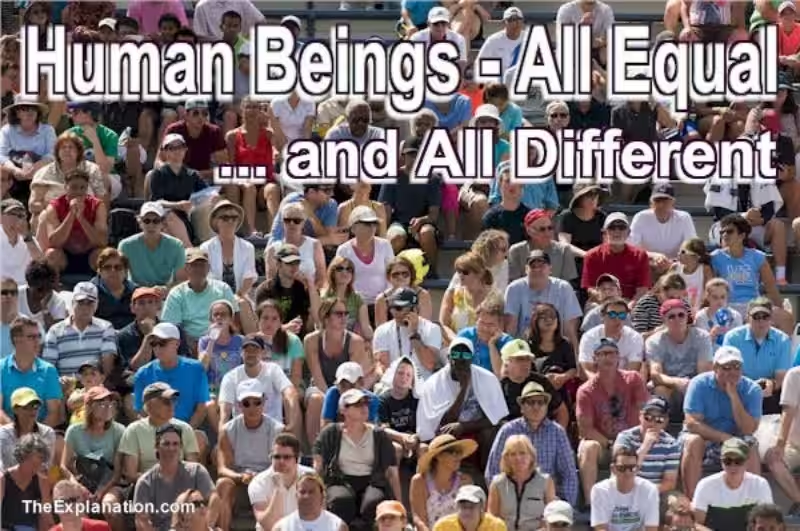
The question of humanity's unique place in creation has captivated thinkers for millennia. Whether viewed through a religious or scientific lens, the differences between humans and other life forms are striking. This article explores this question, focusing on the theological perspective of humans being created in the image of God, while acknowledging the significance of scientific understanding.
- The Biblical Perspective: Imago Dei
- The Atheistic Perspective: Humans as Advanced Animals
- The Nature of the Imago Dei: Spirit, Reason, and Relationship
- The Implications of Being Created Imago Dei
-
Frequently Asked Questions: Humanity's Unique Place in Creation
- What makes humans different from other creatures according to a biblical worldview?
- Is the "image of God" only spiritual, or does it include the physical body?
- How does the concept of imago Dei impact our understanding of human dignity and the sanctity of life?
- What is the role of sin in the "image of God"?
- How does the concept of imago Dei differ from an atheistic or materialistic worldview?
- Does the "image of God" imply that humans are like God in every way?
The Biblical Perspective: Imago Dei
The Bible, particularly the book of Genesis, asserts that humans are fundamentally different from all other creatures. Genesis 1:26-27 declares, "Then God said, 'Let us make mankind in our image, in our likeness, so that they may rule over the fish in the sea and the birds in the sky, over the livestock and all the wild animals, and over all the creatures that move along the ground.' So God created mankind in his own image, in the image of God he created them; male and female he created them." This concept, imago Dei (image of God), is central to understanding humanity's unique nature.
This isn't simply a physical resemblance. While humans share physical characteristics with animals, the imago Dei refers to a deeper, spiritual essence. It implies a unique capacity for reason, moral judgment, self-awareness, and most importantly, a relationship with God. The creation narrative emphasizes God’s direct involvement in forming Adam from dust and breathing life into him, a process distinct from the creation of other creatures.
The implications of this are profound. It suggests an inherent dignity and worth to each human being, regardless of their physical or intellectual capabilities. This inherent dignity is not something earned or achieved; it's bestowed by God naturally.
The Atheistic Perspective: Humans as Advanced Animals
Conversely, an atheistic worldview often views humans as simply the most advanced product of evolution, a complex animal with highly developed cognitive abilities. This perspective, while scientifically plausible, often lacks a robust ethical framework for valuing human life. If humans are merely advanced animals, what inherent moral value do they possess? This lack of an objective moral foundation can lead to the justification of actions that violate human dignity, from acts of genocide to the devaluation of human life before birth. The absence of a divinely ordained value system leaves humanity vulnerable to subjective interpretations of morality.
The Problem of Moral Relativism
A purely naturalistic worldview, lacking a supernatural source of morality, struggles to provide a solid basis for universal human rights. Without a reference point outside of human preferences and societal constructs, moral values become relative and arbitrary. This relativism has historically led to catastrophic consequences, as demonstrated by the atrocities of the 20th century.
The Nature of the Imago Dei: Spirit, Reason, and Relationship
The nature of the imago Dei has been debated throughout theological history. However, several core elements consistently emerge. These include:
- Reason and Intellect: Humans possess a unique capacity for rational thought, abstract reasoning, and problem-solving far exceeding that of any other creature.
- Moral Capacity: We possess an innate sense of right and wrong, a conscience that guides our actions and allows us to judge the morality of our own choices and the choices of others.
- Self-Awareness and Personhood: We are conscious of our own existence, our individuality, and our place in the world. This self-awareness allows for introspection, reflection, and the development of personal identity.
- Capacity for Relationship with God: This is arguably the most significant aspect of the imago Dei. It's the ability to know, love, and commune with God – a relationship unique to humanity.
These attributes, however, were damaged by the Fall, resulting in sin and alienation from God. This damage affects our reason, our moral compass, and our ability to form a right relationship with God. The Christian faith teaches that through faith in Jesus Christ, this damaged image can be restored and renewed, gradually restoring our likeness to God.
The Implications of Being Created Imago Dei
The concept of imago Dei has profound implications for how we understand ourselves and our relationship with the world:
- Inherent Dignity and Worth: Every human being, regardless of their circumstances, possesses inherent dignity derived from their creation in God's image.
- Sanctity of Life: The value of human life is not determined by societal norms or personal preferences but is intrinsically linked to its divine origin. Taking a human life is therefore an assault not only on the individual but also on God.
- The Need for Redemption: Because humans are created in God's image, their alienation from Him requires a divine act of redemption. The Christian faith teaches that this redemption is offered through Jesus Christ.
The Role of the Body
The question of whether the physical body is part of the imago Dei is a complex one. While some theological interpretations emphasize the spiritual aspect, focusing on the soul or spirit, the biblical perspective generally suggests a holistic view where the unity of the body and soul is crucial. The body is not merely a vessel for the spirit but is an integral part of what it means to be human, created and cherished by God. It's a temple of the Holy Spirit, reflecting the sacredness imbued in every aspect of humanity.
In conclusion, the difference between humans and other creatures created by God, according to the biblical worldview, lies in the imago Dei. It’s a spiritual essence that bestows inherent dignity, moral capacity, and the potential for relationship with the divine. Understanding this profound difference is crucial for developing a meaningful ethical framework and appreciating the unique value of every human life.
Frequently Asked Questions: Humanity's Unique Place in Creation
What makes humans different from other creatures according to a biblical worldview?
The biblical worldview, particularly the Genesis account of creation, asserts that humanity is uniquely created in the image of God (imago Dei). This isn't a purely physical resemblance but a spiritual one, encompassing a rational, personal spirit capable of reason, communication, and fellowship with God. This spiritual aspect grants humans a moral compass, free will, and the capacity for a relationship with their creator, unlike any other created being. God's direct involvement in creating humans—forming them from dust and breathing life into them—further emphasizes their unique status.
Is the "image of God" only spiritual, or does it include the physical body?
While traditionally understood as primarily spiritual, residing in the soul, the concept of imago Dei is increasingly viewed holistically. Some interpretations emphasize a psychosomatic unity, recognizing the body's integral role in human personhood. Regardless of the precise interpretation, the biblical perspective affirms the sanctity and importance of the human body, often described as a temple of the Holy Spirit.
How does the concept of imago Dei impact our understanding of human dignity and the sanctity of life?
The imago Dei forms the bedrock of inherent human dignity. Because humans are created in God's image, they possess an intrinsic worth and value independent of their accomplishments or societal status. This directly counters views that devalue human life, providing a theological basis for opposing practices like abortion and genocide. The violation of a human life is viewed as an assault not only on the individual but also on God Himself.
What is the role of sin in the "image of God"?
Sin damaged the original image of God in humanity, causing alienation from God and a distortion of our inherent goodness. However, this damage is not irreparable. Through faith in Christ, regeneration begins the process of restoring the image, renewing knowledge, righteousness, and holiness. Even after death, the image persists in the disembodied spirit, awaiting resurrection and the ultimate perfecting of the image in the spiritual body.
How does the concept of imago Dei differ from an atheistic or materialistic worldview?
Atheistic and materialistic worldviews generally view humans as merely advanced animals, products of evolution with no inherent spiritual value or purpose beyond survival and reproduction. This perspective often lacks a firm foundation for upholding human dignity and can contribute to the dehumanization seen in historical atrocities. The biblical understanding of imago Dei, in contrast, grounds human dignity in a divine relationship and provides a strong moral framework for ethical behavior and societal justice.
Does the "image of God" imply that humans are like God in every way?
No, the "image of God" signifies a resemblance, not a sameness. Humans are created in God's image, reflecting certain aspects of His character such as rationality, morality, and the capacity for relationship, but they are not God. God is transcendent and possesses attributes beyond human comprehension. The image is a reflection, not a duplication.