
Understanding Evil in Hebrew: רָע (Ra) and its Nuances
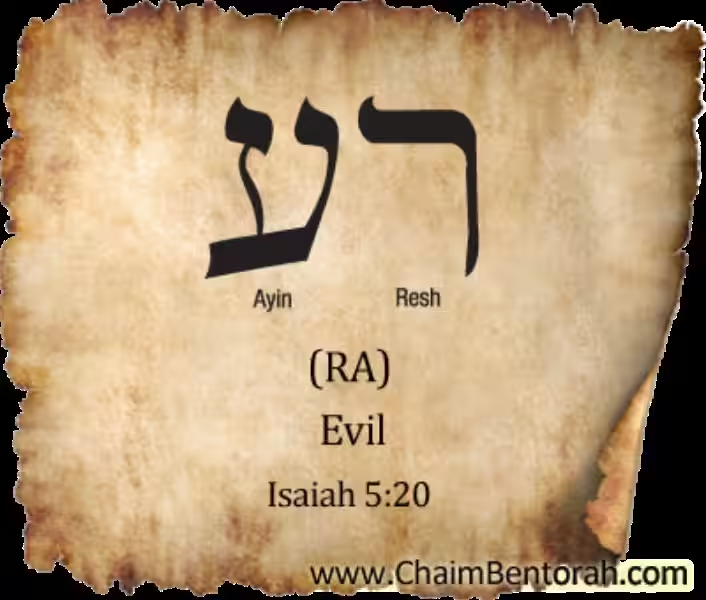
The Hebrew language, rich in its depth and subtlety, doesn't offer a single word for "evil" in the way that English might. Instead, the concept unfolds through various words, primarily stemming from the root ra (רָע), revealing a nuanced understanding of wickedness far beyond a simple label. This exploration delves into the multifaceted nature of ra and its implications, highlighting the intricate ways the Hebrew Bible grapples with the presence of evil in the world.
- The Root רָע (Ra): A Multifaceted Understanding of Evil
- Contrasting Good (טוב - Tov) and Evil (רָע - Ra): A Divine Perspective
- The Growing Prevalence of Evil and the Importance of Scriptural Foundation
- The Cry of "Woe": הוֹי (Hoy) and the Consequences of Ignoring God's Standards
-
Frequently Asked Questions: Evil in Hebrew
- What is the primary Hebrew word for "evil," and what are its nuances?
- How does the Hebrew understanding of "evil" differ from modern interpretations?
- What other Hebrew words convey aspects of evil, and what are their specific meanings?
- What is the significance of the phrase "Woe to those who call evil good"?
- Why is it crucial to ground one's opposition to evil in scripture?
The Root רָע (Ra): A Multifaceted Understanding of Evil
The two-letter root ra (רָע), unusually short for a Hebrew word, forms the foundation for numerous words describing various aspects of evil. This brevity, some scholars argue, is intentional, suggesting an encompassing nature—ra represents the totality of evil, encompassing all its manifestations.
The lack of a definitive third letter allows for multiple interpretations, each adding a specific shade of meaning to the concept of ra. For instance, ra'av (רָעָב) signifies the "evil" of hunger, a physical suffering that reflects a lack of provision and can lead to desperation and wrongdoing. Conversely, ra'am (רָעַם) refers to the "evil" of rage, highlighting the destructive power of uncontrolled anger. Other variations, like ra'ad (רָעַד), describe the "evil" leading to a loss of control or the shaking caused by fear, again emphasizing the destructive power of evil’s influence. It is important to note that these aren't simply negative experiences, but rather expressions of a deeper moral failing.
This multiplicity of meanings isn't accidental; it underscores the multifaceted nature of evil itself. It's not a monolithic force but rather a collection of behaviors, circumstances, and intentions that deviate from God's will. The ambiguity inherent in the root ra reflects the complexity of evil’s presence in the human experience.
Contrasting Good (טוב - Tov) and Evil (רָע - Ra): A Divine Perspective
The Hebrew word for "good," tov (טוב), stands in stark contrast to ra. Tov implies harmony with God's will, reflecting a state of order, blessing, and righteousness. Therefore, anything that disrupts this harmony, that contradicts God's plan or his nature, is considered ra. This perspective is vividly illustrated in Psalm 139:23: "Search me, O God, and know my heart; test me and know my anxious thoughts. See if there is any offensive way in me, and lead me in the way everlasting." (NIV) David's plea reveals a deep understanding that true assessment of "good" and "evil" necessitates divine evaluation.
This passage highlights the inherent danger of establishing a personal moral code separate from God's word. Defining "good" and "evil" independently leads to justification of actions harmful to others, mirroring the actions of those who ignore a higher moral authority and define "good" based solely on their own desires and beliefs. It is crucial to understand that evil, from a biblical perspective, isn't merely an absence of good; it's a deliberate opposition to God's design.
The Growing Prevalence of Evil and the Importance of Scriptural Foundation
The world today witnesses a growing prevalence of blatant evil, from acts of violence and injustice to widespread moral decay. However, the response to this evil must be firmly rooted in scripture. Confronting evil without a scriptural foundation is hypocritical, equivalent to justifying actions without acknowledging a higher moral authority.
It's important to study the Bible and develop a deep understanding of God's character and his moral code. This allows us to identify and confront evil effectively, empowered by divine truth rather than our own limited perceptions. Only by grounding our understanding in God's word can we hope to successfully oppose the influence of ra in the world.
The Cry of "Woe": הוֹי (Hoy) and the Consequences of Ignoring God's Standards
The Hebrew word hoy (הוֹי) signifies "woe," a powerful interjection expressing profound grief and pain. The phrase "Woe to those who call evil good and good evil" (Isaiah 5:20, NIV), represents God's cry of anguish, a lament over humanity's disregard for his established standards. This is not merely a condemnation but a prophecy; those who ignore God's definition of good and evil will ultimately face the consequences of their actions. Their actions, though perhaps seen as "good" in their own eyes, will ultimately bring suffering and pain aligning with the definition of ra.
The study of ra (רָע) and its numerous forms reveals a profound theological understanding. It is not simply a list of negative actions, but a complex exploration of the nature of evil, its origins, and its consequences. Ultimately, understanding "evil" in Hebrew requires acknowledging God's perspective, recognizing the inherent danger of self-defined morality, and embracing a life aligned with His will. Only then can we truly understand and effectively combat the pervasive influence of ra in the world.
Frequently Asked Questions: Evil in Hebrew
What is the primary Hebrew word for "evil," and what are its nuances?
The most basic Hebrew term for "evil" is the two-letter word ra (רָע). Unlike most Hebrew words which have three letters, the third letter is often implied, leading to variations with nuanced meanings. These include ra'av (evil of hunger), ra'ad (evil causing loss of control), ra'al (evil of drunkenness), ra'am (evil of rage), and others. The lack of a definitive third letter suggests ra encompasses all forms of evil. The most common interpretation, ra'a (רָעַע), signifies the evil of worshipping another god, often oneself.
How does the Hebrew understanding of "evil" differ from modern interpretations?
The Hebrew understanding of evil is intrinsically linked to God's will. Tov (טוֹב), meaning "good," implies harmony with God; therefore, anything discordant with God's will is considered evil. This understanding contrasts with modern interpretations that may prioritize individual moral codes or situational ethics. The Hebrew perspective emphasizes that establishing a personal moral code independent of God's word is dangerous and mirrors the actions of those who justify harmful actions based on self-defined beliefs.
What other Hebrew words convey aspects of evil, and what are their specific meanings?
The Hebrew Bible utilizes a rich vocabulary to describe evil. Resha (רֶ֫שַׁע) specifically denotes "wickedness" and inherent moral corruption. Other words describe the manifestations of evil: maalal (מַעֲלָלִים) refers to "evil deeds" or "bad practices"; dibbah (דִּבָּה) signifies "slander" or "evil report"; and mezimmah (מְזִמָּה) denotes "evil plans" or malicious schemes. Words like aven (אָ֫וֶן) and ason (אָסוֹן) capture broader concepts of wickedness, mischief, harm, and suffering. Verbs such as gamal (גָּמַל) ("to deal out," implying consequences), ba'ar (בָּעַר) ("to remove or eradicate evil"), and zamam (זָמַם) ("to plot or devise harm") further illustrate the diverse ways evil is expressed. Finally, shub (שׁוּב) signifies the possibility of turning away from evil through repentance.
What is the significance of the phrase "Woe to those who call evil good"?
The Hebrew word for "woe," hoy (הוֹי), is an onomatopoeic expression of grief and pain. The phrase "Woe to those who call evil good" represents God's anguish at the disregard for His standards. It predicts reciprocal suffering for those who ignore God's definition of good and evil, underscoring the consequences of self-defined morality.
Why is it crucial to ground one's opposition to evil in scripture?
The study emphasizes that opposing evil without a scriptural foundation is hypocritical and equivalent to those who justify their actions without acknowledging a higher moral authority. Scripture provides the necessary framework for identifying and confronting evil effectively. It is essential to understand God's definition of good and evil to effectively combat the growing prevalence of wickedness in the world. This approach prevents the establishment of subjective moral codes and ensures a consistent, God-centered response to evil.