
Colt vs Donkey: Did Jesus Ride a Donkey or a Colt into Jerusalem?
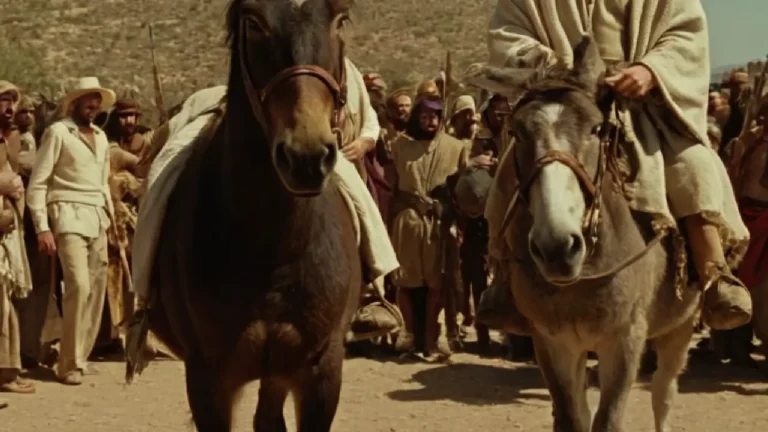
The triumphal entry of Jesus into Jerusalem—celebrated on Palm Sunday—is one of the most significant events in the Gospels. Yet it has sparked a long-standing question: Did Jesus ride a donkey or a colt? The Gospel of Matthew mentions both, while Mark, Luke, and John mention only a colt. This discrepancy has led to the so-called “colt vs donkey” debate among readers, scholars, and skeptics.
Is this a contradiction in the Bible? Or can these differences be harmonized? In this article, we explore the details of Jesus’ entry into Jerusalem, the prophecy behind it, and how the accounts of the donkey and colt actually work together rather than contradict one another.
- 🐴 Colt vs Donkey: What Do the Gospels Say?
- 📖 Why Does Matthew Mention Both Animals?
- 🔮 Zechariah’s Prophecy and the Symbolism of the Colt
- 🔄 Are the Gospels Contradictory? Or Complementary?
- ❌ Was Taking the Donkey Theft? Addressing a Common Objection
- 🧠 Why the “Colt vs Donkey” Debate Matters
- ✅ Did Jesus Ride a Donkey or a Colt?
-
Frequently Asked Questions: Jesus' Triumphal Entry and the Donkeys
- Were there one or two donkeys at Jesus' triumphal entry?
- How does Zechariah 9:9 relate to the number of donkeys?
- What does Matthew 21:7 ("They brought the donkey and the colt, laid their clothes on them, and set Him on them") actually mean?
- Didn't Jesus and his disciples steal the donkeys?
- Why are there discrepancies in the Gospel accounts?
- Shouldn't we assume the Gospel accounts are consistent until proven otherwise?
🐴 Colt vs Donkey: What Do the Gospels Say?
🕮 Gospel Accounts:
- Matthew 21:2–7 mentions both a donkey and a colt.
- Mark 11:2, Luke 19:30, and John 12:14 mention only a colt.
❓ Did Jesus Ride a Donkey or a Colt?
- According to Matthew, Jesus rode a colt, but both the colt and the donkey were brought to Him.
- The other Gospels focus solely on the colt, likely because it was the animal Jesus actually rode.
This difference raises a question of emphasis—not contradiction. The accounts highlight different aspects of the same event, depending on the author’s purpose and audience.
📖 Why Does Matthew Mention Both Animals?
Matthew 21:7 states:
“They brought the donkey and the colt, and laid their cloaks on them, and he sat on them.”
Critics point to the phrase “sat on them” and ask: Did Jesus ride two animals at once?
The answer lies in the language:
- “Them” likely refers to the cloaks placed on both animals, not the animals themselves.
- Jesus rode only the colt, the younger animal, fulfilling prophecy (more on that below).
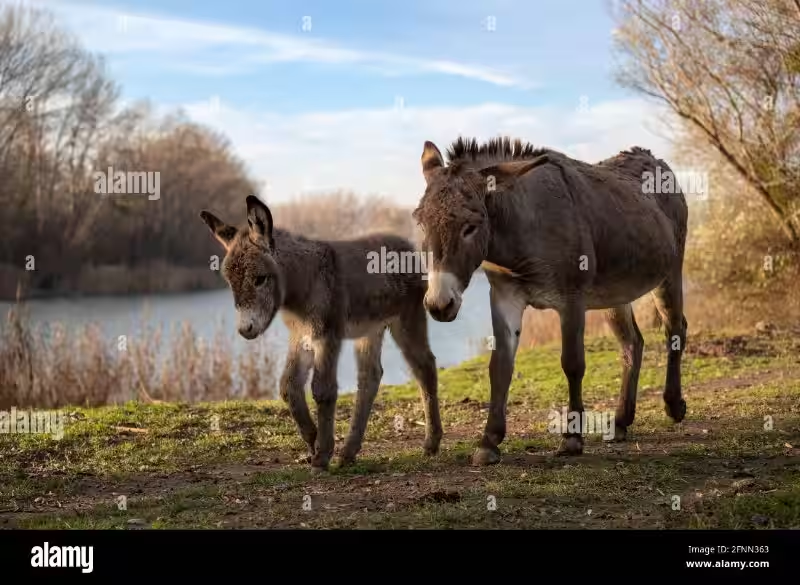
- The mother donkey was likely brought alongside to calm the colt, which had never been ridden (Mark 11:2).
So, did Jesus ride a donkey or a colt? The best answer is: He rode the colt, while the mother donkey was present but not ridden.
🔮 Zechariah’s Prophecy and the Symbolism of the Colt
The key to understanding the donkey and colt connection is found in Zechariah 9:9:
“Behold, your King is coming to you; righteous and having salvation is he, humble and mounted on a donkey, on a colt, the foal of a donkey.”
This verse uses Hebrew parallelism, where the same idea is expressed in two different ways. But it can also be interpreted literally, referring to two animals—a colt (young donkey) and its mother.
Jesus riding a colt, with the mother present, fulfills both the literal and symbolic aspects of the prophecy:
- Humble: He rides not a warhorse, but a lowly beast of burden.
- Peaceful: His kingship is gentle and spiritual, not political or military.
- Prophetic: He deliberately fulfills the Messianic imagery that first-century Jews would recognize.
🔄 Are the Gospels Contradictory? Or Complementary?
When comparing the “colt vs donkey” narratives, it’s important to understand the nature of the Gospels:
- Each author writes with a unique focus, shaped by eyewitnesses, theology, and audience.
- Omitting the mother donkey (as in Mark, Luke, and John) doesn't mean she wasn’t there.
- Including more detail (as in Matthew) offers a fuller picture, not a conflicting one.
This is common in historical accounts: one witness may mention two people; another may highlight only one. Both can be true without contradiction.
❌ Was Taking the Donkey Theft? Addressing a Common Objection
Some skeptics suggest that Jesus and His disciples stole the animals. However, the Bible tells us:
“If anyone says anything to you, say that the Lord needs them, and he will send them right away.” (Matthew 21:3)
This implies:
- Prior arrangement or divine foresight
- Owner consent, as no resistance or dispute follows
- In Jewish culture, kings had the right to requisition animals or resources for noble purposes
Thus, the action was neither random nor dishonest—it reflected Jesus’ authority and messianic role.
🧠 Why the “Colt vs Donkey” Debate Matters
This debate isn’t just about animals—it’s about:
- Trust in the reliability of the Gospels
- Understanding biblical prophecy
- Respecting literary and cultural context
When we read carefully and holistically, we see harmony, not contradiction. The differences enrich the narrative and give us greater insight into the purpose and fulfillment of Jesus' actions.
✅ Did Jesus Ride a Donkey or a Colt?
Jesus rode the colt, just as prophesied, and the mother donkey was present, likely to calm the young animal. The Gospel of Matthew gives the full detail, while the others highlight the main event.
So, in the colt vs donkey question, both animals play a role—but Jesus rode the colt.
This isn’t a contradiction—it's a layered, unified testimony across the Gospels that strengthens the biblical message:
Jesus is the humble King who fulfilled prophecy and entered Jerusalem in peace, on His way to offer salvation to the world.
Frequently Asked Questions: Jesus' Triumphal Entry and the Donkeys
Were there one or two donkeys at Jesus' triumphal entry?
The Gospel accounts appear to differ on the number of donkeys present at Jesus' triumphal entry into Jerusalem. Matthew mentions both a donkey and a colt, while Mark, Luke, and John only mention a colt. However, this is not necessarily a contradiction.
The differing accounts may represent different perspectives or supplemental details, with Matthew providing a more comprehensive picture. One interpretation suggests that the colt was the primary animal ridden by Jesus, while the mother donkey may have accompanied them. Several plausible explanations exist to reconcile these accounts.
How does Zechariah 9:9 relate to the number of donkeys?
Zechariah 9:9 prophesies a king entering Jerusalem humbly, riding on a donkey. The interpretation of this prophecy is key. Some believe the prophecy refers to a single animal, while others argue the poetic parallelism in the verse implies two animals: a colt and its mother.
The presence of the mother donkey, even if not explicitly mentioned in all accounts, is consistent with the overall narrative and fulfills the broader implication of Zechariah's prophecy. A young colt would likely need its mother nearby, especially for a journey.
What does Matthew 21:7 ("They brought the donkey and the colt, laid their clothes on them, and set Him on them") actually mean?
The phrase "laid their clothes on them," is a source of debate. "Them" could refer to the donkeys, implying Jesus rode both. However, a more persuasive interpretation suggests "them" refers to the clothes, a more grammatically sound understanding based on the Greek word order.
Alternative translations support this view, emphasizing the clothes as the direct object. Other options include Jesus riding one animal at different times or the mother donkey simply walking alongside.
Didn't Jesus and his disciples steal the donkeys?
The text does not support the accusation of theft. The accounts suggest the use of the animals was either prearranged or willingly granted by the owners after the disciples explained Jesus' need. The phrase "the Lord has need of them," used by the disciples, implies a divinely sanctioned request that would likely be honored.
Why are there discrepancies in the Gospel accounts?
The Gospels are not verbatim transcriptions but independent accounts, possibly from different eyewitnesses. They often supplement each other with various details (location, the colt's prior use, the owners' question, etc.).
These differences in emphasis and detail don't necessarily indicate contradictions, but rather highlight the multi-faceted nature of the event. The differences should be seen as complementary perspectives rather than conflicting narratives.
Shouldn't we assume the Gospel accounts are consistent until proven otherwise?
Yes, a principle of "innocent until proven guilty" should apply to biblical interpretation. The burden of proof lies on those claiming contradiction. The existence of several plausible explanations reconciling the apparent discrepancies in the donkey accounts demonstrates that a genuine contradiction hasn't been established. The lack of complete detail in the biblical narrative doesn't automatically imply error or inconsistency. Not every fact needs to be explicitly stated.