
The Chronology of the Gospels: Unraveling the Sequence of the New Testament Narratives
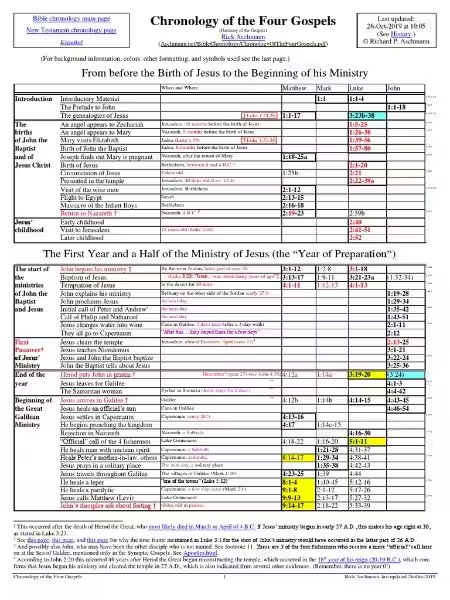
Determining the precise order in which the four Gospels—Matthew, Mark, Luke, and John—were written is a question that has intrigued and challenged biblical scholars for centuries. The lack of explicit dates within the texts themselves, coupled with their distinct theological perspectives and narrative styles, makes establishing a definitive chronology a complex undertaking. However, by carefully examining their literary relationships and stylistic features, we can construct a plausible, albeit debated, sequence. This article will explore the various theories and the evidence supporting them, providing a clearer understanding of the chronology of the Gospels.
- Markan Priority: The Earliest Gospel
- Matthew and Luke: A Close but Contested Relationship
- John: A Unique Perspective, a Later Composition
- Conclusion: A Working Chronology, Not a Fixed Order
-
Frequently Asked Questions: Chronology of the Gospels
- What is the general consensus on the chronological order of the Gospels?
- Why is determining the exact order so difficult?
- Which Gospel is generally considered the earliest?
- What is the "Synoptic Problem," and how does it relate to the chronology?
- How are Matthew and Luke related chronologically?
- When was John likely written?
- Should the Gospels be viewed primarily as chronological accounts?
Markan Priority: The Earliest Gospel
Most biblical scholars agree on the primacy of Mark's Gospel. This consensus rests on several key observations. Mark's writing style is notably concise and action-oriented, lacking the extensive theological reflection found in Matthew and Luke. Its narrative structure focuses on the events of Jesus's ministry with less emphasis on detailed exposition or interpretation.
This relative simplicity suggests that Mark may have served as a foundational text for the subsequent Gospels. Both Matthew and Luke incorporate significant portions of Mark's narrative, often verbatim or with minor modifications. This phenomenon, known as "Markan Priority," is a cornerstone of modern Gospel studies and significantly influences the proposed chronology. While the exact dating of Mark remains debated, scholarly estimates generally place its composition in the 60s or 70s CE.
The Evidence for Markan Priority
Several lines of evidence support Markan Priority:
- Extensive overlap: Matthew and Luke share a significant amount of material with Mark, with many passages being almost identical.
- Order of events: While not perfectly consistent, the overall sequence of events in Matthew and Luke generally follows that of Mark.
- Similarities in language and style: Matthew and Luke occasionally employ the same unusual phrasing and grammatical structures found in Mark.
- Lack of theological development: Mark’s text is less developed theologically compared to the subsequent Gospels.
These similarities suggest that Matthew and Luke used Mark as a source when writing their own Gospels. The differences in their theological perspectives and narrative choices then become a crucial factor in determining their relative chronology.
Matthew and Luke: A Close but Contested Relationship
Following Mark, the next pair in the chronological puzzle is Matthew and Luke. These two Gospels share a considerable amount of material not found in Mark, often referred to as the "Q" source. "Q" is a hypothetical document, a collection of sayings and teachings of Jesus, believed to have been used by both Matthew and Luke. The exact nature of "Q," including its content and extent, remains a subject of ongoing scholarly discussion.
The challenge in establishing the chronology of Matthew and Luke lies in disentangling their unique contributions. Both Gospels draw upon Mark and Q, but they also contain substantial material specific to each author. This unique material, coupled with their differing theological emphases, has led to various chronological proposals.
The Debate Over Matthew and Luke's Order
Some scholars argue for Matthew's precedence, pointing to its apparent structure designed for a Jewish-Christian audience. This argument suggests that Matthew might have been written earlier, aiming to establish the Jewish roots and fulfillment of prophecy in Jesus's ministry.
Others, however, favor Luke's precedence, emphasizing its broader appeal and emphasis on universal salvation. Luke's Gospel includes a more pronounced focus on the inclusivity of Christianity and its message for Gentiles, suggesting a later composition aimed at a broader, less exclusively Jewish audience. Ultimately, a definitive conclusion regarding the sequencing of Matthew and Luke remains elusive.
John: A Unique Perspective, a Later Composition
The Gospel of John stands apart from the Synoptic Gospels (Matthew, Mark, and Luke) in its style, theological perspective, and narrative structure. Unlike the Synoptic Gospels, John is less concerned with a strict chronological account of Jesus's ministry. It focuses instead on presenting Jesus's identity and ministry through symbolic language and deep theological reflection.
The selection of miracles and discourses in John's Gospel also differs significantly from the Synoptic Gospels. This unique approach suggests a different purpose and audience, distinct from the Synoptic tradition. Scholars generally agree that John's Gospel is the latest of the four, likely written several decades after Mark. Estimates place its composition in the late 90s or early 100s CE. This later date is consistent with its distinct theological and literary characteristics.
The Distinctiveness of John
John's Gospel is characterized by:
- Symbolic Language: The use of rich symbolism and metaphorical language is pervasive.
- Theological Depth: Deep theological reflection on Jesus's identity is central to the narrative.
- Different Miracles and Discourses: The selection of miracles and teachings differs significantly from the Synoptic Gospels.
- Unique Narrative Structure: The narrative structure is less linear and more thematic.
These distinctive features support the widely held view that the Gospel of John represents a later stage in the development of Gospel literature, offering a unique perspective on the life and teachings of Jesus.
Conclusion: A Working Chronology, Not a Fixed Order
In summary, while a definitive chronology of the Gospels remains elusive, a generally accepted sequence places Mark as the earliest Gospel, followed by Matthew and Luke (with their order debated), and finally John. This sequence is based on extensive literary analysis, comparison of writing styles, and the identification of intertextual relationships between the Gospels.
It's crucial to remember that the Gospels are not simply historical biographies in the modern sense. They are theological interpretations of Jesus's life and ministry, each with its unique purpose and audience. Understanding the chronology of the Gospels helps us appreciate the evolution of early Christian thought and the diverse ways Jesus's message was understood and transmitted in the early church. The chronology of the gospels therefore, is a subject demanding continued scholarly engagement and nuanced interpretation.
Frequently Asked Questions: Chronology of the Gospels
What is the general consensus on the chronological order of the Gospels?
The chronological order of the Gospels (Matthew, Mark, Luke, and John) is a complex issue debated by biblical scholars. While no single order is universally agreed upon, a widely accepted, albeit simplified, sequence places Mark first, followed by Matthew and Luke (with their order debated), and finally John. This is based on literary analysis and the relationships between the Gospels' texts.
Why is determining the exact order so difficult?
The Gospels weren't written as contemporaneous historical accounts but as theological narratives with different purposes and audiences. They are not simply biographies aiming for strict chronological accuracy, but interpretations of Jesus's life and ministry. This makes simple chronological ordering based on events challenging.
Which Gospel is generally considered the earliest?
Most scholars agree that Mark is the earliest Gospel. Its concise style and lack of detailed theological reflection suggest it served as a foundational text for the others. Matthew and Luke both incorporate significant portions of Mark's narrative. This is known as "Markan Priority". Estimates place Mark's writing in the 60s-70s CE.
What is the "Synoptic Problem," and how does it relate to the chronology?
The Synoptic Problem refers to the striking similarities between Matthew, Mark, and Luke (the Synoptic Gospels). Their shared material indicates a literary relationship, with Mark's influence being particularly clear. Understanding this relationship is key to establishing a likely chronological order. The fact that Matthew and Luke both draw heavily from Mark suggests they were written after Mark.
The exact order of Matthew and Luke remains debated. Both draw heavily from Mark but also include unique material ("Q" material and their own special materials). Some scholars argue for Matthew's precedence due to its apparent structure for a Jewish-Christian audience; others favor Luke, citing its broader appeal and emphasis on universal salvation. The difference is likely within a decade or less.
When was John likely written?
John is generally considered the latest Gospel, possibly written several decades after Mark, perhaps in the late 90s or early 100s CE. Its distinct style, theological perspective, and narrative structure significantly differ from the Synoptic Gospels, suggesting a different purpose and audience.
Should the Gospels be viewed primarily as chronological accounts?
No. The Gospels should not be viewed solely as chronological biographies. They are distinct theological interpretations of Jesus' life and ministry, each with its own unique perspective and purpose for its intended audience. While chronological elements exist, their primary aim is theological.