
Jesus Resting in the Tomb: A Reflection on Holy Saturday
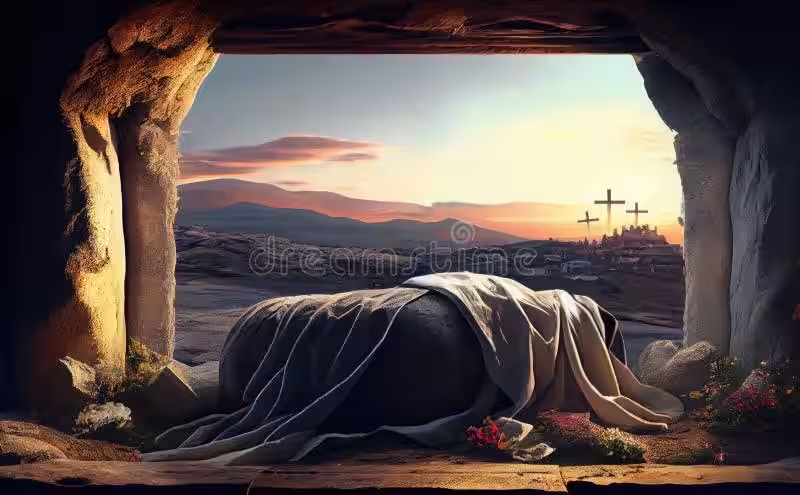
The question lingers: What is the true significance of Jesus resting in the tomb? Often, we rush past Holy Saturday, eager to reach the triumphant celebration of Easter Sunday. But this silent day, this Sabbath of profound stillness, holds a critical theological weight that deserves our careful attention. It's a pivotal moment, not just in the life of Jesus, but in the very narrative of creation and redemption.
- The Incomplete Seventh Day: A Genesis Perspective
- Holy Saturday: The Shocking Fact and the Promise of Triumph
-
Reconciling the Gospel Accounts: Jesus's Rest in the Tomb
- The Triumph of Resurrection: Hope from the Tomb
- What is the theological significance of Jesus resting in the tomb on Holy Saturday?
- How does Jesus's rest in the tomb relate to the concept of "Tetelestai"?
- Why is it important to reflect on Holy Saturday, rather than rushing to Easter Sunday?
- How does the concept of the "cemetery" relate to Jesus's rest in the tomb?
- What is the significance of the Sabbath in relation to Jesus's burial and resurrection?
- How do the Gospels differ in their accounts of the timing of Jesus's burial and the women's visit to the tomb?
- Does the discrepancy in Gospel accounts regarding the timing of Jesus's burial diminish the significance of the resurrection?
The Incomplete Seventh Day: A Genesis Perspective
The book of Genesis describes God's creation in six days, culminating in his rest on the seventh. However, a subtle yet significant difference marks the description of the seventh day compared to the others. Genesis consistently uses the phrase "and there was evening and there was morning, the [number] day," for the first six days. This precise, cyclical structure is absent for the seventh day. This omission suggests an incompleteness, a lack of finality to God’s rest. It's as if the story of creation is left with a gap, an unspoken conclusion.
This "incomplete" seventh day is not a mere oversight in the text. It acts symbolically, hinting at a future fulfillment, a completion yet to come. The ongoing nature of God's rest foreshadows a deeper, more comprehensive rest to be achieved. This missing element in the narrative foreshadows a resolution that will only be found later in the story of redemption.
The Sabbath Rest of Jesus: Completing Creation
The theological significance of Jesus resting in the tomb during this period becomes strikingly clear when we consider this "gap" in Genesis. Jesus's death and burial on the Sabbath, after declaring "It is finished" (John 19:30), mirrors God's rest on the seventh day. The phrase "Tetelestai," meaning "it is finished," powerfully underscores the finality of Christ's sacrifice. It wasn't just a tragic event; it was the culmination of his redemptive work, the necessary step to complete God's creative act and usher in the “new creation.”
This act of Jesus resting in the tomb is not a passive event; it's an active participation in the completion of God's plan. His rest fills the void, the incompleteness of the seventh day. It provides the necessary closure to the creation narrative, a finality that the original account lacked. The Sabbath rest, therefore, takes on a profoundly significant meaning, marking the completion of God's work, a necessary precursor to the new creation.
Holy Saturday: The Shocking Fact and the Promise of Triumph
Holy Saturday is not merely a transition between Good Friday and Easter Sunday; it's a day of profound reflection on the "shocking fact" of God's death and burial. This is not merely a historical event but a powerful demonstration of God's complete immersion in human experience, a solidarity with humanity that reaches the depths of suffering and death. Jesus’s death was not a defeat, but a victory already anticipated in his own mind.
Beyond the Tomb: A Portal to Paradise
The significance of Jesus resting in the tomb extends beyond Holy Saturday itself. The very word "cemetery," derived from the Greek word for "sleeping place," reflects the Christian belief that death is not the end but a temporary rest, a waiting period before the resurrection. The grave, therefore, ceases to be a place of fear and becomes a portal to paradise, its power rendered null and void by Jesus's victory over death and the devil. This understanding transforms our perspective on death and burial, offering hope and comfort in the face of loss. The quiet waiting within the tomb becomes a time of anticipation, a silent pause before the dawn of a new day.
Reconciling the Gospel Accounts: Jesus's Rest in the Tomb
The question of whether Jesus's body rested in the tomb during the Sabbath or after it is a subject of ongoing debate among biblical scholars. The Gospels offer different perspectives: Mark and Matthew emphasize the women visiting the tomb "very early on the first day of the week," leaving the precise timing ambiguous. Luke similarly mentions an early morning visit. However, John's account highlights the Jewish preparation for the Sabbath, suggesting Jesus's burial took place before the Sabbath commenced, placing him in the tomb during the sacred rest.
This discrepancy does not necessarily undermine the central message. The Gospels were written for different audiences and with varied theological emphases. Reconciling the accounts requires accepting that the Gospels represent diverse perspectives focusing on different aspects of the same event. The precise timing is less crucial than understanding the theological significance; Jesus' body being in the tomb during the Sabbath fulfills the prophecy of Isaiah 53:9, highlighting his complete sacrifice. The focus should be on the complete fulfillment of God‘s promise and its implications.
Some scholars propose a reconciliation: Jesus was buried before sunset on Friday, the beginning of the Sabbath, and the women visited after sunrise on Sunday. Others emphasize the significance of Jesus's rest during the Sabbath, highlighting the profoundness of his sacrifice. Regardless of the exact timing, the overarching message remains the same: Jesus’s resting in the tomb, whether before or during the Sabbath, is an integral part of God's plan of salvation.
The Triumph of Resurrection: Hope from the Tomb
Ultimately, the precise timing of Jesus resting in the tomb becomes secondary to the overwhelming triumph of the resurrection. Regardless of whether it occurred immediately after the Sabbath or at its conclusion, the resurrection marks the definitive victory over death, the ultimate fulfillment of God's promise. The act of Jesus resting in the tomb, therefore, serves not as a symbol of defeat but as a necessary prelude to the glorious dawn of Easter Sunday, a testament to the power of God's love and the enduring promise of eternal life. The stillness of Holy Saturday gives way to the resounding joy of the resurrection, a joy born from the depths of suffering and the darkness of the tomb, confirming the ultimate victory over death itself. It is this hope, this promise of resurrection, that resonates throughout the ages, offering solace, comfort and the unwavering belief in a new creation.
What is the theological significance of Jesus resting in the tomb on Holy Saturday?
The resting of Jesus in the tomb on Holy Saturday is theologically significant because it completes the incomplete seventh day of creation described in Genesis. The author argues that the lack of a concluding phrase for the seventh day in Genesis signifies incompleteness. Jesus's rest in the tomb, following the completion of his redemptive work ("It is finished"), mirrors God's rest and "fills in" this gap, signifying the culmination of God's creative act and the beginning of a new creation. His death, therefore, is not simply a tragedy, but a necessary step in this larger plan.
How does Jesus's rest in the tomb relate to the concept of "Tetelestai"?
The Aramaic word "Tetelestai," meaning "it is finished," emphasizes the finality of Jesus's sacrifice and its fulfillment of God's plan. His rest in the tomb signifies the completion of this work, highlighting the victory already present even in death.
Why is it important to reflect on Holy Saturday, rather than rushing to Easter Sunday?
Holy Saturday is crucial because it represents the "shocking fact" of God's death and burial, highlighting the depth of his sacrifice and his complete immersion in human experience. Acknowledging this day allows for a deeper appreciation of the resurrection and avoids minimizing the significance of Jesus's sacrifice.
How does the concept of the "cemetery" relate to Jesus's rest in the tomb?
The term "cemetery," derived from the Greek word for "sleeping place," reflects the Christian belief that death is not the end, but a temporary rest, a waiting period before resurrection. Jesus's victory over death transforms the grave from a place of fear into a portal to paradise.
What is the significance of the Sabbath in relation to Jesus's burial and resurrection?
The Sabbath's observance highlights the completeness of Jesus's sacrifice. His resting in the tomb during the Sabbath fulfills prophecy and underscores the sacredness of this period, directly connecting his rest to God's rest in creation. The precise timing of the burial and resurrection, though debated, does not diminish the theological truth of the resurrection and the victory over death.
How do the Gospels differ in their accounts of the timing of Jesus's burial and the women's visit to the tomb?
The Gospels offer varying accounts of the precise timing of Jesus's burial and the women's visit to the tomb. Some emphasize a burial before the Sabbath and a post-Sabbath visit, while others are less precise. These differences may stem from differing audiences, theological emphases, variations in the observance of the Sabbath, or a lack of focus on chronological precision. However, the discrepancies do not negate the central message of the resurrection.
Does the discrepancy in Gospel accounts regarding the timing of Jesus's burial diminish the significance of the resurrection?
No. The differing Gospel accounts, while seemingly contradictory on the precise timing, do not diminish the profound theological truth of the resurrection. The varying perspectives highlight different theological points, and the core message of victory over death and the promise of eternal life remains unchanged. The focus should be on the ultimate significance of the resurrection rather than the exact hour.