
The 12 Stones in the Jordan River: What They Mean, Where They Are Today, and Why They Still Matter

One of the most compelling questions in biblical archaeology is this: What happened to the 12 stones in the Jordan River? Joshua commanded twelve men to carry twelve stones from the bed of the Jordan River to the camp at Gilgal — one stone for each of the twelve tribes of Israel. That much the Bible records with extraordinary clarity. But what happened to those stones after the Israelites settled in the Promised Land? Are the 12 stones of Joshua still there today? And what do the 12 stones under the Jordan River — a separate set placed by Joshua himself — mean for believers today?
This is a question that sits at the intersection of biblical narrative, archaeology, theology, and enduring mystery — and it deserves a thorough, honest answer. Let's walk through every dimension of this remarkable story.
- 12 Stones of Jordan Today: What Became of Joshua's Memorial?
- 📖 The Biblical Account: Joshua 4 and the Two Sets of Stones
- The First Set: Twelve Stones Carried OUT of the Jordan
- The Second Set: Twelve Stones Left UNDER the Jordan
- 🌊 What Do the 12 Stones Under the Jordan River Mean?
- A Testimony in the Invisible Place
- The Feet of the Priests: Where the Sacred Met the Earth
- 🏕️ The 12 Stones at Gilgal: Joshua's Memorial
- Why Gilgal?
- What the Stones Looked Like
- 🗺️ Are the 12 Stones of Joshua Still There Today?
- The Archaeological Reality
- What Some Researchers Believe
- The Spiritual Answer
- 🏛️ The Significance of Each of the 12 Tribes
- 🔑 What Do the 12 Stones Mean for Us Today?
- The Principle of the Ebenezer: Marking God's Faithfulness
- The Principle of the Hidden Foundation
- The Principle of Intergenerational Faith
- ❓ Frequently Asked Questions About the 12 Stones in the Jordan River
- Are the 12 stones of Joshua still there today?
- Where exactly did the Jordan crossing happen?
- How many sets of 12 stones were there?
- What does "Gilgal" mean?
- Were the 12 stones connected to the 12 tribes of Israel?
- Are these stones related to the stones mentioned in Revelation?
- 🌟 The Enduring Mystery as a Spiritual Invitation
-
Frequently Asked Questions: The Twelve Stones of Jordan
- Where are the twelve stones from the Jordan River today?
- What is the significance of the twelve stones?
- Why were twelve stones chosen, and not a different number?
- What is the significance of the location, Gilgal?
- How did the stones serve as a witness to God's faithfulness?
- Why did Joshua instruct future generations to ask about the stones?
- Were there other stones placed besides the twelve at Gilgal?
12 Stones of Jordan Today: What Became of Joshua's Memorial?
📖 The Biblical Account: Joshua 4 and the Two Sets of Stones
Before asking where the stones are today, it's essential to understand something that many readers of Joshua 4 miss entirely: there were not one but two separate sets of twelve stones placed during the Jordan crossing — and the Bible treats them very differently.
The First Set: Twelve Stones Carried OUT of the Jordan
"Choose twelve men from among the people, one from each tribe, and command them: 'Take up for yourselves twelve stones from the middle of the Jordan where the priests were standing, carry them with you, and set them down in the place where you spend the night.'" — Joshua 4:2-3
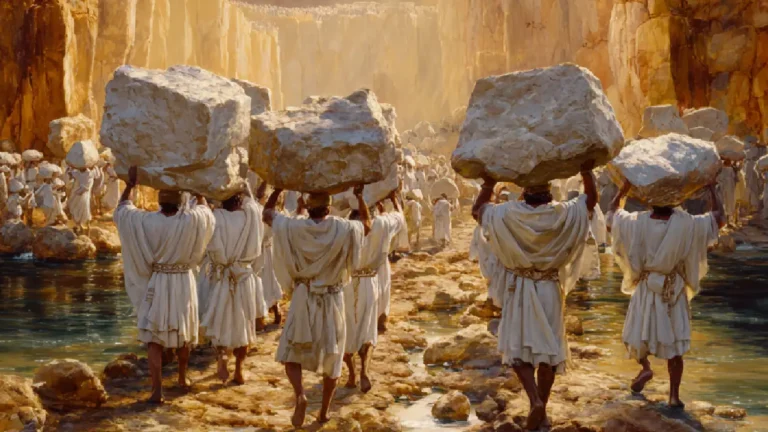
This is the set most people know. God commanded Joshua to select twelve men — one representative from each of the twelve tribes of Israel — to carry a stone each from the bed of the Jordan River to the camp. These twelve stones were:
- Taken from the exact spot where the priests' feet stood as they held the Ark of the Covenant
- Carried across the Jordan on the shoulders of one man per tribe
- Initially placed at the camp for the night
- Later transported to Gilgal, the first permanent camp of Israel in Canaan, where Joshua set them up as a public memorial
The Second Set: Twelve Stones Left UNDER the Jordan

Here is the detail that most articles miss — and that directly answers the question "are the 12 stones in the Jordan River still there?":
"And Joshua set up twelve stones in the midst of the Jordan, in the place where the feet of the priests who bore the ark of the covenant stood; and they are there unto this day." — Joshua 4:9
Joshua himself — separately from the twelve men carrying stones out — placed a second set of twelve stones in the middle of the Jordan River, precisely at the spot where the priests had stood with the Ark. The biblical text explicitly states: "they are there unto this day."
This is a critical distinction that changes the entire question:
| Set | Placed by | Location | Status in text |
|---|---|---|---|
| First 12 stones | Twelve tribal representatives | Carried OUT, set up at Gilgal | Memorial monument |
| Second 12 stones | Joshua himself | LEFT in the Jordan riverbed | "There unto this day" |
The stones under the Jordan River were never meant to be seen. They were submerged — a hidden testimony, a foundation of remembrance beneath the waters, visible only to God and to the fish of the Jordan.
🌊 What Do the 12 Stones Under the Jordan River Mean?
The theological significance of Joshua placing stones at the bottom of the Jordan is profound and multilayered.
A Testimony in the Invisible Place
The stones carried to Gilgal were a public memorial — designed for every Israelite, every passing trader, every curious child to see and ask about. The stones left in the Jordan were something different: a testimony placed in a place no human eye could ordinarily access.
They represent the truth that God's faithfulness doesn't require human visibility to be real. The Jordan River continued flowing over those stones for centuries — and whether or not any eye ever saw them again, they were there. Their existence was not contingent on being seen, recognized, or remembered by people.
"These stones shall be a memorial to the children of Israel forever." — Joshua 4:7
The Feet of the Priests: Where the Sacred Met the Earth
The specific location — exactly where the priests' feet had stood — is theologically deliberate. The priests carrying the Ark of the Covenant had held their ground in the dry riverbed while an entire nation of approximately two million people crossed over. That spot, where human obedience met divine intervention, was marked forever by twelve stones placed in the mud of the Jordan.
It is a marker of the precise point where heaven touched earth — where God's command ("stand still with the Ark") met human obedience ("we will stand still"), and the result was an entire nation walking through on dry ground.
🏕️ The 12 Stones at Gilgal: Joshua's Memorial
Why Gilgal?
The site of Gilgal — where Joshua set up the twelve stones carried out of the Jordan — was not a random choice. The name itself carries enormous theological weight.
"Gilgal" derives from the Hebrew root galal, meaning "to roll". When the Israelites arrived at Gilgal, God told Joshua: "Today I have rolled away the reproach of Egypt from you" (Joshua 5:9). The rolling away of Egypt's reproach — forty years of slavery, forty years of wandering, a generation born and died in the desert — was memorialized in the very name of the place where the stones stood.
Gilgal was:
- The first camp of Israel in the Promised Land after crossing the Jordan
- The place where circumcision was reinstituted for an entire generation born in the wilderness
- The place where Passover was celebrated for the first time in Canaan
- The place where the manna ceased — God's direct provision ending as Israel entered the land of grain
The twelve stones at Gilgal stood at the center of this cascade of new beginnings. Every time an Israelite passed them, they were walking through a living timeline of God's faithfulness.
What the Stones Looked Like
The Bible does not describe the exact appearance of the memorial at Gilgal in architectural detail, but archaeological evidence provides some context. Excavations at multiple Gilgal-type sites have revealed ancient stone circles and foot-shaped enclosures consistent with the memorial concept described in Joshua 4. A double-row stone circle at modern Gilgal-Argaman resembles a tribal boundary marker, consistent with the idea of twelve stones set up in a deliberate formation.
The Hebrew term used for "set them up" (hitziv) suggests they were placed upright — standing stones, visible from a distance, functioning as a visual landmark in the flat plain east of Jericho.
If you're interested in the Old Testament, you should read this article.
🗺️ Are the 12 Stones of Joshua Still There Today?

This is the question that brings most readers to this article — and it deserves the most honest, complete answer possible.
The Archaeological Reality
There is no definitive archaeological evidence confirming the current location or physical survival of either set of twelve stones. This is the honest scholarly consensus, and it's important to state it clearly before exploring the nuances.
Several factors complicate any archaeological search:
1. The uncertain location of Gilgal itself:
Biblical Gilgal is one of the most debated sites in Holy Land archaeology. Multiple locations have been proposed — all within a few miles of Jericho — but none has been definitively confirmed as the site of Joshua's memorial. The most serious candidates include:
- Khirbet el-Mafjar, near modern Jericho
- Khirbet en-Nitla, slightly further north
- Gilgal-Argaman, further up the Jordan Valley
Pottery discoveries at several of these sites date to the Early Israelite period (12th–11th centuries BCE) — consistent with the Joshua timeline — but no twelve standing stones have been conclusively identified at any of them.
2. The modest size of the stones:
The twelve men each carried one stone on their shoulders. This was not a construction project of enormous megalithic blocks like Stonehenge — these were stones manageable by a single person. Over the centuries, stones of this size could easily have been:
- Moved by later inhabitants for construction
- Redistributed by farmers clearing fields
- Eroded beyond recognition
- Buried under layers of sedimentation
3. The Jordan River's behavior:
The Jordan River has changed course multiple times over millennia, and its bed has accumulated significant layers of sediment. Even if Joshua's submerged stones at the crossing site remained in place, they would almost certainly be buried under meters of river sediment by now.
What Some Researchers Believe
Despite the lack of definitive evidence, research continues:
- Recent archaeological work along sections of the Jordan River has documented stone arrangements and memorial-style formations consistent with the biblical description.
- Some Israeli scholars and local communities claim knowledge of Gilgal's location and have shared photographs and videos of what they believe are remnant stone formations from the early Israelite period.
- A Byzantine-era church mosaic from the 6th century CE depicts a church at "Galgala" (Gilgal) with the inscription "Galgala, which is also the twelve stones" — suggesting that as late as the Byzantine period, a specific site was still being identified with Joshua's memorial.
The Spiritual Answer
 12 stones in the Jordan river
For millions of believers across Jewish and Christian traditions, the question of physical survival is secondary to a deeper truth: the stones were designed to be remembered, not necessarily preserved.
Joshua's explicit purpose was intergenerational transmission — the creation of a story that children would ask their parents about, that parents would tell their children, that would be passed down through generation after generation.
"In the future, when your children ask you, 'What do these stones mean?' tell them that the flow of the Jordan was cut off before the ark of the covenant of the Lord." — Joshua 4:6-7
The stones were conversation starters for faith, not museum artifacts. Their function was to generate the question — and the question has been generating answers for more than 3,000 years. In that sense, the twelve stones are more present today than at any point in history: they are discussed, studied, preached, and referenced by hundreds of millions of people worldwide who have never set foot in Israel.
🏛️ The Significance of Each of the 12 Tribes
The selection of exactly twelve stones — one per tribe — was not incidental. It was a carefully designed theological statement about the unity of Israel in a moment that could easily have been fractured.
Consider the context: two and a half tribes (Reuben, Gad, and half of Manasseh) had already received their inheritance on the east side of the Jordan and were crossing as soldiers to help conquer Canaan — not to receive land there. The Jordan crossing was not equally significant for every tribe in terms of their personal future. And yet twelve stones, one per tribe — including the tribes that had already been settled.
The message was unmistakable: Israel is one. The miracle of the Jordan belongs to every tribe equally. The memory of God's intervention must be carried by every tribe equally. The mission ahead must be faced by every tribe together.
The twelve stones were a physical embodiment of national covenant — a visible reminder that the twelve tribes, despite their differences and the different futures before them, were bound together in a common identity, a common history, and a common God.
🔑 What Do the 12 Stones Mean for Us Today?

The twelve stones of Joshua are not ancient curiosities. They carry living spiritual principles that are as applicable in the 21st century as they were on the day they were placed.
The Principle of the Ebenezer: Marking God's Faithfulness
The Hebrew concept behind Joshua's memorial is related to what the prophet Samuel later called an "Ebenezer" — a "stone of help" (eben ha-ezer). After God helped Israel defeat the Philistines, Samuel "took a stone and set it up... saying, 'Thus far the LORD has helped us.'" (1 Samuel 7:12).
Both acts — Joshua's at the Jordan and Samuel's after the battle — reflect the same spiritual discipline: deliberately marking the moments where God intervened. Not just feeling gratitude internally, but creating a physical, visible, tangible reminder that future generations — and your future self — could return to in moments of doubt.
For you today: What are the "stones" in your own life — the moments where God's intervention was so clear that they deserve to be marked, remembered, and told to others? The Jordan crossing principle suggests that faith is not only about what we believe but also about what we remember and how deliberately we transmit that memory.
Joshua's stones left under the Jordan speak to a different truth: the foundation of faith is often invisible. The most important spiritual realities in a life — the prayers prayed in private, the acts of obedience that no one ever saw, the moments of surrender that happened in silence — are like stones placed at the bottom of a river. Unseen. Unmoved. Permanent.
Human faithfulness may go unrecognized. God's faithfulness never goes unrecorded.
The Principle of Intergenerational Faith
Joshua's instruction "when your children ask you" is one of the most important parenting and community principles in the entire Bible. It assumes that children will ask — that curiosity is natural and should be cultivated. And it assumes that parents will be ready to answer — that the story of God's faithfulness should be so present in a household that it can be told at any moment.
The memorial was designed to generate the question. Every generation must be re-introduced to the story — not just receive it as inherited tradition, but encounter it as living reality. The twelve stones at Gilgal were not a monument to the past; they were a launching pad for the future of Israel's faith.
❓ Frequently Asked Questions About the 12 Stones in the Jordan River
Are the 12 stones of Joshua still there today?
Short answer: Almost certainly not in any identifiable form, though absolute certainty is impossible. The stones at Gilgal were likely moved, repurposed, or buried over the 3,000+ years since they were placed. The stones under the Jordan are probably buried under substantial river sediment. No archaeological discovery has conclusively identified either set.
Where exactly did the Jordan crossing happen?
Most scholars locate the crossing near Adam (modern Damiyeh), approximately 25 miles north of the Dead Sea, where the Jordan's current is periodically blocked by mudslides from the surrounding cliffs — a natural mechanism that could explain the "waters rising in a heap" described in Joshua 3:16. The Israelites then traveled south to Gilgal, near Jericho, where the memorial was erected.
How many sets of 12 stones were there?
Two. Joshua 4:8 describes the twelve stones carried out of the Jordan by the twelve tribal representatives and set up at Gilgal. Joshua 4:9 describes a second set of twelve stones placed by Joshua himself at the exact spot in the Jordan riverbed where the priests stood — "and they are there unto this day."
What does "Gilgal" mean?
"Circle" or "Rolling." God told Joshua at Gilgal: "Today I have rolled away the reproach of Egypt from you" (Joshua 5:9) — marking it as the place of transition from the shame of slavery and desert wandering to the freedom of life in the Promised Land.
Were the 12 stones connected to the 12 tribes of Israel?
Yes, explicitly. Each of the twelve stones represented one of the twelve tribes — Reuben, Simeon, Levi, Judah, Dan, Naphtali, Gad, Asher, Issachar, Zebulun, Joseph, and Benjamin. One man from each tribe carried one stone, making each stone a physical representative of an entire people group within the nation of Israel.
Some theologians note a typological connection between the twelve stones of Joshua representing the twelve tribes and the twelve foundation stones of New Jerusalem in Revelation 21:19-20, each bearing the name of one of the twelve apostles. The pattern of twelve — representing completeness and the full people of God — runs consistently through both Testaments.
🌟 The Enduring Mystery as a Spiritual Invitation
The fact that we don't know exactly where the 12 stones are today is not a weakness in the biblical narrative — it may be a feature. The Bible consistently places less emphasis on the preservation of sacred objects than on the transmission of sacred stories.
The Ark of the Covenant disappeared. The Temple was destroyed twice. The tomb of Moses was hidden so that it could never become an object of veneration. Again and again, God seems deliberately to remove the physical object from the center of the story — redirecting human attention from the artifact back to the Author.
The twelve stones at Gilgal served their purpose. They generated thousands of conversations between parents and children across hundreds of years of Israelite history. They were there when Samuel anointed Saul. They may have still been there when the kingdom was divided. At some point, they disappeared into the long silence of history.
But the question they were designed to generate — "What do these stones mean?" — has never stopped being asked. You're asking it right now, three thousand years later, in a world the ancient Israelites could not have imagined.
That is precisely what Joshua intended.
"That all the peoples of the earth might know the hand of the LORD, that it is mighty, that you might fear the LORD your God forever." — Joshua 4:24
The stones may be gone. The testimony they carried is not.
Frequently Asked Questions: The Twelve Stones of Jordan
Where are the twelve stones from the Jordan River today?
The Bible, in Joshua 4, recounts the Israelites placing twelve stones from the Jordan Riverbed at Gilgal to commemorate their crossing. However, the current location of these stones is unknown. The passage describes their placement, but doesn't provide information about their subsequent history or present whereabouts. Archaeological evidence related to Gilgal exists, but definitively identifying these specific stones remains an open question for biblical archaeology.
What is the significance of the twelve stones?
The twelve stones served as a multifaceted memorial. Each stone represented one of the twelve tribes of Israel, symbolizing their unity and shared experience in God's miraculous deliverance. They served as a tangible reminder of God's power and faithfulness, a visual testament to the fulfillment of His promises. The memorial acted as a catalyst for intergenerational faith transmission, ensuring the memory of God's actions would be passed down through storytelling. The stones also marked the transition from wandering to settlement in the Promised Land, signifying a new era of freedom and hope.
Why were twelve stones chosen, and not a different number?
The number twelve directly corresponds to the twelve tribes of Israel. This choice emphasized the collective identity and unity of the nation, highlighting that their success depended on their shared faith and obedience to God, not just individual strength. The selection reinforced the importance of their collective journey and shared destiny.
What is the significance of the location, Gilgal?
Gilgal, meaning "circle" or "rolling," was chosen possibly to symbolize the "rolling away" of the reproach of Egypt (Joshua 5:9). Locating the memorial there underscored the Israelites' transition from slavery to freedom, from wandering to settlement. It marked the beginning of a new era, a fresh start in the Promised Land, and served as a place of remembrance and hope.
How did the stones serve as a witness to God's faithfulness?
The stones acted as a physical testament to God's fulfilled promises. By witnessing the stones, future generations could reinforce their trust in God's power and ability to deliver on His commitments. The memorial served as a powerful counterpoint to doubt and skepticism, reminding them of God's past faithfulness and bolstering their faith in His ongoing presence and provision. They were a constant reminder of God's actions and a source of encouragement in times of uncertainty.
Why did Joshua instruct future generations to ask about the stones?
Joshua's instruction to inquire about the meaning of the stones emphasized the importance of intergenerational faith transmission and the role of oral tradition in preserving the memory of God's acts. This ensured the story of the crossing and the significance of God's intervention wouldn't be forgotten, creating a continuous link between past events and present reality. The act of questioning and receiving answers fostered a strong connection to their history and faith.
Were there other stones placed besides the twelve at Gilgal?
The biblical account mentions two sets of twelve stones. One set was placed visibly at Gilgal, as described above. Another set of twelve stones was placed in the Jordan River itself, beneath the water. These hidden stones likely represent less obvious aspects of God's work, the unseen foundations of faith, or the enduring, though less apparent, presence of God’s grace. The duality emphasizes both the publicly celebrated and the more personally experienced sides of divine intervention.