
7 Pieces of Furniture in the Tabernacle: Spiritual Meaning

What if the ancient blueprints God gave Moses on Mount Sinai weren't just architectural instructions for a tent in the desert — but a detailed, prophetic portrait of Jesus Christ painted centuries before He was born? What if every measurement, every material, every piece of furniture in the Tabernacle was God's way of saying: "Let me show you what is coming"?
That is exactly what a careful study of the Tabernacle reveals. Far from being a collection of dusty religious rituals, the seven pieces of furniture in the Tabernacle form a breathtaking journey — a path that moves from the outside court all the way into the very presence of God, mirroring with stunning precision the journey every believer takes through faith in Jesus Christ.
In this article, we'll walk through each piece of furniture in the order a priest would have encountered them — from the entrance of the outer court to the innermost chamber — and discover how each one points unmistakably to Jesus: who He is, what He did, and what He offers us today. This is not just ancient history. This is your story.
- 🏛️ Understanding the Structure: Why Order Matters
- 🔥 The Brazen Altar: Where the Journey Begins
- Sacrifice Before Service — Always
- The Horns of Power
- Jesus as the Ultimate Altar
- 💧 The Laver: The Ongoing Work of Cleansing
- Forgiven, But Still Being Sanctified
- The Mirror of God's Word
- ✨ The Holy Place: Entering the Space of Fellowship
- 🕯️ The Golden Lampstand: Christ, the Light of the World
- Seven Flames That Never Go Out
- Olive Oil and the Holy Spirit
- 🍞 The Table of Showbread: Fellowship and Constant Provision
- Twelve Loaves, Always Fresh
- The Lord's Supper as the Fulfillment
- 🌿 The Golden Altar of Incense: Prayer as a Fragrant Offering
- The Altar That Stood Before the Veil
- Jesus as Our Intercessor
- 👑 The Holy of Holies: The Innermost Place of Grace
- 📜 The Ark of the Covenant: Law, Provision, and Authority
- A Box That Contained a Nation's Story
- ☁️ The Mercy Seat: The Throne Where Grace Meets Justice
- The Most Sacred Object in Human History
- The Veil Is Torn — Access Is Open
- 🗺️ The Complete Journey: From the Gate to the Glory
- ✝️ From Shadow to Substance: The Invitation
-
Frequently Asked Questions: The Tabernacle's Furniture and Spiritual Meaning
- What is the overall significance of the seven pieces of furniture in the Tabernacle?
- What does the Brazen Altar of Sacrifice symbolize?
- What is the spiritual meaning of the Laver of Washing?
- How do the Golden Lampstand, Table of Showbread, and Golden Altar of Incense relate to worship and fellowship?
- What is the significance of the Ark of the Covenant and the Mercy Seat within the Holiest of Holies?
- How does the Tabernacle furniture contrast with other belief systems?
- What is the overarching message conveyed by the seven pieces of furniture?
🏛️ Understanding the Structure: Why Order Matters
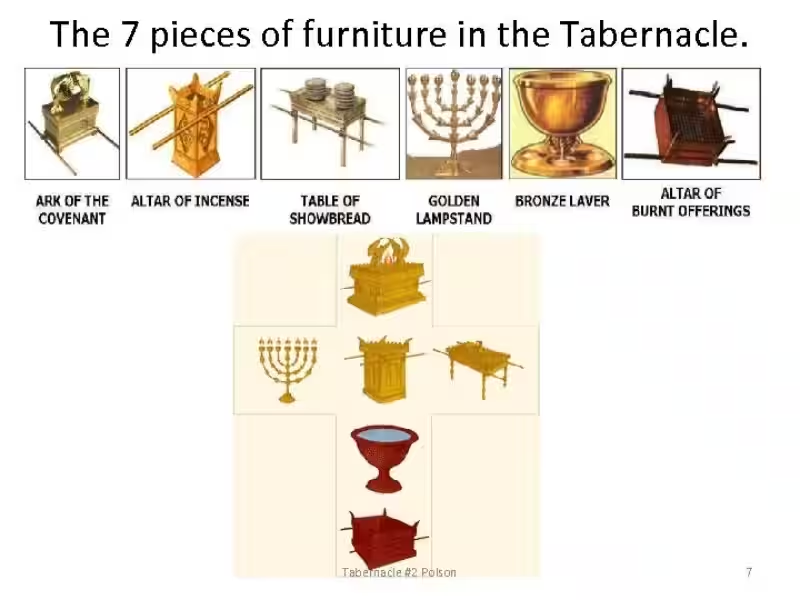
Before we explore each individual piece, it's worth pausing to appreciate the intentional design of the Tabernacle as a whole. God did not scatter these seven pieces of furniture randomly — He arranged them in a precise sequence that tells a complete story of redemption.
The Tabernacle was divided into three distinct zones:
- The Outer Court — accessible to all Israelites, containing the Brazen Altar and the Laver.
- The Holy Place — accessible only to priests, containing the Golden Lampstand, the Table of Showbread, and the Golden Altar of Incense.
- The Holy of Holies — accessible only to the High Priest, once a year, on the Day of Atonement, containing the Ark of the Covenant and the Mercy Seat.
This movement — from the outside in, from public to private, from approach to intimacy — is the movement of every soul that comes to God through Jesus Christ. You begin at the altar of sacrifice, and you end in the embrace of His mercy. Every step forward is a step deeper into the heart of God. Let's walk that path together.
🔥 The Brazen Altar: Where the Journey Begins
Sacrifice Before Service — Always
The very first thing a worshipper encountered upon entering the Tabernacle was the Brazen Altar of Sacrifice — a large, imposing structure made of bronze and wood, stained with the blood of countless offerings. You couldn't go around it. You couldn't ignore it. You had to deal with it first.
And that is one of the most profound theological statements in the entire Bible.
The Tabernacle's order makes an unmistakable declaration: before you can go any further with God, the issue of sin must be addressed. Not minimized. Not worked around. Not earned away through good behavior. Addressed — through sacrifice, through blood, through atonement.
The altar's four equal sides speak to the universality of this message. North, south, east, and west — no direction is excluded, no people group is outside the reach of God's grace. The Gospel is not a regional phenomenon or a cultural preference. It is the universal answer to the universal problem of human sin.
The Horns of Power
At each corner of the altar stood four horns — projections of strength and authority. In the ancient Near East, horns were a symbol of power. A person seeking refuge could grab hold of the altar's horns and receive sanctuary. This is a picture of what happens when we come to the cross of Jesus Christ — we grab hold of His sacrifice, and in doing so, we find refuge, safety, and forgiveness that no power on earth or in hell can take from us.
Hebrews 9:22 — "Without the shedding of blood, there is no forgiveness." The Brazen Altar makes this truth physically, visually, unavoidably real. Blood was shed here. Every day. As a constant reminder that sin has a cost — and that God provided a way to pay it.
Jesus as the Ultimate Altar
Every animal sacrificed on that altar was a shadow pointing forward to the one final, complete, and perfect sacrifice: Jesus Christ on the cross. The animals had to be offered repeatedly — the cross was offered once, for all, forever.
Hebrews 10:10 — "And by that will, we have been made holy through the sacrifice of the body of Jesus Christ once for all."
The order is everything here. Forgiveness comes before righteousness. Grace comes before service. God doesn't say, "Clean yourself up, then come to the altar." He says, "Come to the altar, and I will clean you up." This is the radical, counterintuitive, beautiful logic of the Gospel — and the Brazen Altar announces it from the very entrance of the Tabernacle.
💧 The Laver: The Ongoing Work of Cleansing
Forgiven, But Still Being Sanctified
Just beyond the Brazen Altar stood the Laver of Washing — a large bronze basin filled with water, where the priests washed their hands and feet before entering the Holy Place to minister. Notice that the priests had already dealt with the altar — the issue of sin and atonement had been addressed. And yet, before they could go any further, they had to wash.
This distinction is theologically rich and deeply practical: there is a difference between being forgiven and being sanctified. Forgiveness is an event — it happens the moment you come to the cross. Sanctification is a process — it happens every day, through the ongoing work of the Holy Spirit and the cleansing effect of God's Word in your life.
The Laver represents what theologians call progressive sanctification: the continuous, daily renewal of the believer's mind, heart, and habits. You were forgiven at the altar. But you return to the Laver every single day.
The Mirror of God's Word
Interestingly, the Bible tells us that the Laver was made from the bronze mirrors donated by the women who served at the Tabernacle entrance (Exodus 38:8). A basin made from mirrors — an object designed to show you your reflection.
James 1:23-25 describes the Word of God as a mirror. When we read Scripture, we see ourselves clearly — not to condemn us, but to show us where cleansing is needed. The Laver made from mirrors is one of the most beautiful and detailed prophetic images in the entire Tabernacle: God's Word reflects who we are so that the Holy Spirit can wash us into who we are called to be.
Ephesians 5:26 — "Christ loved the church and gave himself up for her to make her holy, cleansing her by the washing with water through the word." The Laver is not a one-time visit. It is a daily discipline — coming to Scripture, coming to prayer, coming to the Holy Spirit with an open and willing heart to be changed, corrected, and renewed.
For your faith journey today: Ask yourself — when did you last genuinely come to the Laver? Not just the altar (the moment of salvation), but the Laver (the daily discipline of letting God's Word wash your thinking, your attitudes, your patterns)?
✨ The Holy Place: Entering the Space of Fellowship
Once you pass the Laver, you step through the entrance of the Holy Place — a covered, enclosed space accessible only to the priests. This is the space of intimacy and ministry, the place where worship happens, where God and His people commune in the ongoing rhythm of the relationship. Here we find three pieces of furniture, each representing a different dimension of our fellowship with Jesus.
🕯️ The Golden Lampstand: Christ, the Light of the World
Seven Flames That Never Go Out
On the left side of the Holy Place stood the Golden Lampstand — a single piece of hammered gold, with a central shaft and six branches extending outward, holding seven oil-fed flames that burned continuously, day and night. There were no windows in the Holy Place. Without the lampstand, there would be total darkness.
The number seven in Scripture consistently represents completeness and fullness. The seven lamps of the lampstand speak of the complete, undiminishing, ever-present light of God — a light that never flickers, never runs out, and never leaves His people in darkness.
John 8:12 — "I am the light of the world. Whoever follows me will never walk in darkness, but will have the light of life." Jesus is not just a lamp — He is the original light of which the Golden Lampstand is a foreshadowing. He illuminates the truth, reveals what is hidden, exposes what is false, and makes the path forward visible.
Olive Oil and the Holy Spirit
The lampstand burned pure olive oil — a detail that is far from accidental. Throughout Scripture, olive oil is the consistent symbol of the Holy Spirit. The light in the Holy Place was not generated by the priests' effort or ingenuity — it was sustained by oil. The Holy Spirit is the source of our spiritual illumination. We do not manufacture light; we receive it.
Zechariah 4:6 — "Not by might nor by power, but by my Spirit, says the Lord Almighty." The Golden Lampstand is a daily reminder that the light we carry into a dark world is not our own cleverness, gifting, or personality. It is Christ in us, sustained by His Spirit, burning in the darkness.
🍞 The Table of Showbread: Fellowship and Constant Provision
Twelve Loaves, Always Fresh
On the right side of the Holy Place stood the Table of Showbread — a wooden table overlaid with gold, on which twelve loaves of bread were arranged in two rows of six. These loaves represented the twelve tribes of Israel — the entire covenant community, always in God's presence. Each Sabbath, the old loaves were removed and fresh ones were placed on the table. The bread was never absent. God's provision was constant, continuous, and sufficient.
The word translated "showbread" in Hebrew is literally lechem panim — "bread of the face" or "bread of the presence." This was bread that existed in the presence of God, face to face with Him. What a picture.
John 6:35 — "I am the bread of life. Whoever comes to me will never go hungry, and whoever believes in me will never be thirsty." The twelve loaves pointed forward to the One who would declare Himself to be the ultimate and eternal bread — not a physical meal that satisfies for hours, but spiritual nourishment that sustains forever.
The Lord's Supper as the Fulfillment
There is an unmistakable connection between the Table of Showbread and the Lord's Supper Jesus instituted in the Upper Room. When Jesus took the bread and said, "This is my body, broken for you" (1 Corinthians 11:24), He was revealing what the showbread had been silently declaring for centuries: God has always wanted to share His table with His people. The Tabernacle table was a foreshadowing; the Lord's Supper is the fulfillment. And the ultimate fulfillment still awaits us — the Marriage Supper of the Lamb (Revelation 19:9), when we will sit at God's table forever.
For your faith journey today: The Table of Showbread asks you — are you feeding regularly on the Bread of Life? Are you coming to Jesus not just in crisis, but in the daily rhythm of fellowship, allowing Him to nourish, sustain, and strengthen you?
🌿 The Golden Altar of Incense: Prayer as a Fragrant Offering
The Altar That Stood Before the Veil
Perhaps the most intimately positioned piece of furniture in the entire Tabernacle was the Golden Altar of Incense — a small altar of acacia wood overlaid with gold, positioned directly in front of the veil that separated the Holy Place from the Holy of Holies. It was the piece of furniture closest to the presence of God.
Every morning and every evening, the priest would burn sweet-smelling incense on this altar. The fragrant smoke would rise, drift through the veil, and fill the Holy of Holies with a continuous, ascending cloud of worship. God literally breathed in the prayers of His people.
Revelation 5:8 — "Each one had a harp and they were holding golden bowls full of incense, which are the prayers of God's people." In heaven, the prayers of believers are golden bowls of incense before the throne of God. The Golden Altar of Incense is not just a historical image — it is a current reality in the heavenly realm. Every prayer you have ever prayed is a fragrant offering before the throne.
Jesus as Our Intercessor
The burning of incense represents intercession — prayer offered on behalf of others. And here, the connection to Jesus is breathtaking. The priest burned incense as an intercessor for the people. Jesus lives today as our ultimate and eternal Intercessor.
Hebrews 7:25 — "He is able to save completely those who come to God through him, because he always lives to intercede for them." Right now, at this very moment, Jesus is before the Father — and your name is on His lips. Your prayers don't reach the throne on their own strength — they ride on the wings of His intercession. That is why we pray "in Jesus' name" — not as a formula, but as an acknowledgment that our access to God is entirely through His mediation.
For your faith journey today: The Golden Altar of Incense invites you into a life of persistent, faith-filled, fragrant prayer — not because you are worthy, but because the One who is worthy carries your prayers before the Father every moment of every day.
👑 The Holy of Holies: The Innermost Place of Grace

Now we reach the climax of the journey. Beyond the veil — a thick, heavy curtain separating the Holy Place from the Holy of Holies — lay the most sacred space in all of Israel. Only the High Priest could enter, and only once a year, on the Day of Atonement (Yom Kippur). He entered with blood, with incense, with great trembling — and with the weight of an entire nation's sins on his shoulders.
Here we find the final two pieces of furniture — the most important of all.
A Box That Contained a Nation's Story
The Ark of the Covenant was a rectangular chest of acacia wood, overlaid inside and out with pure gold. Inside it were three objects, each one a chapter of Israel's story with God:
- The two tablets of the Ten Commandments — the law of God, His standard of righteousness and holiness.
- A golden jar of manna — the miraculous bread that sustained Israel through 40 years in the wilderness, a symbol of God's supernatural provision.
- Aaron's rod that budded — the staff that miraculously flowered overnight as proof of God's chosen leadership, a symbol of divine authority and resurrection life.
These three objects are not random. Together they paint a portrait of what humanity owes God and what God has provided for humanity. The law reveals how far we fall short. The manna shows that God provides even when we can't provide for ourselves. Aaron's rod declares that God's authority over death is absolute.
And all three find their perfect fulfillment in Jesus Christ.
- Jesus fulfilled the law completely — every requirement, every commandment, every moral standard (Matthew 5:17).
- Jesus is the true manna from heaven — the bread that came down from God to sustain His people forever (John 6:32-35).
- Jesus is the One whose authority over death was vindicated in the resurrection — the ultimate flowering of Aaron's rod, the definitive proof that God's chosen King rules even over the grave (Revelation 1:18).
The Ark is not just a box — it is a summary of the Gospel, written in objects, waiting for the day when the One it described would finally arrive.
☁️ The Mercy Seat: The Throne Where Grace Meets Justice
The Most Sacred Object in Human History
Resting on top of the Ark, covering the law within, was a solid gold slab called the Mercy Seat (or "Atonement Cover"). On each end stood a golden cherub, their wings spread upward and inward, their faces turned downward — gazing at the very spot where once a year, the blood of the sacrifice was sprinkled.
Leviticus 16:15-16 — "He shall then slaughter the goat for the sin offering for the people and take its blood behind the curtain and do with it as he did with the bull's blood: He shall sprinkle it on the atonement cover and in front of it."
When the blood was sprinkled on the Mercy Seat, something extraordinary happened: God looked down from between the cherubim, saw not the broken law beneath, but the blood above — and declared Israel forgiven for another year. Mercy literally covered the law. Grace literally rested on top of justice.
This is perhaps the most powerful physical object in all of Scripture as a symbol of the Gospel.
The Veil Is Torn — Access Is Open
When Jesus died on the cross, the veil of the Temple was torn in two — from top to bottom (Matthew 27:51). From top to bottom: God tore it, not man. God Himself opened the way. The barrier that kept ordinary people from the Holy of Holies — torn. The exclusivity of the High Priest's access — ended. The once-a-year appointment with God's mercy — replaced by constant, direct, bold access for every believer.
Hebrews 4:16 — "Let us then approach God's throne of grace with confidence, so that we may receive mercy and find grace to help us in our time of need."
The Mercy Seat is the final destination of the entire Tabernacle journey — and in Jesus, it is no longer hidden behind a veil, no longer accessible only once a year, no longer approached in trembling uncertainty. Through the blood of Jesus, our Great High Priest, we walk in — every day, every hour, every moment — with confidence.
Hebrews 10:19-22 — "Therefore, brothers and sisters, since we have confidence to enter the Most Holy Place by the blood of Jesus, by a new and living way opened for us through the curtain, that is, his body... let us draw near to God with a sincere heart and with the full assurance that faith brings."
🗺️ The Complete Journey: From the Gate to the Glory
Standing back and looking at all seven pieces together, we see one continuous, unbroken story of what it means to come to God through Jesus Christ:
| Piece of Furniture | Location | Spiritual Meaning | Jesus as Fulfillment |
|---|---|---|---|
| Brazen Altar | Outer Court | Atonement for sin | The Lamb of God who takes away sin |
| Laver | Outer Court | Ongoing cleansing and sanctification | The Word that washes us |
| Golden Lampstand | Holy Place | Light and spiritual illumination | The Light of the World |
| Table of Showbread | Holy Place | Fellowship and provision | The Bread of Life |
| Golden Altar of Incense | Holy Place | Prayer and intercession | Our eternal Intercessor |
| Ark of the Covenant | Holy of Holies | Law, provision, and authority | Fulfiller of the law, Bread from Heaven, Risen King |
| Mercy Seat | Holy of Holies | Atonement and access to God | The once-for-all sacrifice; the open door to the Father |
Every step in this journey moves from the outside in — from public to private, from approach to embrace, from sinner to saint, from distance to intimacy. And every step is made possible not by our worthiness, our effort, or our religious performance, but entirely by Jesus.
✝️ From Shadow to Substance: The Invitation
Colossians 2:17 — "These are a shadow of the things that were to come; the reality, however, is found in Christ."
The Tabernacle was always pointing forward. Every animal sacrifice was whispering, "Someone greater is coming." Every flickering lamp was announcing, "A truer light is on the way." Every loaf of showbread was promising, "A bread that truly satisfies is almost here." Every cloud of incense was crying out, "An Intercessor who never stops is almost here." And when the Mercy Seat was sprinkled with blood year after year, it was rehearsing, over and over and over, the scene that would one day be played out on a hill outside Jerusalem — once, for all, forever.
The seven pieces of furniture in the Tabernacle are not just a theology lesson. They are an invitation — an invitation to walk the full path that God prepared from the very beginning:
- Come to the altar and be forgiven.
- Come to the laver and be renewed.
- Walk in the light of His presence.
- Feed on the bread of His Word.
- Let your prayers rise like incense before His throne.
- Find in Him the fulfillment of the law and the provision you could never provide for yourself.
- And then, boldly, confidently, joyfully — approach the Mercy Seat, not with trembling and uncertainty, but with the full assurance of a child walking into the arms of their Father.
This is the journey the Tabernacle describes. This is the journey Jesus made possible. And this is the invitation that stands open — for you — today.
Frequently Asked Questions: The Tabernacle's Furniture and Spiritual Meaning
What is the overall significance of the seven pieces of furniture in the Tabernacle?
The seven pieces of furniture in the Tabernacle—the Brazen Altar, Laver, Golden Lampstand, Table of Showbread, Golden Altar of Incense, Ark of the Covenant, and Mercy Seat—represent a progressive journey of faith, mirroring the believer's relationship with Jesus Christ. They symbolize the process of acknowledging sin, seeking forgiveness, pursuing holiness, engaging in worship, and ultimately accessing God's grace and mercy through Christ. The Tabernacle's design highlights the importance of a personal relationship with Jesus over mere adherence to religious rituals.
What does the Brazen Altar of Sacrifice symbolize?
The Brazen Altar symbolizes the necessity of acknowledging and atoning for sin. Its four equal sides represent the universality of the Gospel, while its horns signify the power of Jesus' blood to forgive all sins. Crucially, it emphasizes that forgiveness through Christ precedes a life of service, contrasting with systems that prioritize righteous living before seeking forgiveness.
What is the spiritual meaning of the Laver of Washing?
The Laver signifies the need for ongoing spiritual cleansing. Positioned after the altar, it highlights that forgiveness through Christ's sacrifice is followed by the renewal provided by the Holy Spirit and the cleansing effect of God's Word. This emphasizes the continuous process of sanctification in a believer's life.
How do the Golden Lampstand, Table of Showbread, and Golden Altar of Incense relate to worship and fellowship?
These three pieces, located within the Holy Place, represent aspects of worship and fellowship with God. The Golden Lampstand (seven lamps) symbolizes Christ as the light and life, illuminating our understanding of God. The Table of Showbread (twelve loaves) symbolizes the fellowship between God and humanity through Christ's sacrifice, mirroring the Lord's Supper. The Golden Altar of Incense represents prayers offered in Jesus' name, a sweet aroma pleasing to God.
What is the significance of the Ark of the Covenant and the Mercy Seat within the Holiest of Holies?
Located in the Holiest of Holies, the Ark of the Covenant, containing the Ten Commandments, manna, and Aaron's rod, symbolizes God's law, provision, and mediation. The Mercy Seat, representing God's mercy, is where the High Priest offered atonement for Israel's sins. This is ultimately fulfilled by Christ's sacrifice, providing eternal redemption. The tearing of the temple veil upon Christ's death symbolizes the opened way for all believers to directly access God's presence.
How does the Tabernacle furniture contrast with other belief systems?
The author contrasts the Tabernacle's progression (acknowledging sin, then seeking forgiveness, then pursuing holiness, etc.) with the order presented in other belief systems, highlighting the unique emphasis on grace and forgiveness found in Christianity. The Tabernacle's structure emphasizes the primacy of a personal relationship with Jesus Christ over mere adherence to religious rituals and practices.
What is the overarching message conveyed by the seven pieces of furniture?
The overarching message is that the Tabernacle's furnishings provide a powerful typology for understanding salvation through Jesus Christ. It's not about following a set of rules but about entering into a personal relationship with God through faith in Jesus, whose sacrifice fulfills the symbolism of the Tabernacle's furniture.