
Understanding Work Worship: Is Your Job a Form of Worship?
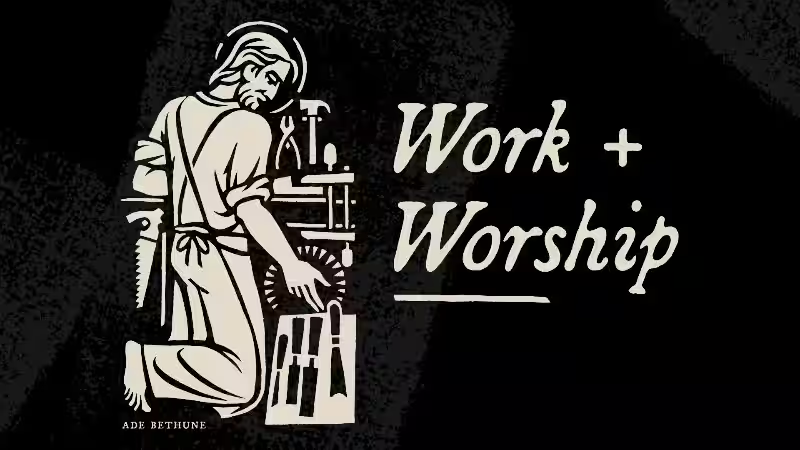
Many Christians grapple with the question of how their faith intersects with their professional lives. A common struggle involves the perceived dichotomy between "spiritual" activities like prayer and Bible study, and "secular" work – a division that often relegates the latter to a lesser, almost irrelevant, status in the context of faith. This article explores the concept of "work worship," arguing that this separation is a misconception rooted in flawed interpretations of biblical teachings and philosophical traditions. Instead, we will explore how all work, when approached with the right intention, can be a profound act of worship.
- The Historical Roots of the Work/Worship Divide
- Reframing Work: Three Biblical Pillars of Work Worship
- Beyond the "Higher Calling": The Equivalence of All God-Given Tasks
- Discerning God's Call in Your Work
-
Frequently Asked Questions: Work as Worship
- What is the "Work is Worship" perspective?
- What are the biblical arguments for this perspective?
- Does this mean there's no such thing as a "higher calling"?
- How do I discern God's will in my work?
- How does the Hebrew word "avodah" support this perspective?
- How does this perspective change my view of the workplace?
- What if my work environment is challenging or hostile?
- Is this perspective applicable to all types of work?
- How can I practically apply this perspective to my daily work?
The Historical Roots of the Work/Worship Divide
The idea of separating "spiritual" from "secular" activities has deep historical roots, stretching back to ancient Greek philosophy. Aristotle, for example, championed contemplation as the highest form of human endeavor. This philosophical viewpoint inadvertently justified a social structure where manual labor was relegated to enslaved people, while the privileged few dedicated themselves to intellectual pursuits.
This hierarchical view, unfortunately, infiltrated early Christian thought. Certain interpretations, exemplified by the writings of Eusebius, categorized Christians into "spiritual" and "lay" groups, echoing the master-slave dynamic. This division created a false hierarchy, suggesting that some forms of work are inherently more "spiritual" than others. This is a misconception that we must actively challenge today.
Reframing Work: Three Biblical Pillars of Work Worship
The central premise of work worship is that all work, regardless of its nature, can be an act of worship when approached with the right intention and perspective. This perspective is supported by several key biblical arguments:
1. The Divine Calling: Your Work as God's Purpose
Ephesians 2:10 reminds us that we are "God’s handiwork, created in Christ Jesus to do good works, which God prepared in advance for us to do." This verse points to a dual calling: a primary call to salvation and a secondary call that encompasses every aspect of our lives, including our work. This secondary call is lived out through loving our neighbor, as highlighted in Matthew 22:35-40. Jesus' call to discipleship didn't necessitate abandoning one's trade; rather, it involved integrating faith into all aspects of life, including marketplace work.
2. Working for Christ: Your Labor as an Offering
Colossians 3:23-24 exhorts us to "work willingly at whatever you do, as though you were serving the Lord rather than people." This perspective elevates even the most mundane tasks to an act of service to Christ. Whether you're a surgeon performing life-saving operations or a janitor cleaning a hospital, your work, when done with a heart focused on Christ, becomes an offering of worship. This removes the pride associated with prestigious jobs and imbues even the humblest tasks with dignity.
3. God's Empowering Hand: His Agency in Your Endeavors
Philippians 2:12-13 emphasizes God's active role in our lives: "Therefore, my dear friends, as you have always obeyed—not only in my presence, but now much more in my absence—continue to work out your salvation with fear and trembling, for it is God who works in you to will and to act in order to fulfill his good purpose." Martin Luther described this as God's work hidden behind the "mask" of our daily actions. Even seemingly insignificant tasks become opportunities for God to work through us, impacting those around us.
Beyond the "Higher Calling": The Equivalence of All God-Given Tasks
The concept of a "higher calling" – the idea that some professions are inherently more spiritual than others – is a dangerous misconception. A pilot landing a plane safely and a farmer harvesting a crop are both fulfilling divinely appointed tasks. The priority shifts based on immediate needs, but both are vital and essential. The defining factor is not the type of work, but the intent: to serve God with all our strength, skills, and talents.
Discerning God's Call in Your Work
How, then, do we practically apply this principle of work worship? Discerning God's call in our work involves prayerful reflection and consideration of several factors:
- Your Skills and Talents: What are you naturally gifted at? What do you enjoy doing?
- Available Opportunities: What doors has God opened for you?
- Your Sphere of Influence: Where can you make the greatest impact for God's kingdom?
- Community Input: Seek wise counsel from mentors and fellow believers.
Work worship isn't about abandoning our secular responsibilities to pursue solely religious activities, but rather about integrating our faith into every aspect of our lives. It's about living a life of total commitment to God, recognizing that He calls us to use our gifts and talents for His glory, wherever we find ourselves. It's about seeing our work not just as a job, but as an opportunity to serve Him and love our neighbors. It’s about transforming our workplaces into spaces of witness and compassion. This is the true essence of work worship – a life fully lived for Christ, encompassing prayer, worship, evangelism, and yes, our work.
Frequently Asked Questions: Work as Worship
What is the "Work is Worship" perspective?
The "Work is Worship" perspective rejects the idea that spiritual activities (prayer, Bible study) are superior to secular work. It argues that all work, when approached with the right intention, is an act of worship, a way of serving God and loving our neighbors. This counters the historical tendency to separate "sacred" and "secular" spheres, rooted in philosophies that prioritized contemplation over practical work.
What are the biblical arguments for this perspective?
Three key biblical arguments support this view:
-
Divine Calling (Ephesians 2:10): God calls us to all tasks, not just "spiritual" ones. Our work is part of our secondary calling, lived out through loving our neighbor (Matthew 22:35-40). Jesus' ministry integrated work into a life of faith.
-
Working for Christ (Colossians 3:23-24): We are to work "as for the Lord," making even mundane tasks acts of service to Christ. This elevates the dignity of all work, regardless of perceived prestige.
-
God's Agency (Philippians 2:12-13): God actively empowers us in our work. Even seemingly mundane tasks become opportunities for God to work through us. This perspective extends to serving others, recognizing Christ's presence in those in need (Matthew 25:40).
Does this mean there's no such thing as a "higher calling"?
No, the "Work is Worship" perspective doesn't negate the concept of a calling. However, it argues against a hierarchy of callings, where some work is deemed inherently more spiritual than others. All God-given tasks hold equal significance. The crucial factor is not the type of work, but the intent—to serve God in all endeavors.
How do I discern God's will in my work?
Discerning God's will in your work involves prayerful reflection, considering your skills, opportunities, and sphere of influence. Seeking guidance from a supportive Christian community is also vital. It's a process of aligning your gifts and passions with available opportunities to serve others and glorify God.
How does the Hebrew word "avodah" support this perspective?
The Hebrew word "avodah" (עבדה), meaning "service" or "work," appears frequently in the Old Testament and encompasses both secular and sacred work, as well as worship. This shows a consistent link between service and devotion to God, regardless of the specific task.
How does this perspective change my view of the workplace?
The "Work is Worship" perspective transforms the workplace from merely a means of livelihood into a sacred space. It's a place where we can interact with God, demonstrate Christian compassion, and serve others. Our work becomes a form of ministry.
What if my work environment is challenging or hostile?
Even in difficult work environments, a worshipful approach can transform your perspective. It allows you to see opportunities to serve even in challenging circumstances, to witness God's grace, and to exhibit Christian character in the midst of adversity. Prayer and reliance on God's strength are essential in such situations.
Is this perspective applicable to all types of work?
Yes, the "Work is Worship" perspective applies to all types of work, from the most prestigious to the most mundane. The focus is on the intention behind the work—to serve God and love our neighbor—rather than the nature of the work itself.
How can I practically apply this perspective to my daily work?
Practically applying this means approaching your work with a spirit of service, seeking to glorify God in every task. This involves prayer, intentionality, and a focus on loving your colleagues and serving your customers or clients. It's about integrating your faith into every aspect of your professional life.