
Unraveling the Mystery: A Tarshish Map and the Search for a Biblical Location
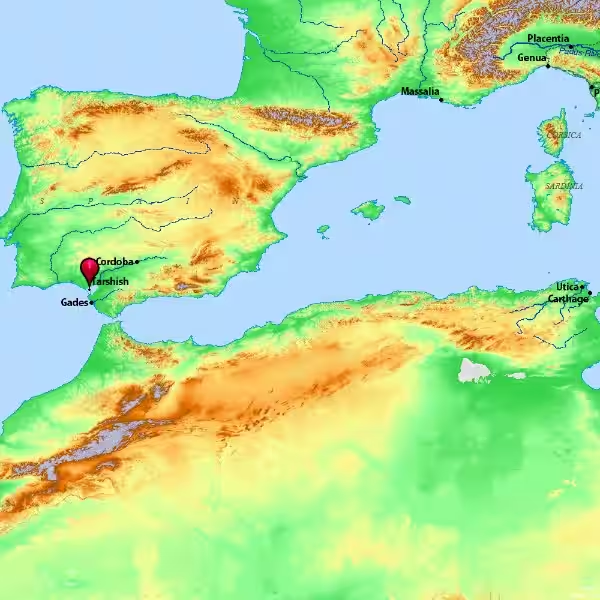
The quest to pinpoint the location of Tarshish, a place name mentioned over 25 times in the Bible, has captivated scholars and archaeologists for centuries. The lack of a definitive answer stems from the inconsistent and often ambiguous descriptions found within the biblical texts themselves. This article aims to explore the various theories surrounding the location of Tarshish, examining the evidence and ultimately illustrating why a simple, definitive "Tarshish map" is unlikely to ever exist.
- The Biblical Evidence: A Patchwork of Clues
- The Metal Connection: A Key to Understanding Tarshish
- Reconciling the Discrepancies: A Multifaceted Interpretation
-
Frequently Asked Questions about Tarshish
- Where was Tarshish located?
- What is the significance of "ships of Tarshish"?
- Why is it so difficult to pinpoint Tarshish's location?
- What role did Tarshish play in ancient trade?
- What evidence supports the various proposed locations for Tarshish?
- What is the connection between Tarshish and King Solomon?
- Does the name "Tarshish" have any etymological significance?
- Is there any modern evidence related to Tarshish?
The Biblical Evidence: A Patchwork of Clues
The Bible's references to Tarshish are scattered across various books and time periods, offering a fragmented picture. Early mentions, such as in Genesis 10:4 and 1 Chronicles 1:7 (the Table of Nations), provide minimal geographical detail, merely listing Tarshish among the descendants of Javan.
This lack of specificity makes it difficult to form a concrete idea of Tarshish's location based solely on these early references. The narrative evolves, with later texts placing Tarshish in seemingly contradictory locations; sometimes in the Mediterranean (Jonah 1:3), sometimes reachable via the Red Sea (1 Kings 22:48; 2 Chronicles 20:36-37), and sometimes described as a far-off land (Isaiah 66:19). This geographical ambiguity is a significant hurdle in creating a reliable Tarshish map.
The Significance of "Ships of Tarshish"
The frequent mention of "ships of Tarshish" (1 Kings 10:22, etc.) initially suggests a specific port of origin or destination. However, modern scholarship generally interprets this phrase as a reference to a type of ship—large, seaworthy vessels capable of long voyages—rather than a specific location. This interpretation further complicates the search for a single, fixed location on a Tarshish map. The ships themselves were likely built and used by various maritime powers, making the term less geographically specific and more descriptive of maritime capability.
The Metal Connection: A Key to Understanding Tarshish
A crucial element in understanding Tarshish is its association with precious metals. The name itself may derive from a Phoenician word relating to "smelting," suggesting that the name might have been applied to multiple locations involved in metalworking and trade. This explains the multiple potential locations proposed by scholars; the name was likely not pinned to a specific geographic point but rather to a function.
This understanding significantly impacts any attempt to create a precise Tarshish map. Instead of one location, we are dealing with a network of places potentially sharing the name. The shifting focus on different metal sources over time further supports this hypothesis.
Competing Candidates: Tarsus, Tharros, and Tartessos
Several locations have been proposed as potential candidates for Tarshish:
- Tarsus (Cilicia): This location is often suggested for the earlier biblical references, especially those in the Table of Nations.
- Tharros (Sardinia): Isotopic analysis of silver from Solomon's reign points towards Sardinia as a major source, making Tharros a strong contender for a particular period.
- Tartessos (Spain): This location, rich in tin and silver, is often linked to the later biblical references to Tarshish. The abundance of tin is a crucial factor, as tin was a highly sought-after metal during this period.
The shift in the likely location of Tarshish over time further complicates the creation of a simple Tarshish map. What may have been accurately represented on a map for the time of Solomon may be completely inaccurate for the time of the prophets.
Reconciling the Discrepancies: A Multifaceted Interpretation
The apparent contradictions in the biblical texts, such as the account of Jehoshaphat building ships at Ezion-geber (on the Red Sea) to sail to Tarshish (2 Chronicles 20:36-37), are addressed by scholars in various ways. Some suggest a possible misinterpretation by the Chronicler, a later scribe who compiled the book of Chronicles. Others argue that "Tarshish" might have been a generic term for a smelting center, perhaps referring to Ophir's gold smelting operations near the Red Sea in this specific instance.
This ambiguity underlines the impossibility of crafting a singular, accurate Tarshish map. The term's meaning likely evolved over time, and its biblical usage reflects a complex network of trade routes and smelting centers across the Mediterranean and beyond. Attempts to create a static map risk oversimplifying a dynamic system of exchange.
Ultimately, the search for a singular, definitive Tarshish map is likely a futile one. The biblical references, while offering intriguing clues, are too inconsistent and ambiguous to support a precise geographical location. Instead, understanding Tarshish requires acknowledging its evolving character, its association with a network of metalworking centers, and the dynamic nature of ancient trade routes. The "Tarshish" of the Bible represents not a single place, but a complex web of interactions across a vast geographical area, making any attempt at precise cartographic representation a necessarily incomplete endeavor.
Frequently Asked Questions about Tarshish
Where was Tarshish located?
The location of Tarshish is a subject of ongoing scholarly debate. The Bible offers inconsistent descriptions, placing it variously in the Mediterranean, reachable from the Red Sea, and far from Israel. Proposed locations include Tartessos (Spain), Tarsus (Turkey), Tharros (Sardinia), and others. The lack of consistent description suggests that "Tarshish" might have referred to different locations or even a network of trading centers at different points in time.
What is the significance of "ships of Tarshish"?
The phrase "ships of Tarshish" is often interpreted as referring to large, seaworthy vessels capable of long voyages, rather than ships originating from or destined for a single specific location called Tarshish. These ships facilitated extensive maritime trade.
Why is it so difficult to pinpoint Tarshish's location?
The difficulty in locating Tarshish stems from the biblical texts themselves. Early references provide limited geographical details, while later passages offer seemingly contradictory descriptions. The name "Tarshish" might have been a generic term for a smelting center, further complicating identification. Additionally, a lack of direct archaeological evidence for early Phoenician presence in some of the suggested locations fuels the debate.
What role did Tarshish play in ancient trade?
Tarshish was a major player in ancient maritime trade, renowned for its valuable imports. It traded in silver, iron, tin, and lead, and also dealt in exotic goods like gold, ivory, apes, and peacocks. The extensive trade connections of Tarshish are highlighted by its mentions in various biblical books, often in the context of significant trading partners and economic activity.
What evidence supports the various proposed locations for Tarshish?
Different theories regarding Tarshish's location are supported by various types of evidence. For example, the association of Tarshish with silver and other metals strengthens candidates like Tartessos (Spain) and Tharros (Sardinia), which were known for their metal resources. Isotopic analysis of silver in Israel during Solomon's reign suggests a significant contribution from Sardinia. However, the lack of conclusive evidence keeps the debate alive.
What is the connection between Tarshish and King Solomon?
Biblical texts link Tarshish to King Solomon's immense wealth and his extensive trade network. Solomon's navy undertook voyages to Tarshish, bringing back valuable goods, which contributed significantly to his kingdom's prosperity.
Does the name "Tarshish" have any etymological significance?
The name "Tarshish" likely originates from a Phoenician word related to "smelting," suggesting that multiple locations with smelting activities might have been referred to by this name. This further supports the idea of a potentially fluid and geographically broad meaning of "Tarshish" throughout the biblical narrative.
There are indeed modern villages named Tarshish (Lebanon) and Tharsis (Spain). However, these modern names do not provide direct evidence to support any specific theory about the biblical Tarshish's location. The modern names are primarily coincidental instances of similar-sounding names.