
Unraveling the Noah Genealogy: A Journey Through Biblical History
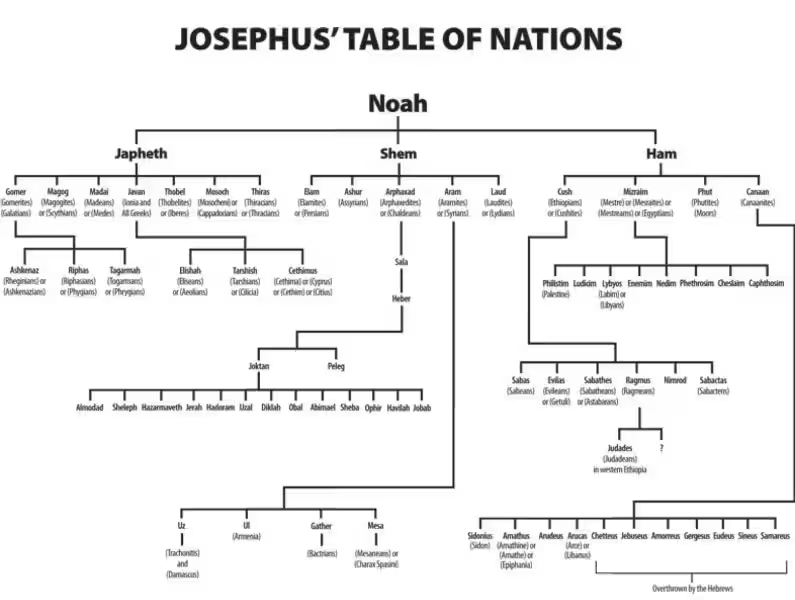
Understanding the Noah genealogy is a fascinating journey into the biblical narrative of humanity's origins. Genesis 10, often called the "Table of Nations," provides a detailed, albeit complex, account of Noah's sons and their descendants. This list, packed with approximately 70 names, raises questions about its historical accuracy, symbolic meaning, and enduring influence on later interpretations of human origins.
- Genesis 10: The Table of Nations and its Interpretations
- The Symbolic Significance of the Noah Genealogy
- Historical Context and Later Interpretations of the Noah Genealogy
- The Misuse of Noah's Genealogy: Race and Ethnicity
- Beyond the Biblical Narrative: Extra-Biblical Traditions
-
Frequently Asked Questions: Noah's Genealogy
- What is the "Generations of Noah," and where is it found in the Bible?
- Who were Noah's sons, and what is their significance?
- How accurate is the genealogy in Genesis 10 as a literal historical record?
- What is the meaning of the term "goyim" in this context?
- How has the "Table of Nations" been interpreted throughout history?
- What are some of the challenges in interpreting the "Table of Nations"?
- How does 1 Chronicles 1 relate to Genesis 10?
- What is the significance of the number 70 in the genealogy?
- Did attempts to link Noah's sons to specific races prove successful?
- What is known about Noah's wife and the wives of his sons?
- What other sources offer information related to Noah's genealogy?
Genesis 10: The Table of Nations and its Interpretations
Genesis 10 presents a genealogical chart detailing the descendants of Noah's three sons: Shem, Ham, and Japheth. These lineages are not presented as strict, linear progressions but rather as a branching network of cousins, reflecting the expanding populations after the Great Flood. The Hebrew term "goyim," often translated as "nations," doesn't carry the same political weight as it does in modern usage. Instead, it refers to distinct groups of people, often identified by their language, territory, or shared cultural practices.
The seemingly straightforward structure of the list, organized around Noah's three sons, belies a complexity in interpretation. The geographical and ethnic distribution of the descendants isn't consistently presented, leading to ongoing debate amongst scholars. Some names clearly denote known groups, such as the Assyrians and Canaanites, while others remain enigmatic, defying easy identification with specific historical populations. The notable omission of many significant ancient civilizations, including the Persians, Greeks, and Romans, underlines the limited scope of the biblical author's knowledge and the complexities of ancient historical records.
The Symbolic Significance of the Noah Genealogy
Many biblical scholars view the "Table of Nations" less as a precise historical record and more as a symbolic representation of the unity and diversity of humanity after the flood. The number 70, approximately the number of names listed, resonates with other instances of the number 70 in Genesis and Exodus, often symbolic of completeness or universality. This perspective emphasizes the overarching message of a single human family diverging into numerous distinct groups, all stemming from Noah's three sons. It highlights the shared ancestry of all people, despite their subsequent diversification and geographic dispersion. This interpretation of the Noah genealogy provides a powerful theological framework for understanding human unity.
Historical Context and Later Interpretations of the Noah Genealogy
The dating of Genesis 1-11, including the "Table of Nations," remains highly debated. Scholars suggest an early core text, possibly originating in the 10th to 5th centuries BCE, expanded over time to incorporate later traditions and geographical knowledge. Intriguingly, parallels exist between the structure and content of this biblical narrative and the work of the Greek historian Hecataeus of Miletus, suggesting potential cross-cultural influences.
I Chronicles 1 presents a revised version of the Noah genealogy, prioritizing the lineage of Israel by condensing certain branches and omitting details such as Nimrod's connection to Mesopotamia. The Book of Jubilees further expands on the narrative, possibly incorporating influences from the Ionian world map and even Hasmonean propaganda, showcasing how different cultural perspectives and agendas reshaped the interpretation of this ancient text. The Septuagint, a Greek translation of the Hebrew Bible, also offers minor variations in the list of names, further highlighting the evolving nature of the text.
The Misuse of Noah's Genealogy: Race and Ethnicity
Attempts to use the "Table of Nations" to establish racial classifications have proven deeply problematic. The traditional association of Shem, Ham, and Japheth with specific racial groups (Caucasoid, Mongoloid, Negroid) is now widely recognized as an oversimplification. Such classifications ignore the complexities of human migration, language adoption, and intermarriage, all of which have significantly blurred any neat racial divisions that might have existed in the ancient world.
The fluidity of national identities and the inherent limitations of patrilineal descent make precise genealogical tracing based solely on the "Table of Nations" largely impossible. The reality is far more nuanced. Human populations have always been interconnected and in flux, rendering any attempt to rigidly categorize them based on this ancient text inherently flawed. Ignoring this reality led to the justification of racist ideologies, a tragic misuse of a text intended to communicate a message of universal human kinship.
Beyond the Biblical Narrative: Extra-Biblical Traditions
Beyond the familiar biblical account, several extra-biblical traditions mention additional sons of Noah, reflecting diverse interpretations and expansions of the original narrative. These traditions, found in Islamic, Irish, Anglo-Saxon, and other sources, showcase the evolving and varied interpretations of the "Generations of Noah" across different cultures and historical periods. These alternative accounts highlight the rich tapestry of human storytelling and the enduring power of the Noah narrative to inspire new interpretations and embellishments throughout history.
The "Table of Nations" in Genesis 10, therefore, presents a complex and multifaceted challenge to modern readers. While it offers invaluable insight into the world view and cultural context of ancient biblical writers, it is crucial to approach its genealogical information with an awareness of its limitations and avoid the pitfalls of misinterpretations. Understanding the Noah genealogy is not simply about tracing a precise family tree, but also about understanding its enduring power as a symbol of unity, diversity, and the ongoing human quest for origins.
Frequently Asked Questions: Noah's Genealogy
What is the "Generations of Noah," and where is it found in the Bible?
The "Generations of Noah," also known as the "Table of Nations," is found in Genesis chapter 10. It's a genealogy tracing the descendants of Noah's three sons – Shem, Ham, and Japheth – and their subsequent spread across the earth. This passage aims to illustrate the origins of various peoples known to the biblical authors.
Who were Noah's sons, and what is their significance?
Noah had three sons: Shem, Ham, and Japheth. According to the biblical narrative, all of humanity after the Great Flood is descended from these three brothers. Their descendants are listed in Genesis 10, forming the basis of the "Table of Nations."
How accurate is the genealogy in Genesis 10 as a literal historical record?
The accuracy of Genesis 10 as a strictly literal, complete genealogical record is debated. While it provides a framework for understanding the origins and dispersion of early populations, it omits many significant ancient civilizations and presents an incomplete picture of human history. The text likely reflects a combination of historical accounts, oral traditions, and symbolic meaning. The dating of this section of Genesis is also a subject of scholarly discussion.
What is the meaning of the term "goyim" in this context?
The Hebrew term "goyim," often translated as "nations," does not carry the same modern political connotations. In Genesis 10, it refers more broadly to distinct peoples or groups identified by their lineage and often their geographical location.
How has the "Table of Nations" been interpreted throughout history?
The interpretation of Genesis 10 has changed over time. Early interpretations focused on establishing a genealogical link to specific peoples and regions. Later, particularly in the 18th century, scholars attempted to connect the sons of Noah (Shem, Ham, and Japheth) to specific racial groups, a now-discredited interpretation. More contemporary scholarship emphasizes the text's symbolic significance, indicating the unity of humanity stemming from a common ancestor. Extra-biblical traditions further expand on the narrative, demonstrating diverse interpretations across cultures and religious traditions.
What are some of the challenges in interpreting the "Table of Nations"?
Several challenges arise when interpreting Genesis 10. The geographical and ethnic organization is inconsistent, making precise interpretations difficult. The list is incomplete, omitting many significant ancient groups. Additionally, the use of patrilineal descent and the fluidity of national identities make it difficult to trace genealogical lines precisely.
How does 1 Chronicles 1 relate to Genesis 10?
1 Chronicles 1 presents a revised and condensed version of the genealogy, emphasizing the lineage of Israel. It omits certain details and condenses some branches found in Genesis 10.
What is the significance of the number 70 in the genealogy?
The approximately 70 names mentioned in the "Table of Nations" may hold symbolic significance, echoing other instances of the number 70 in Genesis and Exodus, possibly representing the unity of humanity.
Did attempts to link Noah's sons to specific races prove successful?
No. Attempts to link Shem, Ham, and Japheth to specific racial groups (such as Caucasoid, Mongoloid, and Negroid) have been largely discredited. Such classifications ignore the complexities of human migration, intermarriage, and language adoption.
What is known about Noah's wife and the wives of his sons?
The Bible does not provide the names of Noah's wife or the wives of his sons. Their presence is implied, as they were aboard the Ark and crucial to the repopulation of the earth after the Flood. The lack of detailed information highlights the text's focus on the patriarchal lineage.
The Book of Jubilees expands on the Table of Nations, and the Septuagint (a Greek translation of the Hebrew Bible) offers minor variations in the list of names. Extra-biblical traditions from Islamic, Irish, Anglo-Saxon, and other sources also mention additional sons of Noah, reflecting diverse interpretations of the biblical narrative.