
Unlocking the Mystery: Mamre Location and its Complex History
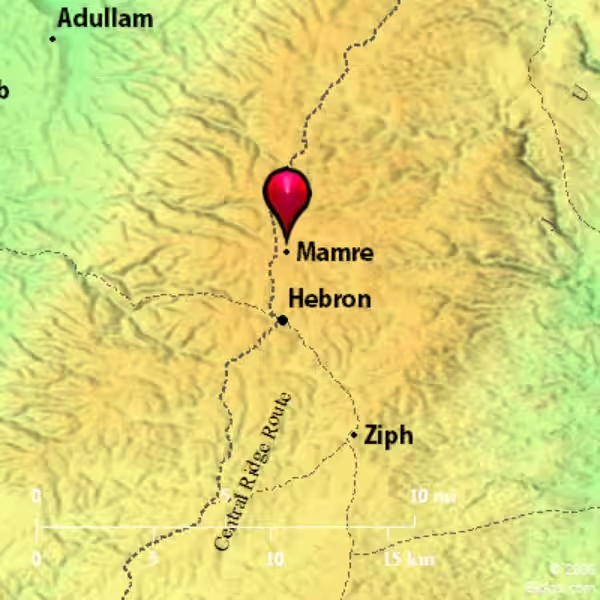
Determining the precise Mamre location has been a puzzle for scholars and religious communities for centuries. The biblical accounts, coupled with archaeological findings and historical interpretations, paint a complex picture of a site deeply interwoven with Jewish, Christian, and pagan traditions. This article explores the historical and geographical intricacies surrounding Mamre, investigating the various proposed locations and the evidence supporting each.
The Biblical Narrative and its Ambiguities
The Book of Genesis mentions Mamre in several passages, primarily associating it with Abraham. These passages, however, create some ambiguity. Sometimes Mamre is presented as a place – a location where Abraham pitched his tent and built an altar. Other times, it seems to refer to Mamre as a person, an Amorite chieftain allied with Abraham. This duality has led to diverse interpretations, often involving the Documentary Hypothesis to reconcile discrepancies within the Pentateuch's various sources.
The descriptions themselves are not geographically precise, leading to the ongoing debate. Genesis mentions proximity to Hebron, but the exact distance and relationship between Mamre and Hebron remain unclear – was Mamre a distinct settlement, a specific grove of trees, or perhaps even synonymous with Hebron itself? This lack of clarity has fuelled the multiplicity of proposed Mamre locations.
Contested Sites: Three Potential Locations for Mamre
The search for the Mamre location has centered on three primary sites near Hebron:
Khirbet Nimra: Echoes of a Pagan Past
Located north of Hebron, Khirbet Nimra presents archaeological evidence of a pre-Israelite pagan tree cult. Findings dating back to the Persian and Hellenistic periods suggest a long history of religious activity at this site, potentially predating the Abrahamic narratives. The name itself, possibly a corrupted form of "Mamre," hints at a possible connection. However, the lack of strong evidence linking it directly to Abraham makes it a less compelling candidate for many scholars.
While the presence of a pagan tree cult is significant, it doesn't automatically disqualify it. The site could have been adopted or repurposed by later religious communities, incorporating existing sacred spaces into their own traditions.
Ramat el-Khalil: A Monumental Site with a Multifaceted History
Arguably the most significant and contested site, Ramat el-Khalil, boasts a rich and layered history. Herod the Great dramatically expanded it, constructing a large enclosure that cemented its association with Mamre and Abraham. This monumental undertaking transformed it into a major marketplace and a focal point for interdenominational festivals attracting Jews, Christians, and pagans.
Constantine the Great, in his attempt to suppress pagan influence, built a Christian basilica here, but the pagan elements persisted. Archaeological excavations reveal structures from various periods, including Roman, Byzantine, and Crusader eras (although the extent of Crusader involvement is debated). Its importance waned under Muslim rule, but recent restoration efforts are making it more accessible to visitors of all faiths. The presence of structures across such a vast timeframe underscores the site’s enduring significance, though the direct link to Abraham remains contested.
Khirbet es-Sibte (Ain Sebta): The Oak of Mamre’s Legacy
Located southwest of Ramat el-Khalil, Khirbet es-Sibte, or Ain Sebta, is more recently associated with the "Oak of Mamre." This identification gained prominence during the 19th century, gaining traction due to the presence of a large, significant tree—until its collapse in 2019. The site currently hosts a Russian Orthodox monastery, further cementing its association with the biblical narrative in the minds of many.
However, the relatively late association with the biblical Mamre, compared to the extensive history of Ramat el-Khalil, raises questions about its historical accuracy. The absence of extensive earlier evidence makes it a less frequently cited candidate among scholars.
Historical Accounts and Interpretations
Josephus, in his writings, describes a very ancient terebinth tree at Mamre, venerated by Jews, Christians, and pagans alike. He places it at Ramat el-Khalil, corroborating later Byzantine accounts. This adds weight to Ramat el-Khalil's claim as the Mamre location.
Conversely, Rabbinic traditions discouraged Jewish participation in the Mamre festivals due to their perceived idolatrous nature. This highlights the evolving religious significance of the site across different traditions and periods, demonstrating how the interpretation of Mamre’s meaning shifted over time.
Archaeological Evidence: Limited but Illuminating
Archaeological evidence supports the existence of long-term religious activity at various sites near Hebron. However, directly linking these findings to the biblical Abraham remains challenging. The lack of continuous occupation from the Bronze Age to the Iron Age at Ramat el-Khalil, for example, complicates the narrative.
While the evidence suggests prolonged use for religious purposes across millennia, the specific connection to the biblical Mamre remains a subject of ongoing scholarly debate. The diverse and often conflicting historical sources underscore the intricate and multifaceted history of Mamre, a site profoundly significant across multiple faiths and centuries. Further research and excavation are required to definitively pinpoint the Mamre location.
Frequently Asked Questions about the Location of Mamre
Where exactly was Mamre located?
The precise location of Mamre, the ancient site near Hebron associated with Abraham in the Bible, remains a subject of scholarly debate. Three primary sites have been proposed: Khirbet Nimra, Ramat el-Khalil, and Khirbet es-Sibte (Ain Sebta). Each site offers evidence supporting its claim, but none definitively proves to be the only location of Mamre. The ambiguity arises from evolving identifications throughout history, along with conflicting interpretations of biblical and historical texts.
What evidence supports the different proposed locations for Mamre?
-
Khirbet Nimra: Archaeological evidence points to a pagan tree cult predating the biblical narrative, suggesting possible earlier religious significance. However, a direct link to the biblical Mamre is lacking.
-
Ramat el-Khalil: This site boasts substantial historical development, including structures from Roman, Byzantine, and Crusader eras. Herod the Great's significant construction projects firmly associated it with Mamre and Abraham. Josephus also mentions a revered ancient tree at a location that likely corresponds to Ramat el-Khalil. However, a continuous occupation from the Bronze Age to the Iron Age is absent, making a direct connection to Abraham's time challenging.
-
Khirbet es-Sibte (Ain Sebta): This site's association with Mamre is relatively recent, gaining prominence in the 19th century and linked to the "Oak of Mamre" (which collapsed in 2019). A Russian Orthodox monastery is located there.
Does the Bible itself offer a clear location for Mamre?
No. The biblical text is ambiguous. "Mamre" sometimes refers to a place where Abraham pitched his tent and built an altar, and other times seemingly refers to a person (an Amorite chieftain). This ambiguity, coupled with varying accounts within the Pentateuch, has led to diverse interpretations and contributes to the ongoing debate regarding Mamre's location.
What role did archaeology play in identifying the location of Mamre?
Archaeological findings at each of the proposed sites reveal long-term religious activity spanning numerous periods. However, the evidence doesn't definitively link any single location to the biblical Abraham. The lack of continuous occupation at key sites from the Bronze Age to the Iron Age hinders definitive conclusions. Archaeology provides valuable context, showing religious practices at these locations, but the specific connection to the biblical Mamre remains a matter of interpretation.
Why is there so much disagreement about Mamre's location?
The disagreement stems from several factors: the ambiguous biblical text, the lack of continuous archaeological evidence linking a specific site to the patriarch Abraham, the evolution of religious practices and associations at the various sites over millennia (involving Jewish, Christian, and pagan traditions), and differing interpretations of historical accounts from writers like Josephus. The complexity of the historical record and the blending of religious traditions make pinpointing a single, undisputed location challenging.