
The Size of the New Jerusalem: A Heavenly Metropolis?
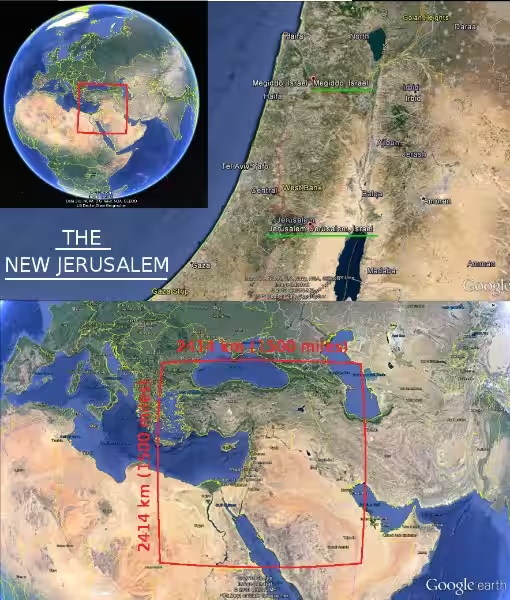
The Book of Revelation paints a vivid picture of the New Jerusalem, a city of breathtaking scale and unimaginable splendor. But just how big is this heavenly metropolis? Understanding the dimensions described in Revelation 21:16 sparks a fascinating exploration into both literal interpretations and symbolic meaning.
- The Staggering Dimensions: 1,400 Miles on Each Side
- Multiple Interpretations: Literal vs. Symbolic
- Comparing the Size of the New Jerusalem to Earthly Entities
-
Frequently Asked Questions: The Size of the New Jerusalem
- How big is the New Jerusalem?
- Is the size of the New Jerusalem literal or symbolic?
- How does the size of the New Jerusalem compare to Earthly nations?
- What is the significance of the New Jerusalem's height?
- Could the New Jerusalem accommodate billions of people?
- What is the significance of the cube shape?
- What is the most important aspect of the New Jerusalem?
The Staggering Dimensions: 1,400 Miles on Each Side
Revelation 21:16 explicitly states that the New Jerusalem is "twelve thousand stadia in length, and breadth, and height." Using the commonly accepted conversion of a stadium to approximately 606.95 feet, this translates to a cube approximately 1,400 miles (2,250 kilometers) on each side. This is an unimaginable size, dwarfing even the largest countries on Earth.
Imagine a cube spanning 1,400 miles in every direction. The sheer ground area alone—nearly two million square miles—is larger than many significant nations. This vast expanse is far beyond what's needed to accommodate even billions of inhabitants, even if we consider only a single level.
This expansive size isn't merely a detail; it’s a powerful statement. It underscores the boundless nature of God's provision and the sheer immensity of His heavenly kingdom. The sheer scale is designed to overwhelm us, causing us to contemplate the incomprehensible nature of God's plan and the magnitude of His love.
Multiple Interpretations: Literal vs. Symbolic
While the literal interpretation is striking, some suggest a symbolic understanding of the dimensions. The "twelve thousand stadia" might represent the completeness and perfection associated with the number twelve, often used throughout scripture to symbolize God's completeness and the fullness of his purposes.
Others propose that the vast height—1,400 miles—doesn't necessarily describe a single, monolithic structure. Perhaps it suggests multiple levels, like a layered city extending far upwards. If, for example, each level were only twelve feet high, the city could easily accommodate an incomprehensible number of people, each with considerable personal space.
The cubic shape itself could also hold symbolic weight. It might reflect the Most Holy Place within the ancient Temple, a cube-shaped sanctuary symbolizing God's presence. Alternatively, it could represent the three persons of the Trinity: Father, Son, and Holy Spirit. Regardless of the exact interpretation, the emphasis remains on the vastness and abundance of God's heavenly dwelling.
Comparing the Size of the New Jerusalem to Earthly Entities
To truly grasp the magnitude of the New Jerusalem’s size, let's compare it to some earthly entities:
- Countries: The New Jerusalem's ground area is significantly larger than even the largest countries on Earth. It would easily encompass nations like the United States, Canada, or China.
- Cities: The city's sheer size is beyond comparison with any earthly metropolis. Even the most sprawling urban areas are minuscule in comparison.
- Structures: No human-built structure comes close to matching such monumental dimensions. The height alone surpasses any man-made building.
This comparison highlights the overwhelming scale of the New Jerusalem, emphasizing the limitless capacity of God’s kingdom and the unimaginable abundance He provides for His people.
Beyond the Physical: The True Significance
Ultimately, however, the size of the New Jerusalem is less important than its significance. The awe-inspiring dimensions are a powerful symbol, pointing towards the boundless love and grace of God. The vastness signifies the limitless capacity of God's kingdom to encompass all who believe.
The physical description is a vehicle to convey the spiritual reality: a place of perfect peace, joy, and communion with God, where suffering and sorrow are absent. The size isn't about mere physical space; it's about the boundless nature of God's love and the infinite capacity of His grace.
Further Exploration: Unveiling the Mysteries
The size of the New Jerusalem remains a topic of much discussion and interpretation. Different perspectives exist within various faith traditions, leading to diverse understandings of its dimensions and meaning. Understanding these various perspectives can enrich our understanding of this powerful biblical image. Further exploration of the topic will undoubtedly reveal a deeper understanding of this heavenly city and its significance for those who believe. The majesty of the New Jerusalem transcends the confines of its size, drawing us into a contemplation of God’s boundless love and the ultimate promise of eternal life.
Frequently Asked Questions: The Size of the New Jerusalem
How big is the New Jerusalem?
The Book of Revelation describes the New Jerusalem as a cube-shaped city measuring 12,000 stadia on each side. Using a common conversion, this equates to approximately 1,400 miles (2,200 kilometers) in length, width, and height. This immense size is emphasized to convey the vastness and abundance of God's heavenly dwelling.
Is the size of the New Jerusalem literal or symbolic?
The text specifies the dimensions are given in "man's measurement," suggesting a literal interpretation is plausible. However, whether the dimensions should be taken literally or symbolically is a matter of ongoing theological discussion. Regardless of interpretation, the core message remains consistent: the New Jerusalem will be extraordinarily spacious and accommodate God's people without constraint. The size serves to emphasize the boundless nature of God's provision and the immensity of His heavenly kingdom.
How does the size of the New Jerusalem compare to Earthly nations?
The ground level alone of the New Jerusalem—nearly two million square miles—is significantly larger than even the largest countries on Earth. This immense area ensures ample space for its inhabitants.
What is the significance of the New Jerusalem's height?
The 1,400-mile height is a striking feature. While some interpret this as the height of the city's tallest structures, potentially creating a pyramid-like shape, the overall scale remains overwhelmingly large. It's possible the city encompasses multiple levels, further increasing its capacity to house a vast population.
Could the New Jerusalem accommodate billions of people?
The sheer size of the New Jerusalem, even if considered only at ground level, suggests it could house billions of people. If the height represents multiple levels, the potential capacity would be far greater. However, the actual capacity is less important than the assurance of ample space for all of God's people.
What is the significance of the cube shape?
The cube shape itself may hold symbolic significance, possibly relating to the Most Holy Place in the Temple and the three persons of the Trinity. However, the precise symbolic meaning is open to interpretation.
What is the most important aspect of the New Jerusalem?
Ultimately, the most significant aspect of the New Jerusalem is not its size, but the presence of God within it. The vast dimensions serve to underscore the boundless nature of God's provision and the immensity of His heavenly kingdom.