
How Long Did You Stay There? Choosing the Right Tense
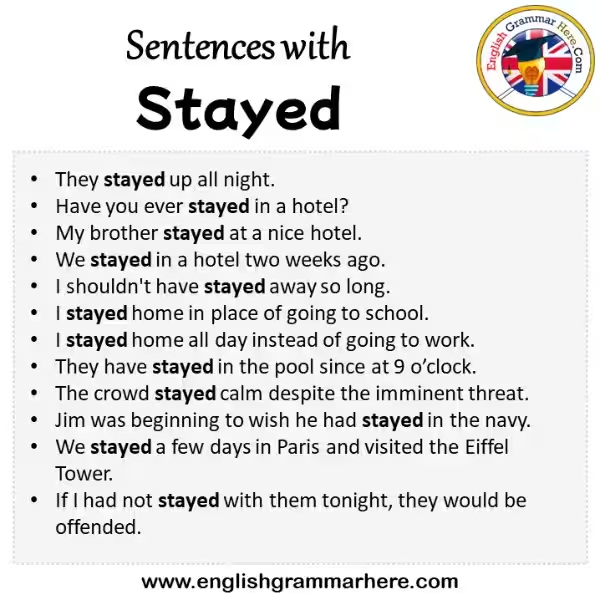
This article explores the subtle yet significant differences between using the past simple ("stayed") and the past perfect ("had stayed") when describing a past event, particularly focusing on the naturalness of the phrasing. We'll analyze why one option often feels more natural than the other, even when both are grammatically correct. The key is understanding context and subtle shifts in emphasis.
- Past Simple vs. Past Perfect: A Grammatical Tug-of-War
- The Nuances of Duration: "I Stayed There for Three Weeks"
- Mastering the Art of Natural Language
-
Frequently Asked Questions about Using "Stayed" and "Had Stayed"
- 1. Is "I stayed there" or "I had stayed there" grammatically correct?
- 2. When should I use "had stayed"?
- 3. Why is "I stayed there" often preferred over "I had stayed there"?
- 4. Does using "had stayed" ever sound unnatural?
- 5. Is "I have stayed there for three weeks" grammatically correct? Why does it sound awkward?
- 6. How does the context affect the choice between "stayed" and "had stayed"?
- 7. Is there a hard and fast rule for choosing between "stayed" and "had stayed"?
- 8. What should I prioritize when choosing between these tenses?
Past Simple vs. Past Perfect: A Grammatical Tug-of-War
The choice between "stayed" and "had stayed" often hinges on the context and what you want to emphasize. Both are grammatically correct in many situations, but one typically sounds more natural and flows better in conversation.
The past simple ("stayed") is straightforward and concise. It simply states that an action happened in the past. It's the go-to choice for simple narration, making it easy for the reader or listener to understand. Think of it as the default setting for recounting past events. It avoids unnecessary complexity and keeps the focus on the main action.
The past perfect ("had stayed"), on the other hand, indicates an action completed before another past action. This anteriority is crucial. It introduces a temporal layering, highlighting the sequence of events. However, this added detail can sometimes feel unnecessary, even cumbersome, particularly if the sequence is already clear from the context. Overusing the past perfect can lead to overly complex sentences and hinder readability.
When to Use Which Tense
To illustrate the difference, consider these examples:
- "I left Kansas City after I stayed there for a week." (Past simple - clear, concise, natural)
- "I left Kansas City after I had stayed there for a week." (Past perfect - grammatically correct, but less natural in this simple context)
In the first example, the order of events is easily understood. The "staying" clearly precedes the "leaving." The simple past tense perfectly conveys this without added complexity. The second example, while grammatically sound, introduces a layer of emphasis that isn't required. The reader has to process the temporal relationship, slowing down the reading process unnecessarily.
The key takeaway here is that while both tenses are grammatically acceptable, the past simple ("stayed") is often the more effective and natural choice, especially in situations where the sequence of events is already clear from the context. Simplicity and clarity should always guide your tense selection.
The Nuances of Duration: "I Stayed There for Three Weeks"
The sentence "I stayed there for three weeks" is grammatically correct and easily understood. However, the author points out that this statement, especially when made in isolation, can sound somewhat unnatural in conversational English. This unnaturalness stems primarily from the context and the implied emphasis on the duration.
The simple statement lacks the conversational flow typical of everyday speech. It feels as if the speaker is unusually highlighting the length of their stay. This is where context becomes crucial. The sentence's naturalness dramatically improves when embedded within a larger narrative.
Context is King
Consider these alternative phrasings:
- "I've stayed there before. My longest stay was three weeks." (This sounds more natural because it provides additional context. The three-week stay is presented as a detail within a broader history of visits.)
- "They asked how long I'd stayed, and I told them three weeks." (Here, the sentence is prompted by a question, making the statement of duration feel more natural and less emphatic.)
- "I stayed there for three weeks, as long as I could afford." (Adding a phrase like "as long as" helps contextualize the three-week stay, making the sentence flow more naturally.) The added clause provides a reason for the duration, justifying the emphasis on the three weeks.
The awkwardness of "I stayed there for three weeks," when presented in isolation, isn't a rule of grammar but a matter of conversational flow and stylistic preference. The sentence tends to feel incomplete or oddly emphatic without additional context or supporting information. The duration, while factually accurate, lacks the natural conversational ease of other phrasings.
Mastering the Art of Natural Language
The examples above illustrate the importance of considering the context and the overall conversational flow when choosing between "stayed" and "had stayed." While grammatical rules provide a framework, natural language is far more nuanced, and sometimes, the most grammatically accurate phrasing isn't the most natural-sounding one.
The key is to prioritize clarity and ease of understanding. Overuse of the past perfect, while grammatically permissible, can make your writing feel cumbersome and less engaging. In many cases, the past simple provides a more direct and efficient way to convey the necessary information. It's the most readily understood, and that often translates to the most impactful communication.
Remember, the goal is effective communication, not strict adherence to every grammatical rule. Context, emphasis, and the overall flow of your writing should guide your tense selection. So, the next time you're choosing between “stayed” and “had stayed,” consider the surrounding context and strive for clarity and naturalness. This ensures your message is not only grammatically correct but also easily understood and engaging for your audience. In many instances, the simplest option, the one that most naturally conveys the information, is also the best option. I stayed there for a while to think about this, and this is what I concluded.
Frequently Asked Questions about Using "Stayed" and "Had Stayed"
1. Is "I stayed there" or "I had stayed there" grammatically correct?
Both "I stayed there" (past simple) and "I had stayed there" (past perfect) are grammatically correct. The choice depends on the context and the desired emphasis. "Stayed" is generally simpler and easier to understand.
2. When should I use "had stayed"?
Use "had stayed" when you need to clearly indicate that the action of staying happened before another past action. This shows a clear sequence of past events. The past perfect emphasizes the anteriority of the action. However, if this sequence isn't crucial to understanding the sentence, it's often unnecessary.
3. Why is "I stayed there" often preferred over "I had stayed there"?
"I stayed there" is preferred because it's more concise and easier to understand. Using "had stayed" forces the reader to infer the temporal relationship between the staying and another event, adding unnecessary complexity. Clear and concise communication is generally favored.
4. Does using "had stayed" ever sound unnatural?
While grammatically correct, "had stayed" can sometimes sound unnatural, particularly when the prior event it refers to isn't explicitly stated. This is especially true if the sentence simply states a past fact without implying a sequence of events. The past perfect can introduce a subtle shift in narrative focus that may not be needed.
5. Is "I have stayed there for three weeks" grammatically correct? Why does it sound awkward?
While grammatically correct, "I have stayed there for three weeks" (present perfect) often sounds awkward in conversational English because the present perfect usually implies relevance to the present or a continuation of the action. Saying you have stayed implies an ongoing relevance, which isn't necessarily implied by a simple past stay of three weeks. The specified duration adds to the awkwardness. Alternative phrasings, such as "My longest stay was three weeks," or incorporating "as long as," generally sound more natural.
6. How does the context affect the choice between "stayed" and "had stayed"?
Context is crucial. If the sentence is part of a narrative describing a sequence of past events, the past perfect ("had stayed") might be necessary to show the order of events. However, if the focus is simply on the fact of staying, the past simple ("stayed") is usually sufficient and more natural. The surrounding sentences will influence the best tense choice.
7. Is there a hard and fast rule for choosing between "stayed" and "had stayed"?
There isn't a strict grammatical rule dictating the choice between "stayed" and "had stayed" in all situations. The decision often comes down to stylistic preference, clarity, and the intended emphasis. Simple and easy-to-understand language is generally preferred.
8. What should I prioritize when choosing between these tenses?
Prioritize clarity and ease of understanding. If using the past perfect adds unnecessary complexity or sounds unnatural, opt for the past simple. Overuse of the past perfect can make writing cumbersome and less readable. The goal is effective communication, not strict adherence to complex tense rules.