
Unveiling the Mystery: What is a Mjusi Kafiri?
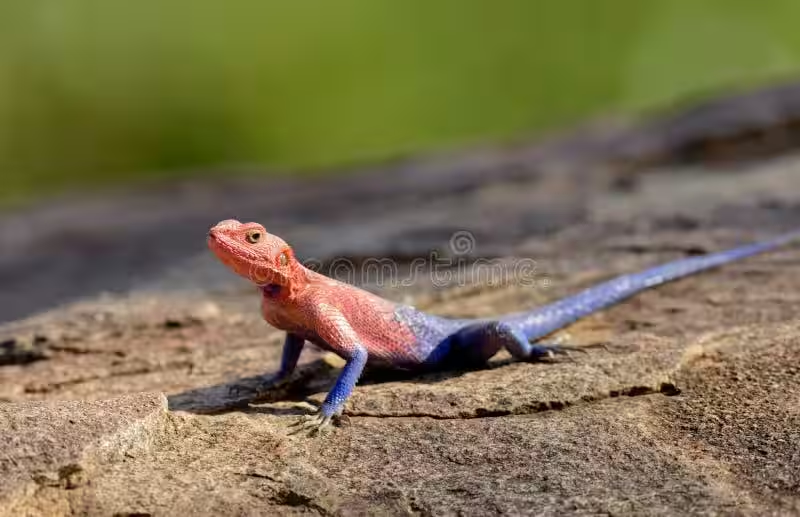
The Swahili phrase "mjusi kafiri" presents a fascinating linguistic puzzle. While a direct translation might seem straightforward, the nuances of the words involved reveal a deeper complexity demanding careful consideration. This article aims to explore the meaning and implications of "mjusi kafiri," offering insights into its cultural context and providing alternative interpretations to avoid misinterpretations and potential offense.
- Decoding the Terms: Mjusi and Kafiri
- The Figurative Nature of Mjusi Kafiri
- Finding Accurate Equivalents in English
- Mjusi Kafiri: A Call for Collaborative Understanding
-
Frequently Asked Questions about "Mjusi Kafiri"
- What does "Mjusi Kafiri" mean in Swahili?
- What is the origin of the term "Mjusi Kafiri"?
- Why is there limited information about "Mjusi Kafiri"?
- How can I contribute to understanding "Mjusi Kafiri"?
- What is the most accurate English translation of "Mjusi Kafiri"?
- Is "Mjusi Kafiri" a scientific term?
- Where can I find more information about "Mjusi Kafiri"?
- What kind of lizard is implied by "Mjusi Kafiri"?
- Is the term "Mjusi Kafiri" offensive?
- How does the lack of information about "Mjusi Kafiri" highlight the collaborative nature of Wikipedia?
Decoding the Terms: Mjusi and Kafiri
The first component, "mjusi," is relatively straightforward. It simply translates to "lizard" in Swahili, often referring to the gecko family. These small, often agile reptiles are widely distributed across East Africa. Their presence in homes and gardens is common. These lizards are often viewed differently depending on cultural beliefs and personal experiences; some might be seen as beneficial pest controllers, while others view them with aversion, fearing their presence.
The term "kafiri," however, is significantly more nuanced. Derived from the Arabic root "kafir," it generally refers to a non-believer or infidel, particularly in a Muslim context. However, its connotation varies dramatically depending on the context. In some instances, it can be used neutrally to describe someone who does not adhere to Islam. In other contexts, "kafiri" can carry a severe negative connotation, suggesting heresy, wickedness, or even ungodliness. This ambiguity underscores the potential for misinterpretations when directly translating phrases involving this word.
The Figurative Nature of Mjusi Kafiri
Given the significant range of meanings for "kafiri," it's highly unlikely that "mjusi kafiri" refers to a lizard's religious beliefs. The pairing of "mjusi" and "kafiri" strongly suggests a figurative application, a metaphorical expression where "kafiri" is used to ascribe a certain characteristic or behavior to the gecko. This characteristic isn't literal disbelief but likely reflects a negative association or judgment placed upon the gecko.
This metaphorical usage could stem from various cultural perspectives. Perhaps certain gecko behaviors, like their nocturnal habits or quick movements, are perceived as unsettling or even sinister leading to their negative labeling. Alternatively, the term might be used derisively to express annoyance or disgust at the gecko's presence. The gecko's reputation might be influenced by local folklore or superstitions that attribute negative associations to its appearance or habits.
Cultural Context is Key
Understanding the true meaning of "mjusi kafiri" hinges entirely on the specific cultural context. The phrase's usage within a conversation or narrative drastically influences its interpretation. A derogatory statement might use it to belittle or insult someone indirectly by comparing them to an unwanted gecko. In contrast, a playful usage could employ it ironically, highlighting a humorous aspect of a situation. Therefore, attempting a direct translation without understanding the context is almost certainly misleading.
Finding Accurate Equivalents in English
The challenge lies in finding appropriate English equivalents that capture the intended meaning without resorting to a literal, and potentially offensive, translation like "infidel gecko." The best approach focuses on conveying the underlying sentiment or attitude, rather than translating the individual words directly.
Here are a few alternatives based on potential contexts:
- "Pesky gecko": This conveys annoyance or inconvenience. It's suitable if the speaker is merely expressing irritation at the presence of a gecko.
- "Nasty gecko": This emphasizes disgust or revulsion. It might be used if the gecko is considered unclean or undesirable.
- "Worthless gecko": This implies a sense of insignificance or disdain, suitable if the speaker holds a dismissive attitude towards the creature.
- "That darn gecko!": This informal expression accurately reflects irritation and exasperation.
- "Unwanted gecko": This is a more neutral alternative, suitable when the context doesn't necessitate strong negative connotations.
The Importance of Nuance
It's crucial to recognize that even these alternatives might not perfectly capture the original meaning in all situations. The beauty and complexity of language lie in its ability to convey subtle nuances of emotion and perspective. A translator or reader should always strive to understand the speaker's intent and select the most appropriate equivalent phrase in the target language that conveys the same emotional weight and meaning.
Mjusi Kafiri: A Call for Collaborative Understanding
The very existence of this incomplete Wikipedia entry highlights the importance of collaborative knowledge building. The "mjusi kafiri" entry serves as a reminder that our understanding of cultural expressions often relies on shared contributions and cross-cultural dialogue. By actively seeking information and engaging in discussions, we can move beyond simplistic translations and arrive at a richer, more nuanced understanding of the phrase and its place within Swahili culture. This participatory approach ensures that the meaning of "mjusi kafiri" remains true to its context and avoids potentially harmful misinterpretations. The collaborative effort to expand knowledge about the creature referenced as "mjusi kafiri" and its culturally-specific meaning is as important as any factual description.
Frequently Asked Questions about "Mjusi Kafiri"
What does "Mjusi Kafiri" mean in Swahili?
"Mjusi Kafiri" is a Swahili phrase composed of two words: "mjusi," meaning "lizard" or "gecko," and "kafiri," which is a complex term derived from Arabic. "Kafiri" generally translates to "non-believer" or "infidel," but its connotation varies significantly based on context. While a literal translation might be "infidel lizard," this is misleading and potentially offensive. The phrase likely carries a figurative meaning, often expressing a negative sentiment towards the lizard, rather than describing its religious beliefs.
What is the origin of the term "Mjusi Kafiri"?
The origin of the term "Mjusi Kafiri" is currently unknown. More research is needed to determine its historical usage and the specific reasons for applying the term "kafiri" to a lizard. Contributions from Swahili speakers with knowledge of local folklore, traditions, or colloquialisms are crucial to understanding its background.
Why is there limited information about "Mjusi Kafiri"?
The lack of information reflects a gap in documented knowledge about this specific term. It highlights the importance of community contributions to building comprehensive knowledge bases. More research and contributions from Swahili speakers are needed to fill this gap.
How can I contribute to understanding "Mjusi Kafiri"?
You can contribute by sharing any knowledge you have about the term's usage, origin, and cultural context. This includes personal anecdotes, observations from Swahili-speaking communities, or relevant information from any source that helps clarify its meaning and application. You can also research similar terms or phrases in other languages that might offer analogous meanings.
What is the most accurate English translation of "Mjusi Kafiri"?
There isn't a single, universally accurate English translation. The best equivalent depends heavily on the context. It could range from neutral descriptions like "unwanted gecko" or "pesky gecko" to more negative ones like "worthless gecko" or "nasty gecko." A direct translation of "infidel gecko" is inaccurate and should be avoided. The context is key to choosing the most appropriate translation.
Is "Mjusi Kafiri" a scientific term?
No, "Mjusi Kafiri" is not a scientific term used in zoology or herpetology. It's a colloquial expression with cultural significance within Swahili-speaking communities. It's not a recognized biological classification for any specific lizard species.
Where can I find more information about "Mjusi Kafiri"?
Currently, information about "Mjusi Kafiri" is scarce. This FAQ aims to provide a starting point. Further research in Swahili language resources, cultural studies, and local folklore might yield additional insights. Collaboration and shared knowledge are essential to expanding our understanding of this term.
What kind of lizard is implied by "Mjusi Kafiri"?
The term doesn't specify a particular species of lizard. "Mjusi" is a general term for lizards and geckos. The "kafiri" part adds a cultural and contextual layer, not a biological one. Any type of gecko or lizard could potentially be referred to as "Mjusi Kafiri" depending on the context.
Is the term "Mjusi Kafiri" offensive?
The potential for offense depends entirely on context and intent. While "kafiri" can be offensive in certain religious contexts, its use with "mjusi" likely signifies a figurative, rather than a literally religious, insult. However, it's wise to exercise caution and consider the potential for misinterpretation.
How does the lack of information about "Mjusi Kafiri" highlight the collaborative nature of Wikipedia?
The limited information available serves as a demonstration of Wikipedia's collaborative nature. It showcases the ongoing process of building a knowledge base through collective contributions. The absence of information about "Mjusi Kafiri" is an invitation for anyone with relevant knowledge to contribute and expand the existing understanding of this term.