
LSB vs NASB: A Detailed Comparison for Bible Students
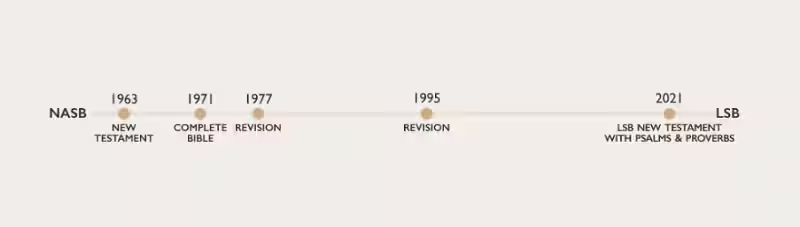
Choosing the right Bible translation can significantly impact your understanding and experience of Scripture. Two popular options often compared are the Legacy Standard Bible (LSB) and the New American Standard Bible (NASB), both known for their emphasis on accuracy. This article delves into the key differences between the LSB and NASB 1995, helping you determine which might be the best fit for your study needs.
- Key Differences: A Closer Look at LSB vs NASB
-
Which Translation is Right for You?
- What is the Legacy Standard Bible (LSB), and how does it differ from the New American Standard Bible (NASB 1995)?
- How does the LSB handle the divine name in the Old Testament?
- Does the LSB translate "doulos" consistently?
- Is the LSB a more literal translation than the NASB 1995?
- How does the LSB handle units of measurement?
- Does the LSB include extensive notes and cross-references?
- What is the overall philosophy behind the LSB's translation approach?
- Is the LSB a completely new translation, or a revision of an existing one?
Key Differences: A Closer Look at LSB vs NASB
The LSB, building upon the NASB 1995, aims for even greater precision and accuracy in its rendering of the original Hebrew and Greek texts. While both translations prioritize accuracy over readability, the LSB takes this commitment a step further in several key areas.
The most immediately apparent difference lies in the rendering of the divine name. The LSB consistently uses "Yahweh" in the Old Testament, whereas the NASB 1995 typically opts for "LORD" (in all caps). This reflects a growing scholarly trend towards restoring the original pronunciation of God's name, offering a more historically accurate representation. This change, however, can be jarring for readers accustomed to the traditional "LORD."
Beyond the divine name, the LSB exhibits a more consistent approach to translating specific words. For instance, it consistently renders the Greek word "doulos" as "slave," avoiding the occasional variations found in the NASB 1995. This consistency streamlines understanding and avoids potential ambiguities.
Accuracy and Literal Translation: A Defining Feature
Both the LSB and NASB 1995 lean towards literal translations, prioritizing a word-for-word equivalence to the original languages. However, the LSB refines this approach, striving for even greater lexical and grammatical accuracy. This often results in a more precise, yet potentially less readable, translation than the NASB 1995. The LSB's commitment to accuracy is evident in its detailed handling of original units of measurement, retaining them while also providing helpful modern conversions in footnotes. This preservation of original units is important for understanding the historical and cultural context of the text.
The extensive use of footnotes in the LSB further distinguishes it from the NASB 1995. These footnotes provide valuable contextual information, clarifying ambiguous passages and offering alternative interpretations. While the NASB 1995 includes footnotes, the LSB boasts a significantly more comprehensive and detailed explanatory apparatus. This increased level of annotation can be extremely helpful for serious Bible students seeking a deeper understanding of the text's nuances.
Readability and Style: A Trade-off for Precision
The pursuit of greater accuracy in the LSB sometimes comes at the expense of readability. While both translations are not overly difficult to read, the LSB's more literal approach can occasionally lead to sentences that are longer and more complex than those in the NASB 1995. This is a conscious choice reflecting the LSB's prioritization of accuracy over stylistic elegance. The NASB 1995 often aims for a balance between accuracy and readability, making it a more accessible choice for a wider range of readers.
The increased precision of the LSB's word choices is another significant difference. The translators have carefully considered the original meaning in choosing the most appropriate English equivalent. This meticulous approach ensures greater fidelity to the source text, but it can also lead to less common or less familiar phrasing.
Which Translation is Right for You?
The choice between the LSB and NASB 1995 ultimately depends on your individual needs and priorities.
-
Choose the LSB if:
- You prioritize maximum accuracy and a literal translation.
- You appreciate extensive footnotes and detailed explanations.
- You value the restoration of "Yahweh" as the divine name.
- You prefer a consistent rendering of specific words like "doulos."
- You are comfortable with a translation that prioritizes accuracy over effortless readability.
-
Choose the NASB 1995 if:
- You want a balance between accuracy and readability.
- You prefer a more familiar and less challenging reading experience.
- You are comfortable with variations in the translation of certain words.
- You need a translation that is widely accepted and used in various academic settings.
Ultimately, the "best" translation is subjective and depends on the reader's goals. Both the LSB and NASB 1995 offer valuable contributions to the world of Bible translation, each with its own strengths and weaknesses. Careful consideration of these differences will enable you to make an informed decision based on your specific needs. Consider reading sample passages from both translations to gain a firsthand understanding of their respective styles and approaches before making your final choice. Using both translations in tandem can also provide a richer understanding of the text.
What is the Legacy Standard Bible (LSB), and how does it differ from the New American Standard Bible (NASB 1995)?
The Legacy Standard Bible (LSB) is a revision and improvement of the New American Standard Bible (NASB) 1995. While building upon the NASB's foundation, the LSB prioritizes even greater accuracy and precision in its translation from the original Hebrew and Greek texts. Key differences lie in its approach to word-for-word equivalence, the handling of specific terms, and the inclusion of detailed explanatory notes.
How does the LSB handle the divine name in the Old Testament?
Unlike the NASB 1995, which typically uses "LORD" as a substitute for the Tetragrammaton (YHWH), the LSB restores the use of "Yahweh," the presumed pronunciation of the divine name.
Does the LSB translate "doulos" consistently?
Yes, the LSB consistently renders the Greek word "doulos" as "slave," unlike the NASB 1995, which may use variations depending on context. This ensures a more uniform and accurate representation of the original meaning.
Is the LSB a more literal translation than the NASB 1995?
Yes, the LSB strives for a more precise, word-for-word equivalence to the original languages, resulting in a more literal translation compared to the NASB 1995. This prioritizes accuracy over stylistic fluency.
How does the LSB handle units of measurement?
The LSB retains the original weights, measurements, and currency from the source texts. It also includes helpful notes providing both American and metric conversions for modern readers, aiming for global accessibility and preserving the potential interpretative significance of these original units.
Does the LSB include extensive notes and cross-references?
Yes, the LSB is characterized by its detailed footnotes, providing extensive explanations, cross-references, and clarifications to aid in understanding the text.
What is the overall philosophy behind the LSB's translation approach?
The LSB prioritizes accuracy and fidelity to the original languages over readability and stylistic elegance. It reflects a scholarly approach, incorporating careful linguistic research and a commitment to conveying the original author's intent as accurately as possible through specific word choices and contextual understanding. It aims for enhanced clarity by improving lexical and grammatical accuracy.
Is the LSB a completely new translation, or a revision of an existing one?
The LSB is a revision of the NASB 1995, building upon its strengths while addressing perceived weaknesses and striving for increased accuracy and precision in its translation methodology.