
Jehovah Bore: The Simplicity of Creation
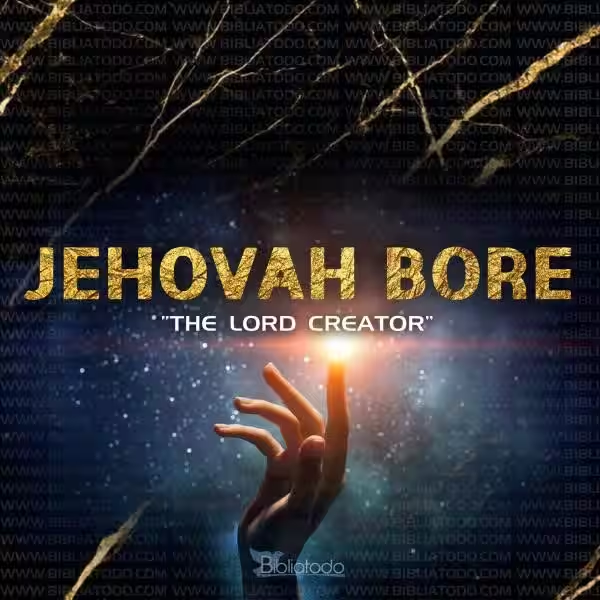
The sheer elegance of the Genesis creation narrative, "In the beginning, God created the heavens and the earth," stands in stark contrast to the often-convoluted explanations offered by modern science. This simple yet profound statement, attributed to Jehovah-Bore, the Lord Creator, encapsulates a power and simplicity that eludes even the most sophisticated scientific models.
- The Inadequacy of Human Language
- The Power of Jehovah-Bore's Word
- Beyond Scientific Explanations
- What is Jehovah-Bore?
- How does the text compare the Genesis creation account to modern scientific explanations?
- What is the central argument of the text regarding creation?
- Why does the text use the name "Jehovah-Bore"?
- What is the rhetorical strategy employed in the text?
- What is the overall tone and message of the text?
The Inadequacy of Human Language
Consider the task of a modern writer, even a devout believer, attempting to recreate the Genesis account. Would they be able to capture the sheer immensity and wonder of that singular act of creation with the same breathtaking conciseness? It's unlikely.
The temptation to embellish, to add adjectives and technical jargon, to weave a tapestry of complex scientific terminology, would be almost irresistible. Yet, such additions would only serve to dilute the raw, unadulterated power of the original statement. The attempt to explain, to dissect, to analyze, would ultimately fall short of the original's inherent beauty and simplicity.
The Power of Jehovah-Bore's Word
The name Jehovah-Bore itself speaks volumes. It emphasizes the very act of creation, the divine agency and absolute power involved in bringing the universe into existence. It's not merely a passive observation of the universe's formation, but a declaration of divine authorship, a testament to the Lord's direct and involved participation in creation. This active involvement, this personal touch, is often lost in the impersonal, often abstract, language of modern cosmology.
Scientists, for all their advancements, often find themselves "scratching their heads," admitting the uncertainty surrounding the universe's origins. While scientific inquiry continues to push the boundaries of human understanding, it ultimately grapples with incomplete data and unanswered questions. The Genesis account, on the other hand, presents a clear, unequivocal declaration: God created. Period. No tentative hypotheses, no probabilities, no qualifications. Just a statement of absolute, undeniable fact.
A Contrast in Styles
Imagine a modern scientific attempt to describe the creation of the universe. It might fill pages with complex equations, detailed descriptions of the Big Bang, and intricate explanations of particle physics. The language would likely be peppered with technical terms, requiring a specialized background to fully understand. In stark contrast, the biblical account offers a singular, powerful statement that resonates across cultures and generations.
The beauty of the Genesis narrative lies in its simplicity. It's a testament to the power of direct communication, the ability to convey profound truths without obfuscation. It's a statement that transcends the limitations of human language, speaking directly to the human heart and spirit. This directness is a key element of what makes the simple statement so powerful.
Beyond Scientific Explanations
The scientific approach, while valuable in its own right, inevitably falls short of fully capturing the wonder and awe inherent in the creation narrative. It can explain the "how" of creation, perhaps, but it struggles to articulate the "why," the underlying purpose and intention behind it. And it's in this "why" that the true power and significance of Jehovah-Bore's act resonate.
This is not to diminish the importance of scientific inquiry. Rather, it is to emphasize the distinct and complementary nature of scientific explanation and divine revelation. Science can illuminate the mechanics of the universe, but only faith can comprehend the divine purpose behind it. Science tackles the observable, while faith addresses the unobservable, the spiritual dimension that underpins all of creation.
The Ultimate Simplicity
The concluding statement, "God just spoke and it was so," encapsulates the essence of the Genesis account. It underlines the absolute power and effortless ease with which Jehovah-Bore brought forth the universe. No lengthy processes, no gradual evolution, no trial and error—just the divine word, instantaneously bringing creation into being. It is a statement of divine power beyond human comprehension, a testament to the boundless capabilities of the Creator.
This simplicity is not to be mistaken for naivety or lack of depth. It is a profound statement that speaks volumes about the nature of God and the power of His word. It is a statement that continues to inspire awe and wonder, even in the face of scientific advancements that continue to unveil the intricate details of the universe. The simplicity, in fact, is the greatest testament of all to the ultimate power of Jehovah-Bore.
Here's an FAQ section based on the provided information about Jehovah-Bore, focusing on the creation narrative and its contrast with scientific explanations.
What is Jehovah-Bore?
Jehovah-Bore is a name signifying "The Lord Creator," emphasizing God's role as the active and powerful force behind the creation of the universe and everything in it. It highlights His personal involvement and agency in the act of creation.
How does the text compare the Genesis creation account to modern scientific explanations?
The text contrasts the simple elegance of the Genesis statement, "In the beginning, God created the heavens and the earth," with what it perceives as the verbose and ultimately incomplete attempts of modern science to explain the universe's origin. It argues that even a believing scientist would struggle to capture the power and wonder of creation as succinctly and beautifully as the biblical account. The implication is that scientific explanations, while valuable, remain incomplete and cannot fully encompass the divine act of creation.
What is the central argument of the text regarding creation?
The core argument is that God's creation of the universe was a direct, powerful, and simple act of divine will. The text emphasizes the inadequacy of human language, especially the technical jargon of modern science, to fully grasp the immensity and wonder of this event. God's simple declaration, "God spoke and it was so," is presented as the ultimate and most powerful explanation.
Why does the text use the name "Jehovah-Bore"?
The use of "Jehovah-Bore" strengthens the emphasis on God's absolute power and personal involvement in creation. It serves as a powerful reminder of the divine agency behind the universe's existence, an agency that surpasses human comprehension and scientific explanation.
What is the rhetorical strategy employed in the text?
The text uses a rhetorical strategy of comparison. It juxtaposes the imagined lengthy and complex descriptions a modern writer, even a believer, might use to describe creation with the simple and direct statement of Genesis. This comparison highlights the perceived limitations of human language and understanding in contrast to the divine revelation.
What is the overall tone and message of the text?
The overall tone is one of reverence and awe for the divine act of creation. The text conveys a message of the inherent beauty and power found in the simplicity of the biblical account. It emphasizes the limitations of human knowledge and scientific inquiry in fully understanding the origins of the universe and ultimately points to the absolute power and simplicity of God's creative act.