
Honra o Honra: Understanding the Nuances of Honor in Portuguese
Many Portuguese learners stumble upon the word "honra," often questioning its spelling and usage. This article aims to clarify the meaning, spelling, and pronunciation of "honra" and its verb form, "honrar," providing a comprehensive understanding of this important word. We will explore the subtleties of its meaning and how it's used in different contexts.
- Understanding the Meaning of Honra
- Honra as a Noun: Exploring its Many Facets
- Honrar: The Verb of Honor
- The Importance of Correct Spelling: Honra (One 'r')
-
Conclusion: Embracing the Depth of Honra
- What is the correct spelling: honra or honrra?
- What does "honra" mean?
- What are some synonyms for "honra"?
- How is the 'r' pronounced in "honra"?
- Why doesn't "honra" have a double 'r'?
- Is "honra" related to any verbs?
- What does "honrar" mean?
- What are some examples of how to use "honrar"?
- What are some synonyms for "honrar"?
- Where can I find more information on Portuguese orthography?
Understanding the Meaning of Honra
The word "honra" in Portuguese is a multifaceted term, carrying weight beyond a simple English translation of "honor." It encompasses a broad spectrum of meanings, ranging from moral uprightness and integrity to recognition and privilege.
Think of it as embodying a deep sense of respect, both self-respect and respect for others. It implies a commitment to ethical conduct and a strong moral compass. This is why directly translating "honra" as simply "honor" often falls short. The word carries a deeper cultural significance.
Honra can also refer to awards, titles, or distinctions bestowed upon someone in recognition of their achievements or virtues. This aspect highlights the societal acknowledgment of one's character and actions. Achieving honra is a testament to one's uprightness and contributions to society.
Honra as a Noun: Exploring its Many Facets
As a noun, "honra" can be understood in several ways. Let's examine some examples:
-
Moral Uprightness: "Ele vive com honra." (He lives with honor/integrity). Here, "honra" signifies a life lived according to high moral standards.
-
Awards and Titles: "Receber uma honra como essa é um privilégio." (Receiving an honor like that is a privilege). This illustrates "honra" as a prestigious award or title.
-
Social Standing: "A honra da família estava em jogo." (The family's honor was at stake). This emphasizes the importance of honra within a social context.
To further clarify the meaning of "honra," let's explore some synonyms:
- Dignidade (dignity): Reflects the inherent worth and respect due to someone.
- Integridade (integrity): Emphasizes moral uprightness and honesty.
- Respeito (respect): Highlights the esteem and deference shown towards someone or something.
- Pureza (purity): Suggests innocence and moral cleanliness.
- Virtude (virtue): Refers to moral excellence and righteousness.
Honrar: The Verb of Honor
The verb "honrar" is intrinsically linked to the noun "honra." It means to honor, respect, or revere someone or something. But its meaning extends beyond mere politeness; it implies a deep sense of admiration and acknowledgment.
Conjugation and Usage Examples
As a verb, "honrar" conjugates regularly. For example:
- Eu honro: I honor.
- Tu honras: You (singular, informal) honor.
- Ele/Ela honra: He/She honors.
- Nós honramos: We honor.
- Vós honrais: You (plural, informal) honor.
- Eles/Elas honram: They honor.
"Honrar" can also mean to fulfill a commitment or pay a debt, further showcasing its depth of meaning. "Honrar um compromisso" (to honor a commitment) exemplifies this aspect. This speaks to the importance of upholding one's word and responsibilities. The act of honoring a commitment is an integral part of maintaining one's honra.
Synonyms for Honrar
Similar to "honra," the verb "honrar" also has several synonyms, each carrying slightly different nuances:
- Respeitar (to respect): To show deference and esteem.
- Reverenciar (to revere): To show deep respect and admiration.
- Venenrar (to venerate): To regard with great respect and reverence.
- Glorificar (to glorify): To praise and extol.
- Cumprir (to fulfill): To carry out a commitment or obligation.
The Importance of Correct Spelling: Honra (One 'r')
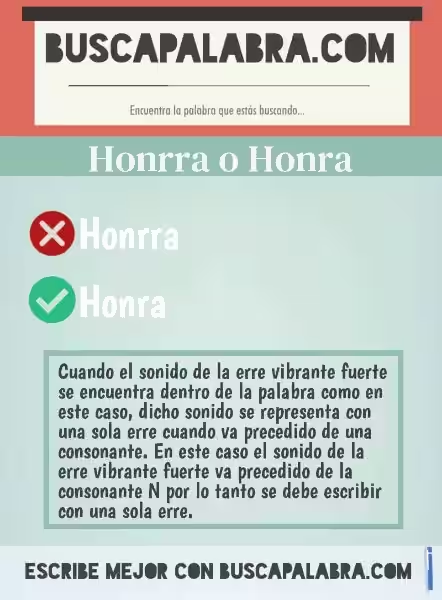
It's crucial to note the correct spelling: "honra" has only one 'r'. The double 'r' ("honrra") is incorrect. This is often a point of confusion for learners, as the pronunciation can sometimes sound like a stronger 'r'. However, Portuguese orthography dictates a single 'r' in this case. The rules governing the use of double 'r' in Portuguese relate to the position of the 'r' between vowels. In "honra," the 'r' is not situated between two vowels.
Conclusion: Embracing the Depth of Honra
Understanding "honra" and "honrar" goes beyond simple translation. It requires grasping the cultural and social implications of these words. They represent a core value in Portuguese-speaking cultures: a commitment to integrity, respect, and fulfilling one's responsibilities. By understanding these nuances, you can engage more deeply with the language and its rich cultural context. Remember the single 'r' in "honra" and appreciate the multifaceted meaning it carries.
What is the correct spelling: honra or honrra?
The correct spelling is "honra" (with one 'r'). The double 'r' spelling ("honrra") is incorrect.
What does "honra" mean?
"Honra" is a Portuguese noun that encompasses a range of meanings including: honor, integrity, dignity, respect, consideration, recognition, privilege, purity, and reverence. It can refer to moral uprightness, awards, or titles of honor.
What are some synonyms for "honra"?
Synonyms for "honra" include dignity, integrity, honesty, respect, privilege, purity, virtue, and reputation.
How is the 'r' pronounced in "honra"?
The 'r' in "honra" has a weak pronunciation, typical of a single 'r' not located between two vowels. This contrasts with the strong, prolonged 'r' sound represented by a double 'r' (rr) in words like "carroça" (cart).
Why doesn't "honra" have a double 'r'?
The double 'r' (rr) in Portuguese indicates a strong 'r' sound usually found between two vowels. Since the 'r' in "honra" is not between two vowels, a single 'r' is correct. This follows standard Portuguese orthographic rules.
Yes, "honra" is closely related to the verb "honrar."
What does "honrar" mean?
"Honrar" means to honor, respect, revere, fulfill a commitment, pay a debt, or be proud of something. It's the verb form associated with the noun "honra."
What are some examples of how to use "honrar"?
"Honrar" can be conjugated in various ways. For instance, "ele honra" (he honors), "honra teus pais" (honor your parents), are examples of its use in different tenses and persons.
What are some synonyms for "honrar"?
Synonyms for "honrar" include dignify, respect, revere, venerate, glorify, fulfill, pay (a debt), and pride oneself.
Where can I find more information on Portuguese orthography?
Consulting a reputable Portuguese dictionary or grammar book will provide further information on Portuguese spelling and pronunciation rules, including the use of single and double 'r'. Resources from recognized linguistic institutions or trusted online dictionaries are also excellent sources.