
Decoding Eagle Hebrew: Ne-sher and A-yit – A Journey into Biblical Symbolism
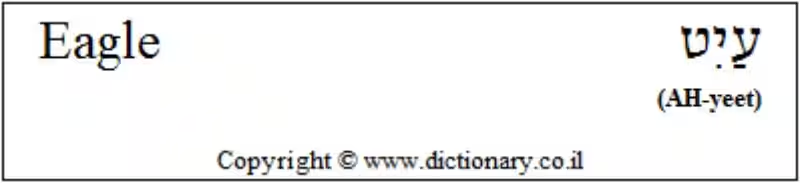
Understanding the nuances of ancient languages often reveals fascinating insights into cultural beliefs and values. One such example lies in the Hebrew words for "eagle" and "vulture," which, despite seemingly straightforward translations, carry a depth of meaning far exceeding simple ornithological descriptions. This article explores the Hebrew words Ne-sher (נשר) and A-yit (איית) and their complex symbolic roles within biblical and cultural contexts.
- The Etymological and Definitional Challenges of Ne-sher and A-yit
- Predatory Behavior vs. Scavenging: The Key Distinctions
- Ne-sher (Eagle) in Biblical and Cultural Contexts
- The Enduring Power of Symbolism
-
Eagle in Hebrew: Frequently Asked Questions
- What are the Hebrew words for "eagle" and how are they different?
- What is the symbolic meaning of *Ne-sher* (נשר)?
- Why was the bald eagle chosen as the national emblem of the United States?
- Is there ambiguity in the meaning of *Ne-sher* (נשר) and *A-yit* (איית)?
- How does the etymology of *Ne-sher* contribute to its symbolic meaning?
- What is the significance of the eagle's imagery in other ancient Near Eastern cultures?
The Etymological and Definitional Challenges of Ne-sher and A-yit
The terms Ne-sher and A-yit, often translated as "eagle" and "vulture" respectively, present a persistent challenge to etymologists and translators. Existing Hebrew dictionaries offer varying interpretations, highlighting a historical ambiguity that hasn't been fully resolved. While ornithological distinctions clearly exist between eagles and vultures, the crucial difference highlighted in biblical texts lies not solely in their physical characteristics but primarily in their symbolic roles.
This ambiguity isn't a recent development. Scholars have debated the precise distinctions between the two for centuries, particularly when examining ancient texts where the descriptions aren't always perfectly clear-cut. The lack of detailed ornithological descriptions in the ancient world contributes to the difficulty in definitively assigning specific species to these Hebrew terms. Furthermore, the symbolic interpretations often overshadowed the purely biological categorizations.
Different translations of the Hebrew Bible often reflect these ambiguities. Certain translations may opt for a broader term like "bird of prey" when the exact species is uncertain. Others opt for "eagle" for both terms, highlighting the shared predatory nature rather than focusing on the subtle differences in scavenging versus hunting.
Predatory Behavior vs. Scavenging: The Key Distinctions
The core distinction between Ne-sher and A-yit hinges on their predatory behaviour. A-yit (vulture), consistently associated with carrion, represents scavenging. Biblical depictions of A-yit often portray them gathering around carcasses, anticipating and feeding on death. Their symbolic representation, therefore, tends to be negative, associated with decay and ill omen.
Conversely, Ne-sher (eagle) holds a significantly more positive symbolic weight. The eagle, with its powerful flight and hunting prowess, represents strength, independence, and a certain majesty. It's an active hunter, not a scavenger, a key factor shaping its symbolic interpretation. The visual image of the eagle soaring high above the earth further contributes to its association with elevated status, insight, and divine connection.
This difference in hunting style is crucial to understanding their symbolic implications. The eagle actively hunts its prey, showcasing strength and agility. The vulture, on the other hand, passively waits for its meals, representing a less active, and often less desirable, role in the ecosystem.
Ne-sher (Eagle) in Biblical and Cultural Contexts
The Bible uses Ne-sher to portray God's power and protective nature. Deuteronomy 32:11 uses the eagle's actions – stirring its nest, hovering over its young, spreading its wings to carry them – as a metaphor for divine guardianship of the Israelites. This powerful imagery is not unique; other passages reinforce this connection between the eagle and God's protective care. This imagery highlights the eagle's nurturing side, contrasting with the purely predatory aspects.
The powerful imagery of the eagle in Deuteronomy 32:11 had a profound impact. It significantly influenced the adoption of the bald eagle as the United States' national emblem on June 20, 1782. The connection is further strengthened by the etymology of "bald eagle," stemming from the Hebrew root "na-shar," meaning "to fall out" or "to be bald," a characteristic of the mature bald eagle. This suggests a deliberate and biblically-informed choice reflecting the founding fathers' religious beliefs. This unexpected link between the Hebrew Ne-sher and the American national bird underscores the enduring influence of biblical symbolism.
Beyond Protection: Strength and Prowess
Beyond its protective symbolism, Ne-sher embodies strength, prowess, and keen vision. Some scholars note that the final two letters of the word, שר (sar), translate to "prince" or "mighty warrior," further enriching the eagle's symbolic representation. This interpretation adds layers to the meaning, linking the eagle not only to divine protection but also to earthly power and leadership. The eagle's role as a hunter, capable of bringing down prey far larger than itself, reinforces this image of strength and dominance.
This dual symbolism – protective and powerful – makes Ne-sher a potent and multifaceted symbol. It's not merely a representation of physical strength but also of divine authority and the capacity to both nurture and protect. The eagle's ability to soar to great heights also symbolizes aspiration, ambition, and the pursuit of spiritual elevation.
The Enduring Power of Symbolism
The continued confusion surrounding the precise distinction between Ne-sher and A-yit highlights the complexity of translating ancient languages. The enduring power of symbolic interpretations in shaping cultural identity is undeniable. The eagle, as a symbol of strength, protection, and divine authority, continues to resonate deeply in many cultures, reflecting the enduring influence of ancient biblical imagery. The Hebrew word Ne-sher provides a compelling case study in how a seemingly simple word can encapsulate complex cultural and religious meanings. Further research into the specific uses of these words within different biblical texts will likely further illuminate the subtleties and deepen our understanding of their symbolic significance.
Eagle in Hebrew: Frequently Asked Questions
What are the Hebrew words for "eagle" and how are they different?
The Hebrew language uses several words that can be translated as "eagle" or related birds of prey, creating some confusion. Two of the most prominent are Ne-sher (נשר) and A-yit (איית). While both refer to large birds of prey, the key distinction lies in their symbolic and behavioral connotations rather than strict ornithological classification. A-yit is consistently associated with scavenging and carrion, while Ne-sher carries a much more positive symbolic weight, often representing strength, protection, and divine power.
What is the symbolic meaning of *Ne-sher* (נשר)?
In biblical and cultural contexts, Ne-sher (eagle) holds profound symbolic meaning. It represents God's protective power and care, as seen in Deuteronomy 32:11 where the eagle's actions of sheltering and carrying its young are used as a metaphor for divine guardianship. Beyond protection, Ne-sher also embodies strength, prowess, and the ability to soar to great heights, both literally and metaphorically. The final two letters of the word, "שר" (sar), translate to "prince" or "mighty warrior," further enriching its powerful and protective symbolism.
Why was the bald eagle chosen as the national emblem of the United States?
The selection of the bald eagle as the US national emblem is believed to have been influenced by the biblical imagery associated with Ne-sher. The etymology of "bald eagle," connected to the Hebrew root "na-shar" meaning "to fall out" or "to be bald," suggests a deliberate link to the Hebrew word for eagle and its symbolic representation of divine protection and strength. This reflects the religious beliefs of the Founding Fathers and their desire to imbue the national symbol with deep meaning.
Is there ambiguity in the meaning of *Ne-sher* (נשר) and *A-yit* (איית)?
Yes, some ambiguity exists in the precise definitions and distinctions between Ne-sher and A-yit. Existing dictionaries and translations sometimes offer conflicting interpretations reflecting a historical lack of clarity. However, the core distinction consistently drawn is between the predatory behavior of the eagle (Ne-sher) and the scavenging behavior of the vulture (A-yit). This difference significantly impacts their cultural and symbolic roles.
How does the etymology of *Ne-sher* contribute to its symbolic meaning?
While the precise etymology of Ne-sher is debated, its connection to the concept of "lacerating" or "tearing" is suggested by some scholars. This might allude to the eagle's predatory nature, yet it doesn't diminish its overall positive symbolic weight in biblical and cultural contexts. The powerful imagery associated with the eagle, regardless of its etymology, remains central to its symbolic representation of divine power, protection, and strength.
What is the significance of the eagle's imagery in other ancient Near Eastern cultures?
In ancient Near Eastern cultures, the eagle was a revered symbol of power, divinity, and the ability to reach great heights. This cultural understanding significantly influenced the biblical usage of Ne-sher, reinforcing its symbolic association with God's power and protective presence. The eagle's high-altitude nests further enhanced its connection to safety and security. The biblical use of neshar reflects both its observable characteristics and its deeply ingrained cultural meaning.