
¿Cuánto Están los Precios? Understanding Price Fluctuations and Finding the Best Deals
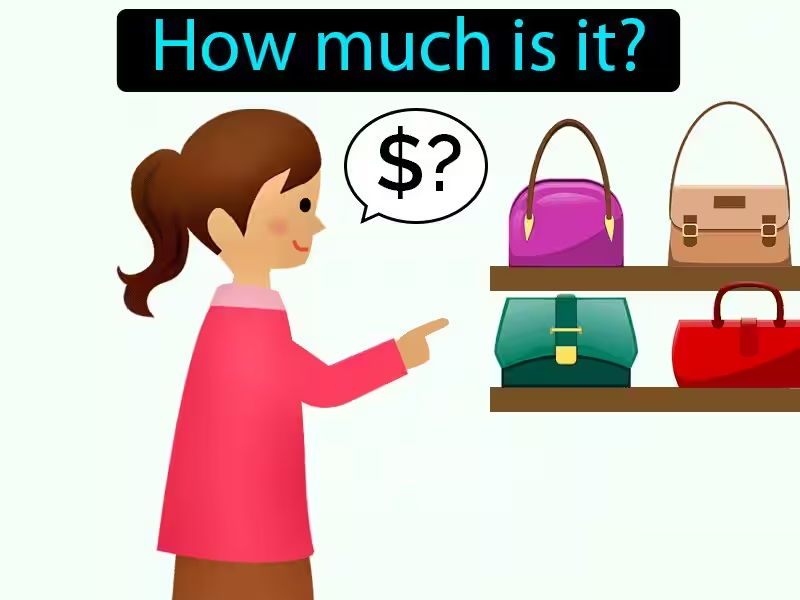
This article aims to help you understand how prices change and how to find the best deals, regardless of what you're buying. We will explore how to effectively navigate price changes and make informed purchasing decisions. Understanding "cuánto están" (how much are they) goes beyond simply asking for a price; it's about understanding the factors influencing that price.
- Factors Affecting Prices: Why "Cuánto Están" Changes
- Strategies for Finding the Best Deals: Beyond "Cuánto Están"
- Conclusion: Mastering the Art of "Cuánto Están"
-
Frequently Asked Questions about "Cuánto Están"
- What is the literal translation of "¿Cuánto están?"?
- Why is the literal translation often inaccurate?
- When does "¿Cuánto están?" refer to price?
- When does "¿Cuánto están?" refer to something other than price?
- How can I accurately translate "¿Cuánto están?" into English?
- What are the key challenges in translating "¿Cuánto están?"?
- What are some examples of different contexts and their corresponding translations?
- How important is context in translating "¿Cuánto están?"?
- Why is a direct, word-for-word translation usually unsatisfactory?
- What translation principle is most relevant to translating "¿Cuánto están?"?
Factors Affecting Prices: Why "Cuánto Están" Changes
Several factors influence the price of goods and services. Understanding these factors is crucial to making smart purchasing decisions. A simple question of "cuánto están" can have a complex answer.
One of the most significant factors is supply and demand. When demand for a product is high and supply is low, prices tend to rise. Conversely, when supply exceeds demand, prices usually decrease. Think about seasonal items – the price of a pumpkin might be high in October near Halloween but significantly lower afterward.
Another key factor is inflation. Inflation is a general increase in the prices of goods and services in an economy over a period of time. This means that the same item will likely cost more in the future than it does today. This gradual increase impacts the answer to "cuánto están" over time.
Beyond the broader economic factors, individual product pricing can also be affected by production costs, marketing and advertising, distribution costs, and retailer markup. For instance, a luxury brand handbag will likely cost more due to higher-quality materials, intricate design, and marketing expenses compared to a similar-looking bag from a less established brand. These are all aspects that contribute to the final answer to "cuánto están."
Competition and Market Dynamics
The level of competition within a market significantly impacts pricing. In markets with many competitors, prices tend to be lower due to increased competition for customers. Conversely, in markets with limited competition, prices might be higher due to less pressure to offer competitive pricing. This plays a critical role in determining the answer to "cuánto están".
Imagine a small town with only one grocery store. They have less incentive to lower their prices compared to a large city with multiple supermarkets vying for customers. This competitive landscape is a major determinant of "cuánto están" the products in question.
Strategies for Finding the Best Deals: Beyond "Cuánto Están"
Now that we understand what influences price, let's explore strategies to find the best deals. Simply asking "cuánto están" isn't always enough.
-
Comparison Shopping: Before making a purchase, compare prices from multiple retailers, both online and offline. Websites and apps dedicated to price comparison can be invaluable tools. This ensures you get the most competitive price for your purchase.
-
Timing Your Purchases: Be mindful of seasonal sales, holiday promotions, and clearance events. Prices often fluctuate throughout the year, and strategic timing can help you save.
-
Utilizing Loyalty Programs and Coupons: Many retailers provide loyalty programs and offer coupons or discounts to regular customers. These programs can provide significant savings over time, effectively changing the answer to "cuánto están" for you.
-
Negotiating Prices: While less common in retail settings, negotiation can be effective in certain situations, especially when purchasing high-value items or services.
-
Buying in Bulk: Buying larger quantities can often lead to lower per-unit costs, especially for consumable goods. Consider if the bulk purchase makes sense for your consumption needs.
-
Looking for Alternatives: Don't be afraid to explore alternative brands or products that offer similar functionality or quality at a lower price. Sometimes, a slightly different brand can significantly change the response to "cuánto están."
Online Resources and Tools
The internet offers many tools to help you find the best deals. Price comparison websites, deal-finding apps, and online coupon sites are valuable resources. These tools can help you answer the question "cuánto están" quickly and efficiently for a wide range of products.
Conclusion: Mastering the Art of "Cuánto Están"
Knowing "cuánto están" the goods you intend to purchase requires more than just asking for a price. Understanding the factors that affect pricing, combined with employing smart shopping strategies, can lead to significant savings. By employing the tips outlined above, you can become a savvy shopper who consistently gets the best deals, making the question of "cuánto están" more than just a question of price, but a question of strategic purchasing.
Frequently Asked Questions about "Cuánto Están"
Here are some frequently asked questions about the Spanish phrase "¿Cuánto están?" and its translation challenges:
What is the literal translation of "¿Cuánto están?"?
The literal translation of "¿Cuánto están?" is "How much are they?". However, this is often misleading and doesn't capture the nuanced meaning in many contexts.
Why is the literal translation often inaccurate?
The phrase "¿Cuánto están?" often uses "cuánto" (how much) figuratively, not literally referring to price. The meaning depends heavily on context. Unlike English, where "how much" primarily relates to cost, Spanish can use "cuánto" to imply distance, time, or other quantities.
When does "¿Cuánto están?" refer to price?
"¿Cuánto están?" can ask about price, but only in the context of clearly discussing the cost of something, like items in a shop. If the context isn't about purchasing items, it's unlikely to refer to price.
When does "¿Cuánto están?" refer to something other than price?
In many situations, "¿Cuánto están?" implies distance, location, or availability. For example, it might ask "How far are they?" (referring to a destination) or "How many are there?" (referring to a quantity of something).
How can I accurately translate "¿Cuánto están?" into English?
There is no single perfect translation. The best translation depends entirely on the context. You need to consider the surrounding conversation and the speaker's intention to determine the correct translation. It might be "How much are they?", "How far are they?", "How many are there?", or something else entirely.
What are the key challenges in translating "¿Cuánto están?"?
The main challenge is the figurative use of "cuánto," which doesn't directly translate into English. The translation requires understanding the implicit meaning and context, prioritizing functional equivalence over literal equivalence. Idiomatic expressions like this often pose significant translation difficulties.
What are some examples of different contexts and their corresponding translations?
- Context: Asking about the price of apples at a market. Translation: "How much are the apples?"
- Context: Asking about the distance to some ruins. Translation: "How far are the ruins?"
- Context: Asking how many people are attending an event. Translation: "How many people are there?"
How important is context in translating "¿Cuánto están?"?
Context is absolutely crucial. Without understanding the context, it is impossible to provide an accurate translation. The surrounding conversation and the topic of discussion are essential elements in determining the intended meaning.
Why is a direct, word-for-word translation usually unsatisfactory?
Direct translation fails because it doesn't account for the figurative language and implicit meaning often present in "¿Cuánto están?". A good translation prioritizes conveying the intended meaning accurately, even if it means departing from a literal word-for-word rendering.
What translation principle is most relevant to translating "¿Cuánto están?"?
The principle of functional equivalence is most relevant. This principle focuses on conveying the meaning and function of the original phrase rather than sticking to a literal, word-for-word translation. The goal is to ensure that the target language text achieves the same communicative effect as the original Spanish.