
Unlocking the Mysteries of the Ark of Mercy: The Kaporet and its Significance
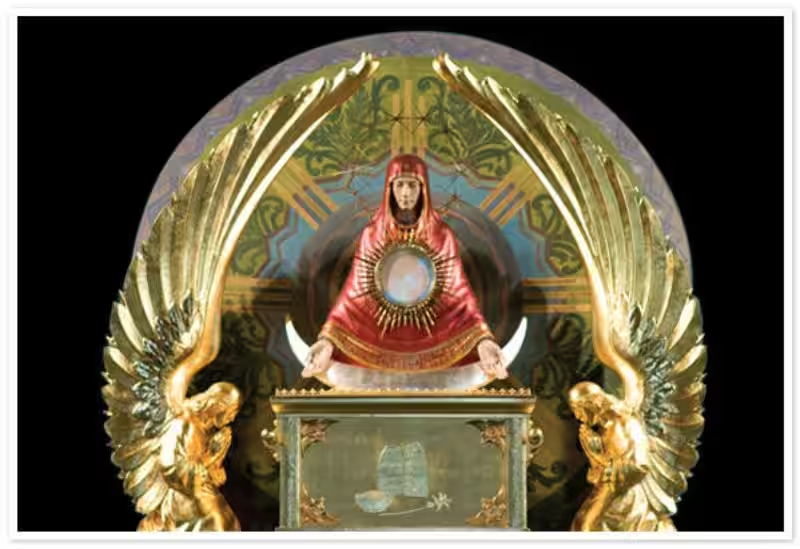
The Ark of the Covenant, a sacred chest described in the Hebrew Bible, holds a central place in Jewish and Christian theology. Less understood, yet equally significant, is the Kaporet, often translated as the "mercy seat," which sat atop the Ark. This article delves into the mysteries surrounding the Ark of Mercy, exploring its construction, purpose, and enduring theological implications.
- The Kaporet: A Golden Lid with Profound Significance
- The Ark of Mercy and the Day of Atonement (Yom Kippur)
-
The Ark of Mercy in Christian Theology
- Different Translations and Interpretations
- What is the Ark of the Covenant?
- What is the Mercy Seat (Kaporet)?
- Where was the Ark of the Covenant kept?
- Who could access the Holy of Holies?
- What happened on Yom Kippur at the Mercy Seat?
- What were the cherubim on the Mercy Seat?
- What is the meaning of "Kaporet"?
- How is the Mercy Seat described in the New Testament?
- What are the different translations of "hilastērion"?
- What is the theological significance of the Mercy Seat?
The Kaporet: A Golden Lid with Profound Significance
The Kaporet wasn't simply a lid; it was a meticulously crafted cover of pure gold, the same dimensions as the Ark itself. This attention to detail emphasized its importance within the Tabernacle and later the Temple in Jerusalem. Its golden brilliance symbolized the divine glory and reflected the holiness contained within.
The Kaporet's most striking feature was the two cherubim, angelic figures, positioned on its top, facing each other with outstretched wings. These cherubim weren't mere decorative elements; they were believed to represent the divine presence of Yahweh, creating a space where God's glory manifested. This space, nestled within the Holy of Holies, represented the very throne of God on earth.
The Ark of Mercy and the Day of Atonement (Yom Kippur)
The Kaporet played a crucial role in the annual Day of Atonement (Yom Kippur), the holiest day in the Jewish calendar. This day was dedicated to atonement for the sins of the entire Israelite nation. Only the High Priest was permitted to enter the Holy of Holies, where the Ark of the Covenant and its Kaporet resided.
On Yom Kippur, the High Priest would sprinkle the blood of sacrificial animals on the Kaporet. This act symbolized the transfer of the people's sins, cleansing them and restoring their relationship with God. The Kaporet, therefore, acted as a mediator, a point of contact between the divine and the human, facilitating atonement and forgiveness.
The Etymology and Meaning of "Kaporet"
The Hebrew word "kaporet" itself is rich in meaning. While a straightforward translation is "cover," its root verb, "kaphar," encompasses notions of covering, atoning, and making expiation. This multifaceted meaning reflects the multiple functions of the Kaporet: literally covering the Ark, but also symbolically covering or atoning for the sins of the people.
The Septuagint, the Greek translation of the Hebrew Bible, uses "hilastērion," meaning "thing that atones." This emphasizes the atoning function of the Kaporet, highlighting its role as a means of propitiation. The Latin Vulgate further translated "hilastērion" as "propitiatorium," influencing the use of "propitiation" in some English translations.
The Ark of Mercy in Christian Theology
The description of the Kaporet and the Yom Kippur ritual appears in the New Testament, particularly in Hebrews 9:5. Here, "hilastērion" is frequently translated as "mercy seat," directly linking it to the Ark of the Covenant. This passage emphasizes the significance of the Kaporet not just within the Old Testament context but also as a prefiguration of Christ's sacrifice.
The author of Hebrews portrays the Yom Kippur ritual as a shadow or precursor of Christ's sacrifice, a greater atonement that establishes a New Covenant. Christ, in this perspective, is the ultimate "mercy seat," the ultimate sacrifice that atones for the sins of humanity, surpassing the temporary atonement offered through the animal sacrifices on the Kaporet. This interpretation links the Ark of Mercy to the central tenet of Christian belief in salvation through Christ.
Different Translations and Interpretations
The various translations of "hilastērion" – from "propitiation" to "mercy seat" – reflect evolving interpretations of the Kaporet's theological significance. Both Jewish and Christian traditions understand the Kaporet as a sacred object, but their interpretations of its symbolic meaning diverge. Jewish tradition focuses on the ritual aspect of Yom Kippur and atonement, while Christian tradition emphasizes the foreshadowing of Christ's atoning sacrifice.
The Ark of Mercy, with its golden Kaporet and majestic cherubim, remains a powerful symbol of divine presence, atonement, and the enduring relationship between God and humanity. Its multifaceted symbolism continues to inspire theological reflection and debate, enriching our understanding of faith across religions. The enduring mystery of the Ark and its Kaporet serves as a testament to the enduring power and mystery of faith itself.
Here's an FAQ section about the Ark of the Covenant and its Mercy Seat (Kaporet), based on the provided information. Note that the terms "Ark of Mercy" and "Ark of the Covenant" are used interchangeably in some contexts. This FAQ focuses on the biblical aspects and avoids denominational interpretations.
What is the Ark of the Covenant?
The Ark of the Covenant was a sacred chest described in the Hebrew Bible. It housed the Ten Commandments and was the central object of ancient Israelite worship.
What is the Mercy Seat (Kaporet)?
The Mercy Seat, also known as the Kaporet, was the solid gold lid of the Ark of the Covenant. It was an integral part of the Ark and held immense religious significance.
Where was the Ark of the Covenant kept?
The Ark and its Mercy Seat were kept within the Holy of Holies, the innermost and most sacred chamber of the Tabernacle (the portable sanctuary) and later Solomon's Temple.
Who could access the Holy of Holies?
Only the High Priest could enter the Holy of Holies, and only once a year, on Yom Kippur (the Day of Atonement).
What happened on Yom Kippur at the Mercy Seat?
On Yom Kippur, the High Priest would sprinkle the blood of sacrificial animals on the Mercy Seat as a ritual of atonement for the sins of the Israelites.
What were the cherubim on the Mercy Seat?
Two cherubim, winged figures, were positioned on the Mercy Seat, facing each other with outstretched wings. They were believed to represent the divine presence of God.
What is the meaning of "Kaporet"?
The exact etymology of "Kaporet" is debated. It is generally understood to mean "covering" or something related to atonement or propitiation (appeasing God’s wrath).
How is the Mercy Seat described in the New Testament?
The Greek word "hilastērion," often translated as "mercy seat" or "propitiation," appears in the New Testament (Romans 3:25 and Hebrews 9:5). It connects the Yom Kippur ritual to the atoning sacrifice of Jesus Christ.
What are the different translations of "hilastērion"?
The translation of "hilastērion" varies. It is sometimes translated as "propitiation" (emphasizing appeasing God's wrath), and other times as "mercy seat" (emphasizing God's mercy).
What is the theological significance of the Mercy Seat?
The Mercy Seat's theological significance is complex and interpreted differently in Jewish and Christian traditions. In general, it represents God's presence, the means of atonement for sin, and the concept of divine mercy.
This FAQ provides a general overview. For deeper theological understanding, consulting religious texts and scholarly works is recommended.