
Understanding Lengua Libro: Navigating the World of Language Learning Resources
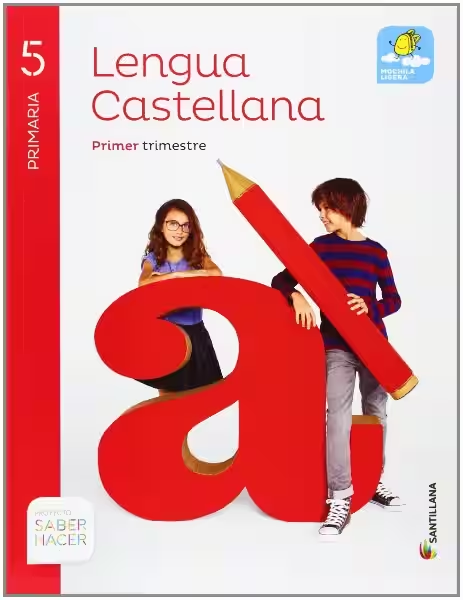
Choosing the right resources for language learning can feel overwhelming. This article explores the crucial elements of effective language learning materials, using the example of a hypothetical "lengua libro" (language book) to illustrate key principles. We'll examine what makes a good language textbook, focusing on aspects like clarity, structure, and accessibility.
- The Importance of Clarity and Conciseness in Language Learning Materials
- Structuring a Lengua Libro: A User-Centered Approach
- Accessibility and Inclusivity in Lengua Libro Design
- Conclusion: Crafting a Successful Lengua Libro
-
Lengua Libro FAQ
- What is "Lengua Libro"?
- What is the book's structure?
- What kind of information does the book contain about each language?
- What supplementary materials are included?
- Who is the target audience for this book?
- How does the book handle the vast number of languages in the world?
- Where can I find this book?
The Importance of Clarity and Conciseness in Language Learning Materials
A successful lengua libro prioritizes clear and concise instruction. Ambiguity can be incredibly frustrating for learners, leading to confusion and hindering progress. Think of the simple instruction: "To move between elements, use the up or down arrow keys on the keyboard." This seemingly simple sentence embodies several key principles of effective communication:
- Directness: It gets straight to the point, avoiding unnecessary jargon or complex sentence structures.
- Specificity: It precisely specifies the method of navigation (arrow keys) and the input device (keyboard). This prevents learners from wasting time trying different approaches.
- Brevity: Its brevity minimizes cognitive load, allowing the learner to quickly grasp the instruction and move on.
This same principle applies to a lengua libro. Explanations of grammar rules, vocabulary definitions, and exercise instructions should all be clear, concise, and easy to understand, regardless of the learner's prior knowledge. Avoid overly technical terms and overly long explanations. Use visuals and examples to aid comprehension.
A well-designed lengua libro should anticipate potential learner difficulties and address them proactively. For example, it might include a glossary of key terms, or provide multiple examples of grammatical concepts.
Structuring a Lengua Libro: A User-Centered Approach
The structure of a lengua libro greatly impacts its usability. A well-structured textbook makes it easy for learners to find the information they need and to track their progress. This often involves a logical progression of topics and a clear indication of learning objectives.
Consider a lengua libro structured around a thematic or communicative approach. This contrasts with a purely grammatical approach, which can feel dry and less engaging. A thematic approach groups vocabulary and grammar points around relevant themes or situations, making the learning more contextualized and relatable. For example, a unit might focus on "ordering food in a restaurant," incorporating relevant vocabulary, grammar points, and practical exercises.
The Role of Interactive Elements
Interactive elements are key to creating an engaging and effective lengua libro. This could include:
- Exercises: A variety of exercises, such as multiple-choice questions, fill-in-the-blanks, translation exercises, and writing prompts.
- Activities: Activities that encourage interaction and collaboration, such as role-plays, debates, and group projects.
- Self-assessment tools: Self-assessment tools that allow learners to track their progress and identify areas where they need further practice.
These interactive elements help to solidify learning and provide opportunities for practical application of the language.
Moreover, the inclusion of audio and video materials can significantly enhance the learning experience. Audio recordings of native speakers can help learners develop their listening comprehension skills, while video clips can provide contextual information and cultural insights. These multimedia components make the learning process more dynamic and engaging.
Accessibility and Inclusivity in Lengua Libro Design
Accessibility is a crucial factor in the design of any lengua libro. The book must be accessible to learners of all abilities and backgrounds. This includes considerations such as:
- Clear and simple language: The use of clear and simple language, avoiding jargon and complex sentence structures.
- Visual aids: The use of visual aids, such as diagrams, charts, and illustrations, to support comprehension.
- Large font size: A large font size and clear layout to improve readability for learners with visual impairments.
- Multilingual support: Consideration for learners who are not native speakers of the target language. For example, a bilingual lengua libro might include translations and explanations in multiple languages.
The design should also be inclusive of diverse learning styles and preferences. Some learners benefit from visual learning, others from auditory learning, and still others from kinesthetic learning. A good lengua libro will cater to a variety of learning preferences.
Furthermore, the book should strive to represent diverse cultures and perspectives, reflecting the richness and complexity of the target language and its speakers. Ignoring cultural aspects will weaken the learner's capacity to truly understand the language.
Conclusion: Crafting a Successful Lengua Libro
Creating a successful lengua libro requires a user-centered approach that prioritizes clarity, structure, accessibility, and engagement. By carefully considering the needs and preferences of learners, educators can create materials that facilitate effective language acquisition. The principles discussed above—clarity, structured progression, interactive elements, and accessibility—are crucial to developing a truly effective lengua libro that empowers learners to achieve fluency and cultural understanding. Remembering these principles will increase the effectiveness of any language learning endeavor.
Lengua Libro FAQ
What is "Lengua Libro"?
"Lengua Libro," or "The Language Book," is a comprehensive overview of global languages. It focuses on the genetic classification and geographical distribution of languages worldwide, organizing its content around a phylogenetic framework to examine language families and their relationships. The book provides a structured and accessible introduction to the world's languages.
What is the book's structure?
The book is organized geographically, with significant sections dedicated to Africa, America, Asia, Europe, and Oceania. Each section surveys major language families and individual languages within that continent, touching upon their historical development, current status, and sociolinguistic contexts. This is supported by a genetic classification system, grouping languages based on shared ancestry.
What kind of information does the book contain about each language?
The level of detail varies depending on the language's significance. Major language families receive more in-depth coverage. The book aims to provide a general overview of both major and lesser-known languages. The information typically includes details on historical development, current status, and sociolinguistic contexts.
What supplementary materials are included?
"Lengua Libro" includes a "pequeño diccionario de lenguas" (small dictionary of languages) with concise definitions and information about key languages. A glossary clarifies linguistic terminology. The book also features English-Spanish and Spanish-English correspondences for all languages mentioned, and comprehensive indexes (by continent and alphabetically) for easy navigation along with a bibliography and appendices.
Who is the target audience for this book?
The book is designed to be accessible to a broad audience interested in learning about the world's languages. Its structure and supplementary materials make it suitable for students, researchers, and anyone curious about global linguistic diversity.
How does the book handle the vast number of languages in the world?
Given the sheer number of languages, the book prioritizes major language families and provides a general overview of lesser-known ones. The genetic classification system helps structure the information and ensures a coherent presentation of the complex relationships between languages.
Where can I find this book?
Information on where to purchase or access "Lengua Libro" would need to be sought from the publisher or relevant bookstores.