
God's Warning: Echoes of Ancient Judah in Modern America
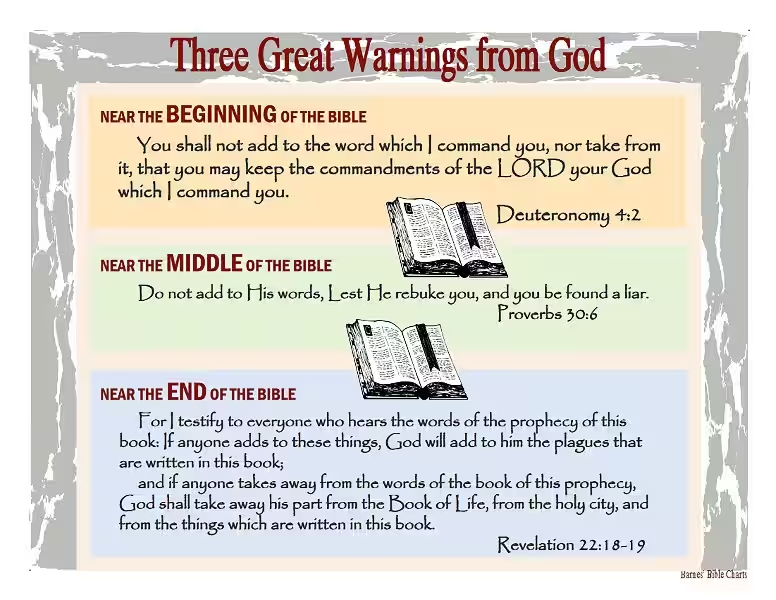
Many wonder if history repeats itself, and if so, what lessons we can learn from past civilizations. Billy Graham's powerful sermon, "God's Warning," directly addresses this question, drawing a chilling parallel between ancient Judah and contemporary America. By examining the prophecies of Jeremiah, Graham delivers a stark message about the potential consequences of ignoring God's moral law. Understanding this message, and the potential "gods warning" it implies, is crucial for navigating our present circumstances.
- The Parallel Between Judah and America: A Nation's Fall
- Idolatry: The Worship of Substitutes
- Entangling Alliances: The Dangers of Worldly Power
- Moral Degeneration: The Erosion of Ethical Values
- Spiritual Apostasy and the Lost Sense of Sin
-
Frequently Asked Questions: Billy Graham's "God's Warning"
- What is the core message of Billy Graham's "God's Warning"?
- What parallels does Graham draw between ancient Judah and modern America?
- What specific areas of concern does Graham highlight in America's spiritual health?
- What does Graham mean by "idolatry" in the context of modern America?
- What is the significance of the Book of Jeremiah in Graham's sermon?
- What is Graham's call to action?
- Is Graham predicting immediate doom for America?
The Parallel Between Judah and America: A Nation's Fall
Graham's central argument rests on the striking similarities between the rise and fall of Judah and the trajectory of the United States. Both nations experienced periods of unprecedented prosperity and global influence. Judah flourished under its kings, enjoying material wealth and military strength. Similarly, America, in its relatively short history, has achieved remarkable economic and political dominance. However, Graham argues that this outward success masks a deeper internal decay, a spiritual and moral rot mirroring that which ultimately led to Judah's destruction.
The comparison isn't about a literal mirroring of events, but rather a cautionary tale about the consequences of spiritual apathy and moral compromise. Just as Judah’s material success couldn't mask its spiritual emptiness, so too, Graham argues, America’s prosperity cannot shield it from the potential for divine judgment. The core message is one of profound spiritual warning – a call for reflection and repentance before it's too late.
Idolatry: The Worship of Substitutes
One of the key areas of concern Graham highlights is idolatry. While Americans may not openly worship false gods in the traditional sense, Graham suggests a pervasive worship of substitutes. The relentless pursuit of wealth, the obsession with pleasure, and a narcissistic focus on self-aggrandizement all function as idols, diverting attention from God and leading to spiritual emptiness. This mirrors Judah's polytheism; the worship of multiple gods alongside Yahweh ultimately led to their spiritual and moral downfall.
Graham argues that this modern idolatry isn't merely a matter of individual choice, but a societal phenomenon reflected in our cultural values and priorities. The relentless pursuit of material possessions and fleeting pleasures, often at the expense of ethical considerations or genuine human connection, demonstrates a shift in priorities away from spiritual values. This, he suggests, leaves us vulnerable to the same fate as Judah.
The Allure of Material Wealth
The "god of gold," as Graham describes it, exerts a powerful influence over many aspects of modern life. The relentless pursuit of wealth and possessions frequently overshadows spiritual growth and ethical considerations. This materialistic focus, Graham argues, mirrors the spiritually corrosive influence of false gods on ancient Judah, leading to a sense of emptiness despite material abundance.
This pursuit isn't merely about financial security; it often becomes an end in itself, a source of identity and meaning that ultimately fails to satisfy the human soul's deepest longings. This echoes the emptiness experienced by Judah despite its material wealth, highlighting the dangers of prioritizing material possessions over spiritual fulfillment.
Entangling Alliances: The Dangers of Worldly Power
Graham also cautions against America's reliance on worldly alliances for security. He argues that focusing on material strength and international partnerships, rather than spiritual fortification, mirrors Judah's failed alliances with Egypt and Assyria. These alliances, instead of providing protection, ultimately contributed to Judah's downfall.
He isn't advocating isolationism, but rather a call for a reevaluation of priorities. Instead of seeking security through military might and political maneuvering, Graham suggests that true strength lies in a renewed commitment to God and His principles. This spiritual foundation, he argues, is far more resilient and enduring than any worldly alliance.
The Illusion of Control
The pursuit of worldly power often fosters an illusion of control, a belief that we can secure our future through strategic alliances and military might. However, as Graham points out, relying solely on worldly power ignores the limitations of human endeavor and the ultimate sovereignty of God. This reliance often leads to a neglect of spiritual matters, leaving us vulnerable to unforeseen circumstances.
This parallels Judah’s misguided attempts to secure its position through alliances with powerful nations. These alliances, instead of providing lasting security, ultimately led to their downfall, emphasizing the futility of seeking security through worldly means alone.
Moral Degeneration: The Erosion of Ethical Values
Another crucial aspect of Graham's "gods warning" is the erosion of moral values in America. He cites the rise of sexual immorality, profanity, and the breakdown of family structures as evidence of a profound moral decay closely mirroring the societal corruption that plagued Judah. This decline, he argues, is a direct result of rejecting God's moral law and embracing a culture of self-indulgence.
The prevalence of these issues, Graham argues, isn't simply a matter of individual choices but reflects a broader societal shift away from traditional moral values. This decline in morality, he suggests, weakens the fabric of society and leaves it vulnerable to the consequences of its actions.
The Consequences of Moral Relativism
The abandonment of absolute moral standards, often replaced by a culture of moral relativism, further exacerbates the problem. Without a clear framework for ethical behavior, individuals and societies are left adrift, prone to self-destructive behavior. This moral ambiguity, Graham argues, mirrors the state of Judah before its fall, where the absence of clear moral guidelines contributed to its downfall.
Spiritual Apostasy and the Lost Sense of Sin
Graham also addresses spiritual apostasy, noting the parallel between Judah's false prophets who preached false peace and the contemporary religious climate that often avoids confronting sin and judgment. The avoidance of uncomfortable truths and the reluctance to preach repentance create, he argues, a false sense of security. This, coupled with a diminished sense of sin in modern society, further increases the vulnerability to divine judgment.
The minimization or outright denial of sin, Graham suggests, prevents genuine repentance and leaves individuals and nations open to the consequences of their actions. Without acknowledging our shortcomings and seeking forgiveness, we remain spiritually stagnant and vulnerable to God’s judgment. This mirrors Judah's spiritual complacency, which ultimately contributed to their demise. The gods warning is a call to confront our own shortcomings and seek genuine spiritual renewal.
Frequently Asked Questions: Billy Graham's "God's Warning"
What is the core message of Billy Graham's "God's Warning"?
Billy Graham's sermon uses the biblical account of ancient Judah's downfall as a cautionary tale for America. He argues that despite its prosperity and power, America is experiencing a parallel moral and spiritual decline, risking divine judgment unless there is widespread repentance and a return to God.
What parallels does Graham draw between ancient Judah and modern America?
Graham identifies several key parallels: Judah's idolatry is mirrored in America's pursuit of wealth, pleasure, and self-worship; Judah's failed alliances with worldly powers find an echo in America's international relations; Judah's moral decay is reflected in America's widespread sexual immorality, profanity, and family breakdown; Judah's false prophets are compared to modern religious leaders who shy away from preaching judgment; and Judah's lost sense of sin is paralleled by America's minimization of sin's significance.
What specific areas of concern does Graham highlight in America's spiritual health?
Graham points to several critical areas: Idolatry, where material possessions and self-gratification replace God; Entangling alliances, where worldly power is prioritized over spiritual strength; Moral degeneration, characterized by widespread immorality and the breakdown of family structures; Spiritual apostasy, where a reluctance to confront sin and preach judgment creates a false sense of security; and a lost sense of sin, hindering true repentance and vulnerability to God's judgment.
What does Graham mean by "idolatry" in the context of modern America?
Graham doesn't refer to literal worship of false gods. Instead, he argues that Americans are enslaved to various substitutes for God, like the pursuit of wealth ("the god of gold"), pleasure, and self-worship. This prioritization of material things and self-gratification prevents a genuine relationship with God.
What is the significance of the Book of Jeremiah in Graham's sermon?
The Book of Jeremiah provides the framework for Graham's message. Jeremiah's prophecies of judgment against Judah for its sins serve as a warning for America. Graham uses the historical events and prophetic pronouncements in Jeremiah to illustrate the consequences of ignoring God's warnings and neglecting moral and spiritual responsibility.
What is Graham's call to action?
Graham's central call to action is for repentance and a return to God through Jesus Christ. He emphasizes the urgency of this call, suggesting that God's patience is not infinite and that ignoring His warnings will have severe consequences, mirroring the fate of ancient Judah.
Is Graham predicting immediate doom for America?
Graham's message is not a prediction of immediate destruction but a stark warning of potential judgment if America continues on its current path. He emphasizes the importance of repentance and turning to God as a way to avert the consequences described in Jeremiah’s prophecies. The sermon focuses on the urgency of spiritual renewal and the potential for divine intervention if America chooses to heed God's warnings.