
Understanding Adonai Tzva'ot: More Than Just Lord of Armies
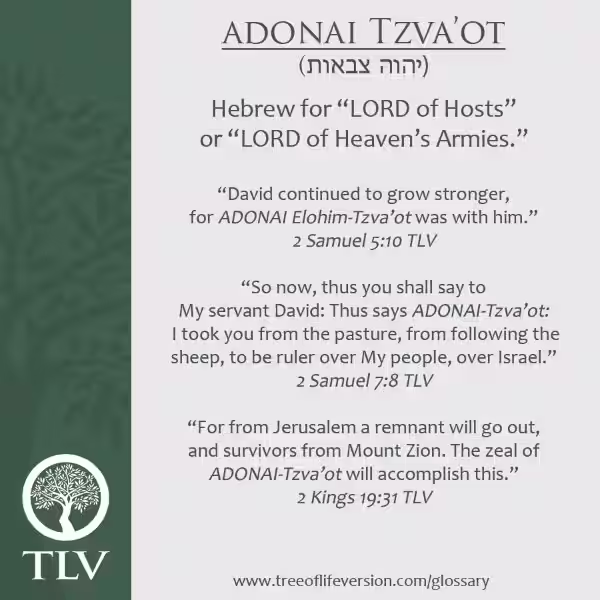
The name Adonai Tzva'ot appears a remarkable 235 times in the Hebrew Bible. This frequent repetition underscores its significance, inviting us to delve deeper than a simple translation might suggest. While often rendered as "Lord of Hosts" or "Lord of Armies," the true meaning of Adonai Tzva'ot extends far beyond a literal military context.
- The Multifaceted Meaning of Tzva'ot
- Beyond the Battlefield: God's Unseen Power
- God's Sovereignty: Transcending Conflict
- Adonai Tzva'ot: Sovereign Over Creation
- Adonai Tzva'ot: A Holistic Understanding
-
Frequently Asked Questions about Adonai Tzva'ot
- What does "Adonai Tzva'ot" mean?
- Why is "Adonai Tzva'ot" a significant name for God?
- Does "Adonai Tzva'ot" only refer to angelic armies?
- How does the story of Elisha in 2 Kings 6 illustrate the meaning of "Adonai Tzva'ot"?
- What does the encounter between Joshua and the commander of the Lord's army (Joshua 5:13-15) reveal about God?
- How does Isaiah 19:23-25 relate to the meaning of "Adonai Tzva'ot"?
- Does "Adonai Tzva'ot" encompass creation itself?
- What is the ultimate significance of the name "Adonai Tzva'ot"?
The Multifaceted Meaning of Tzva'ot
The Hebrew word tzava (army) and its plural form tzvaot possess a remarkable flexibility. While it certainly refers to a military force, its application expands to encompass any large, organized group pursuing a shared objective. Think of a bustling anthill, a team of dedicated lawyers, or a group of volunteers working tirelessly towards a common cause – all could be considered a tzava.
This semantic richness is crucial to appreciating the depth and breadth of Adonai Tzva'ot. It's not simply a title of military might, but a descriptor of God's comprehensive control and involvement in all aspects of existence. The term hints at a vast, organized power far exceeding any earthly army.
Beyond the Battlefield: God's Unseen Power
The biblical narrative frequently illustrates the unseen aspects of Adonai Tzva'ot's power. The story of Elisha in 2 Kings 6 vividly portrays the invisible angelic forces surrounding the prophet. Elisha's servant, gripped by fear at the sight of the enemy army, sees only overwhelming odds. Elisha, however, possessing unwavering faith, sees the far greater unseen army of God, demonstrating the profound difference faith makes in perceiving God's protection and power.
This narrative underscores the contrast between human perception and God's reality. The seemingly insurmountable odds faced by the Israelites are overcome not through military prowess, but through God's intervention and provision. Furthermore, the story culminates not in a brutal battle, but in an act of surprising compassion: the Israelites offer their captured enemies a feast symbolizing reconciliation, demonstrating a powerful display of divine mercy.
God's Sovereignty: Transcending Conflict
The encounter between Joshua and the commander of the Lord's army (Joshua 5:13-15) further illuminates the nature of Adonai Tzva'ot. This commander, a celestial being, clarifies that his allegiance lies with God, not with either side of the earthly conflict. This passage powerfully emphasizes a crucial theological point: God transcends human conflict; He is not a partisan God who takes sides but rather the ultimate sovereign, orchestrating all outcomes according to His will.
This concept finds further expression in Isaiah 19:23-25, where God's blessing is extended to both Egypt and Assyria, former adversaries of Israel. This reveals a profound truth: God's love and plan extend beyond national boundaries and earthly conflicts, encompassing all of creation in His overarching purpose.
God's Universal Love and Control
This perspective on Adonai Tzva'ot moves beyond a solely military understanding. It points to a God who is both powerful and merciful, capable of both judgment and boundless compassion. This isn't a God confined to human limitations or earthly struggles, but a being who holds all things in His hands.
Adonai Tzva'ot: Sovereign Over Creation
The term "Lord of Hosts" also encompasses the entirety of creation. Genesis 2:1 uses "host" (tzava) to describe the totality of creation, implying that everything, from the smallest atom to the vast expanse of galaxies, exists and functions according to God's plan and command.
This understanding is crucial when considering Hannah's prayer in 1 Samuel 1. She appeals to Adonai Tzva'ot, the God who commands all creation, trusting in His power to overcome her seemingly insurmountable barrenness. Her prayer highlights the faith that comes from recognizing God's absolute sovereignty over all aspects of life.
The Creator's Comprehensive Control
This interpretation of Adonai Tzva'ot moves beyond merely military might. It emphasizes God's complete authority over all things, visible and invisible. It's not just about the control of armies, but the control of all of creation, large and small, temporal and eternal.
Adonai Tzva'ot: A Holistic Understanding
Therefore, understanding Adonai Tzva'ot requires a nuanced approach, moving beyond simplistic interpretations. It represents God's absolute authority, encompassing the angelic realm, the forces of nature, and the very fabric of existence. It signifies His sovereignty over all things, His ultimate control over the outcomes of both earthly and spiritual conflicts, and, importantly, His boundless love and compassion for all of creation. The name reflects His power, His omnipresence, and His overarching purpose in all things. It is a title that simultaneously inspires awe, reverence, and profound comfort.
Frequently Asked Questions about Adonai Tzva'ot
What does "Adonai Tzva'ot" mean?
"Adonai Tzva'ot" is a Hebrew phrase that translates literally to "Lord of Hosts." While often interpreted as "Lord of the armies," the term "hosts" (Tzva'ot) refers to much more than just a military force. It encompasses any large, organized group working towards a common goal, including angelic beings, the forces of nature, and even the entirety of creation.
Why is "Adonai Tzva'ot" a significant name for God?
The name appears 235 times in the Hebrew Bible, highlighting its importance. It signifies God's absolute authority and sovereignty over all things – the spiritual realm, the natural world, and even the fabric of creation itself. It emphasizes His ultimate control over the outcomes of both earthly and spiritual conflicts, as well as His boundless love and compassion.
Does "Adonai Tzva'ot" only refer to angelic armies?
While some translations use "Lord of the Angel Armies," this is a limited interpretation. While angelic forces are undoubtedly included, the term's scope encompasses far more. It reflects God's complete dominion over all creation, including natural forces and the entirety of existence, operating according to His plan.
How does the story of Elisha in 2 Kings 6 illustrate the meaning of "Adonai Tzva'ot"?
This passage showcases the unseen angelic forces protecting Elisha, highlighting God's vast, unseen resources in spiritual battles. It contrasts faith (Elisha's knowledge of God's protection) with doubt (his servant's fear), demonstrating God's power to overcome seemingly insurmountable odds. The peaceful resolution further emphasizes God's compassion.
What does the encounter between Joshua and the commander of the Lord's army (Joshua 5:13-15) reveal about God?
This encounter reinforces that God transcends earthly conflicts and controls all outcomes. The commander's allegiance is to God, not to either side in the conflict, emphasizing God's position above earthly battles.
How does Isaiah 19:23-25 relate to the meaning of "Adonai Tzva'ot"?
This passage shows God's blessing extending to both Egypt and Assyria, former enemies of Israel. This illustrates God's universal love and overarching plan, encompassing even those who were previously adversaries.
Does "Adonai Tzva'ot" encompass creation itself?
Yes. Genesis 2:1 uses "host" to describe all of creation, suggesting that everything, from atoms to galaxies, operates according to God's plan and command. Hannah's prayer, appealing to the God who commands all creation, further exemplifies this.
What is the ultimate significance of the name "Adonai Tzva'ot"?
"Adonai Tzva'ot" signifies far more than military might. It represents God's absolute authority, encompassing the angelic realm, the forces of nature, and the very fabric of creation. It emphasizes His sovereignty, omnipresence, and overarching purpose in all things, coupled with His boundless love and compassion for all of creation.