
The God of Authors: Exploring Divine Patronage of Literature
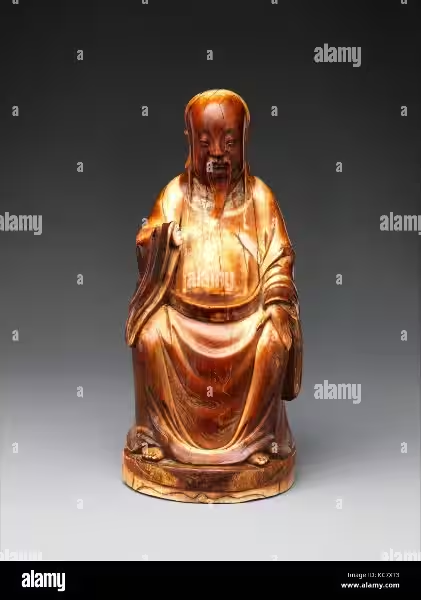
The question often arises: Is there a single deity who reigns supreme as the "god of authors"? The answer, as we'll explore, is more nuanced than a simple yes or no. While no single god explicitly holds the title in ancient mythologies, several deities played crucial roles in the creation, inspiration, and dissemination of literature, effectively acting as patrons of the written and spoken word. Let's delve into the divine figures who shaped the literary landscape across different cultures.
The Muses: The Collective Patronage of Literature
The Greek Muses are arguably the closest equivalent to a collective “god of authors.” These nine goddesses, daughters of Zeus and Mnemosyne (Memory), each presided over a specific art form. Their influence extended to all aspects of creative expression, making them essential patrons of literature.
Calliope, the Muse of epic poetry, is particularly relevant. Her name literally means "beautiful-voiced," highlighting the importance of eloquent expression in literary works. Her association with epic poetry, a cornerstone of ancient Greek literature, solidifies her position as a key figure in the pantheon of literary inspiration.
The presence of other Muses, such as Clio (history), Erato (lyric poetry), and Melpomene (tragedy), further reinforces the Muses' comprehensive patronage. Ancient Greek authors would invoke the Muses before beginning their work, seeking their divine inspiration and guidance. This act underscores the central role the Muses played in the creative process of writing.
Apollo: The God of Inspiration and Prophecy
Beyond the collective influence of the Muses, Apollo emerges as a significant figure in the literary realm. As the god of music, poetry, light, and prophecy, Apollo's domains directly relate to literary creation and transmission.
His association with prophecy is particularly noteworthy. Apollo's oracles, often delivered in poetic verse, served as powerful forms of storytelling and the dissemination of divine wisdom. These prophecies influenced both oral and written traditions, shaping narratives and influencing the content of literary works. Moreover, his musical and poetic connections directly inspired the creation of literature. His role as a patron of artistic expression provided writers with the necessary inspiration and skill to craft compelling narratives.
Hermes: The Messenger of Literary Dissemination
While not a creator of literature, Hermes, the messenger god, played a critical role in its dissemination. His swiftness and ability to travel between worlds ensured the rapid and wide distribution of literary works. The communication of stories, poems, and written texts relied heavily upon effective transmission, a realm directly governed by Hermes.
His role transcends simply carrying messages; he facilitated the spread of ideas and knowledge. The ability to share literary creations across vast distances and diverse populations depended on the efficient communication that Hermes provided. Without his influence, the reach and impact of literary masterpieces would have been significantly diminished.
The concept of a "god of authors" is not limited to Greek mythology. Many cultures have deities associated with knowledge, wisdom, and creative writing, although their specific roles and attributes may differ. Consider the following examples:
-
Egyptian Mythology: Thoth, the god of writing, knowledge, magic, and wisdom, is a prime example. He is often depicted with a scribe's tools, highlighting his critical role in the development of writing systems and the preservation of knowledge.
-
Hindu Mythology: Saraswati, the goddess of knowledge, music, arts, wisdom, and learning, is a powerful patron of creative endeavors. Her association with the arts and learning makes her a natural candidate for a "goddess of authors." Her image often includes a veena, a stringed instrument, symbolizing the harmony and creativity that are integral to literary works.
-
Norse Mythology: Odin, the Allfather, while a multifaceted deity, holds significant sway over knowledge and wisdom. His acquisition of knowledge, often through sacrifice and self-imposed hardship, resonates with the dedication and perseverance required for creative writing. He is often associated with runes, an ancient Germanic alphabet, which further reinforces his role in the transmission of knowledge and stories.
The search for a singular "god of authors" highlights the complex relationship between divine patronage and human creativity. While no single deity exclusively embodies modern notions of "literature," several figures across cultures played crucial roles in inspiring, creating, and disseminating written and oral narratives. Ultimately, the concept of a "god of authors" represents the acknowledgment of the divine inspiration and influence that many believe underpins great works of literature.
There isn't one single god definitively identified as the "god of authors" in classical mythology. The concept of "literature" as a distinct discipline didn't exist in the same way it does today. However, several deities held domains that significantly overlap with and support the creative process and dissemination of literary works. The closest equivalents are a group of gods and goddesses whose powers and influence encompass the elements crucial to authorship.
Several Greek deities are closely linked to aspects of authorship:
-
The Muses: Nine goddesses who presided over various arts and sciences, including different forms of poetry, music, history, and even astronomy. Their patronage was crucial for inspiration and success in all creative endeavors, making them the closest equivalent to patrons of literature. Invoking the Muses was considered essential for writers.
-
Apollo: God of music, poetry, prophecy, and light. His association with prophecy and poetic expression directly relates to the creation and transmission of literary works. His oracles, often delivered in poetic language, served as a powerful form of storytelling.
-
Hermes: The messenger god, crucial for the dissemination of information. While not a creator of literature, his role in communication ensured the spread of written and oral stories, poems, and other literary works.
Did any other cultures have similar deities?
The provided text doesn't detail knowledge deities from other cultures, focusing primarily on Greek mythology. To understand similar figures in other pantheons (e.g., Egyptian, Norse, etc.), further research into those specific mythologies would be needed. Many cultures have deities associated with wisdom, prophecy, and communication—all relevant to the creation and sharing of stories and written works.
- The Muses: Provided inspiration, skill, and creative energy. Authors would invoke them for assistance and guidance in their writing.
- Apollo: Inspired creative expression, particularly in poetry and prophecy. His oracles acted as a form of divinely sanctioned narrative.
- Hermes: Facilitated the communication and distribution of literary works, ensuring their reach to a wider audience.
The ancient understanding of creativity and the arts differed from our modern conception of "literature" as a distinct field. The creative process was viewed as a multifaceted endeavor influenced by various divine powers, rather than the domain of a single deity. The gods associated with authorship represent different, yet interconnected, aspects of the creative process and dissemination of literary works.