
Understanding the Nuances of "Charco de Lodo": More Than Just a Mud Puddle
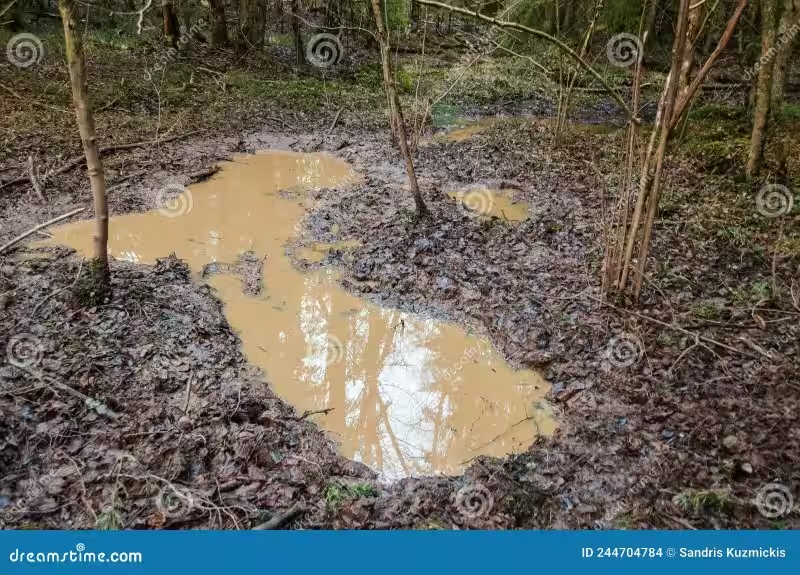
The seemingly simple Spanish phrase "charco de lodo" presents a fascinating challenge for translators. While a literal translation might render it as "puddle of mud," the true meaning often extends far beyond this simple interpretation. The richness of the Spanish language, with its capacity for nuanced expression, requires a more sophisticated approach than a direct word-for-word substitution. This article explores the complexities involved in translating "charco de lodo" and highlights the considerations a translator must make to capture its essence.
- The Contextual Importance of "Charco de Lodo"
- Beyond Size: The Texture and Location
- Figurative Meanings of "Charco de Lodo"
- The Role of Target Audience and Register
- Conclusion: The Art of Translating "Charco de Lodo"
-
Frequently Asked Questions about Translating "Charco de Lodo"
- What is the most accurate translation of "charco de lodo"?
- How does the size and depth of the puddle affect the translation?
- What if the mud's consistency is important?
- How does the location impact the translation?
- What if "charco de lodo" is used figuratively?
- How do I choose the best translation for my specific context?
- Are there any other nuances I should be aware of?
- What resources can help me translate "charco de lodo" accurately?
The Contextual Importance of "Charco de Lodo"
The effectiveness of any translation hinges heavily on context. Consider the scenario: a child playing in a small, shallow puddle of mud in their backyard is drastically different from a vehicle stuck in a deep, expansive charco de lodo after a flood. In the first case, "mud puddle" or even "muddy patch" might suffice. However, the second scenario demands a far more evocative term.
The size and depth are crucial. A small puddle implies a minor inconvenience, while a large, deep accumulation of mud suggests a significant obstacle or even danger. The translator needs to assess the scale of the "charco de lodo" to choose the appropriate equivalent. Words like "quagmire," "mire," "bog," or even "mud flat" might be more fitting depending on its size and depth.
Beyond Size: The Texture and Location
The consistency of the mud itself further complicates the translation. Is the charco de lodo thick and sticky, almost like clay? Or is it thin and watery, more like a slurry? The texture plays a significant role in conveying the image accurately. Terms like "slurry," "ooze," "gumbo," or "mire" each evoke different textures and could be more appropriate than a simple "mud puddle."
Furthermore, the location significantly influences the translation. A "charco de lodo" in a child's backyard differs greatly from one found in a swamp, a flood plain, or a desolate marshland. The surrounding environment should inform the choice of English equivalent, adding layers of meaning and atmosphere.
Figurative Meanings of "Charco de Lodo"
Beyond the literal, "charco de lodo" can also carry significant figurative weight. It might metaphorically represent a messy situation, a complicated problem, or a morally dubious affair. In such instances, a direct translation proves inadequate. The translator must discern the intended meaning and choose words that convey the figurative sense.
For example, "mess," "quagmire" (often used to describe a difficult situation), "sticky situation," or even "a mire of deceit" could be suitable alternatives. The translator must move beyond simple vocabulary and understand the underlying message to provide an accurate and impactful translation.
The Role of Target Audience and Register
The intended audience and the overall tone of the text also influence the translation choices. A formal text might demand more sophisticated vocabulary than an informal one. A children's book will use different language than a scientific report.
The translator must be sensitive to these factors and adapt their language accordingly. A simple and direct translation might be suitable for a children's story, but a more nuanced and evocative translation might be necessary for a literary work or a journalistic piece. The translator's skill lies in understanding the context and tailoring the language to fit the specific need.
Conclusion: The Art of Translating "Charco de Lodo"
Translating "charco de lodo" is more than simply finding the English equivalent of "puddle of mud." It's about understanding the context, grasping the nuances of the Spanish language, and selecting words that accurately convey the intended meaning and impact. This careful consideration of size, texture, location, and the potential for figurative meaning demonstrates the art and complexity inherent in the process of translation. The translator acts as a bridge between cultures, ensuring that the message is not only accurate but also resonates with the target audience. The seemingly simple phrase "charco de lodo" thus reveals the depth and skill required in effective cross-cultural communication.
Frequently Asked Questions about Translating "Charco de Lodo"
The Spanish phrase "charco de lodo" literally translates to "puddle of mud," but finding the perfect English equivalent requires careful consideration of context. This FAQ addresses common questions about translating this phrase.
What is the most accurate translation of "charco de lodo"?
There isn't one single perfect translation. "Mud puddle" is a literal translation, suitable in some contexts. However, the best translation depends on factors like the size, depth, consistency of the mud, its location, and whether it's used literally or figuratively. More evocative alternatives include "muddy pool," "mire," "quagmire," "bog," "slough," "mud flat," or even "gumbo," depending on the specific situation.
How does the size and depth of the puddle affect the translation?
A small, shallow puddle might be a simple "mud puddle" or "muddy patch." A larger, deeper accumulation could be a "muddy pool," "quagmire," or "bog," reflecting its scale and potential difficulty to traverse. A vast expanse might be best described as a "mud flat" or "slough."
What if the mud's consistency is important?
The mud's texture significantly influences the choice of words. Thick, sticky mud might be described as a "mire" whereas thin, watery mud could be an "ooze" or "slurry." "Gumbo" might be appropriate for a specific type of thick, sticky mud.
How does the location impact the translation?
The setting matters greatly. A mud puddle in a child's backyard differs vastly from one in a swamp or after a flood. A "mire" suggests a more desolate or challenging environment than a simple "mud puddle".
What if "charco de lodo" is used figuratively?
If used metaphorically to represent a messy or complicated situation, a direct translation is insufficient. Consider options like "mess," "quagmire" (representing a difficult situation), "sticky situation," or other phrases that capture the intended figurative meaning.
How do I choose the best translation for my specific context?
Carefully analyze the context in which "charco de lodo" appears. Consider the size, depth, consistency, and location of the mud, and whether it's used literally or figuratively. Consider the overall tone and intended audience of your text. The goal is to find the English equivalent that best conveys the meaning and impact of the original Spanish.
Are there any other nuances I should be aware of?
Yes. The register (formal or informal) of the original text should be maintained in the translation. Also, be mindful of cultural connotations. While "charco de lodo" might seem straightforward, its translation requires sensitivity to the subtle differences in how mud is perceived and described in different cultures.
What resources can help me translate "charco de lodo" accurately?
Consulting a bilingual dictionary and thesaurus can offer several options. However, relying solely on these may not be sufficient. Ideally, seeking advice from a professional translator experienced in conveying nuances of language and culture is the best approach for complex situations. Context is key, and a human translator can best judge the most fitting equivalent.