
List of Mortal Sins in Catholicism: A Comprehensive Guide

Understanding the list of mortal sins in the Catholic Church is essential for every believer who seeks to live according to God’s commandments. In Catholic theology, mortal sins—also called grave sins—are offenses of such seriousness that they destroy the life of grace within the soul.
The Catechism (CIC 1855–1861) defines a mortal sin as:
“A grave violation of God’s law that turns man away from God, preferring an inferior good to Him.”
To commit a mortal sin, three conditions must coexist:
- Grave matter (serious violation of God’s law).
- Full knowledge (awareness that it is a serious sin).
- Deliberate consent (free choice to commit it).
When one of these elements is missing, the sin is considered venial—still harmful but not spiritually deadly. Mortal sin, however, cuts the soul off from sanctifying grace and requires sacramental confession for forgiveness.
- Mortal Sins in Catholicism: Complete List, Meaning, and Forgiveness
- 1. Complete List of Mortal Sins and Examples
- 2. The Seven Deadly Sins: Roots of Mortal Disorder
- 3. Consequences of Mortal Sin
- 4. Repentance and Forgiveness
- 5. The Importance of Avoiding Mortal Sin
- 6. Biblical Foundations for Understanding Mortal Sin
- 7. Spiritual Practices to Overcome Mortal Sin
- 8. Reflection: The Meaning of Grace and Salvation
- What are the seven deadly sins?
- What is the difference between a mortal sin and a venial sin?
- What are the consequences of committing a mortal sin?
- How can I be forgiven for a mortal sin?
- How can I avoid committing mortal sins?
Mortal Sins in Catholicism: Complete List, Meaning, and Forgiveness

1. Complete List of Mortal Sins and Examples
The following is an organized list of mortal sins Catholic teaching identifies as grave offenses, grouped by category for clarity. These represent deliberate and serious acts that rupture our relationship with God.
| Category | Mortal Sin | Examples or Description |
|---|---|---|
| 1. Against God (First Commandments) | Blasphemy | Mocking or insulting God, Jesus, Mary, or the saints. |
| Idolatry & Superstition | Worshiping false gods, astrology, occult rituals, charms. | |
| Sacrilege | Profaning sacred objects or receiving Communion in mortal sin. | |
| Atheism / Apostasy | Denying God or deliberately abandoning the Christian faith. | |
| 2. Against Faith & Worship | Missing Sunday Mass (without serious reason) | Skipping Mass for trivial reasons like leisure or laziness (CIC 2181). |
| Desecration of the Eucharist | Disrespecting or discarding consecrated hosts. | |
| Occult or Magic Practices | Consulting mediums, horoscopes, witchcraft (CIC 2116). | |
| 3. Against Life (Fifth Commandment) | Murder | Taking an innocent human life. |
| Abortion | Procuring or cooperating in abortion (CIC 2271). | |
| Euthanasia | Intentionally ending a life to alleviate suffering. | |
| Suicide | Taking one’s own life with full reason and consent. | |
| Hatred or Violence | Wishing grave harm or death on another person. | |
| 4. Against Sexual Morality (Sixth & Ninth Commandments) | Fornication | Premarital sexual relations. |
| Adultery | Infidelity within marriage. | |
| Homosexual acts | Engaging in same-sex sexual activity (distinct from orientation). | |
| Masturbation | Deliberate self-gratification for lust. | |
| Pornography | Producing or consuming pornographic material (CIC 2354). | |
| Contraception | Artificial means opposing the procreative purpose of marriage. | |
| Incest, rape, bestiality | All are gravely disordered sexual acts. | |
| 5. Against Others (Justice & Charity) | Theft (serious value) | Stealing significant property or value (CIC 2408). |
| Slander / Calumny | Ruining another’s reputation with lies. | |
| Envy / Covetousness | Deep resentment or desire for another’s blessings. | |
| Refusal to Forgive | Willfully holding grudges or hatred. | |
| 6. Against the Body (Temperance) | Drunkenness | Losing reason or control through excessive alcohol. |
| Drug Abuse | Recreational use of harmful or illegal substances. | |
| Gluttony | Persistent overindulgence in food or drink. | |
| 7. Against Marriage & Family | Divorce and remarriage (without annulment) | Breaking a valid marriage and re‑marrying. |
| Neglect or abuse of children | Failure in parental duties or causing harm. | |
| 8. Against Society | Corruption / Fraud / Exploitation | Bribery, oppression, trafficking, or social injustice. |
| Scandal | Leading others to sin deliberately (CIC 2284). |
These categories encapsulate the major areas of grave moral disorder that Scripture and Tradition consistently denounce.
2. The Seven Deadly Sins: Roots of Mortal Disorder
While the list of mortal sins refers to actions, the seven deadly sins identify the interior vices that often lead to them. Described by St. Gregory the Great and codified by later theologians like St. Thomas Aquinas, they are the roots of many mortal offenses:
- Pride – Excessive self‑love and arrogance against God.
- Greed (Avarice) – Inordinate desire for material possessions.
- Lust – Disordered sexual appetite or thoughts.
- Envy – Resentment over the good fortune of others.
- Gluttony – Excess consumption or indulgence.
- Wrath – Uncontrolled anger, hatred, or revenge.
- Sloth – Spiritual laziness; neglecting one’s duties toward God or neighbor.
Each deadly sin becomes “mortal” when it leads to grave and deliberate acts done with full knowledge.
3. Consequences of Mortal Sin
The impact of mortal sin goes beyond guilt; it wounds the relationship between the soul and God.
The Catechism explains clearly in CIC 1861:
“If it is not redeemed by repentance and God’s forgiveness, it causes exclusion from Christ’s kingdom and the eternal death of hell.”
The principal consequences include:
- Loss of Sanctifying Grace: The soul no longer lives in God’s friendship.
- Spiritual Blindness: Repeated grave sin darkens moral judgment.
- Eternal Separation: Persisting in unrepented mortal sin leads to damnation (Matthew 25:46).
- Damage to the Church: Every mortal sin hurts the Body of Christ, not just the individual.
4. Repentance and Forgiveness
Despite their gravity, no mortal sin is beyond God’s mercy. The door to reconciliation remains open through the Sacrament of Confession:
“If we confess our sins, He is faithful and just to forgive us.” (1 John 1:9)
For forgiveness to be valid, the penitent must have:
- Contrition: Sincere sorrow for having offended God.
- Confession: Acknowledging each mortal sin to a priest.
- Satisfaction: Performing the assigned penance.
- Firm Purpose of Amendment: Resolved effort not to repeat the sin.
After absolution, the soul is restored to a state of grace, and communion with God is renewed.
Frequent confession and examination of conscience are therefore vital to spiritual growth and vigilance.
5. The Importance of Avoiding Mortal Sin
Avoiding mortal sin is not just a rule but a path of love. It preserves our ability to receive the Eucharist, pray with freedom, and live joyfully in unity with God.
By striving to avoid mortal sin, Catholics:
- Maintain a Living Relationship with God.
- Guard Their Souls Against Spiritual Death.
- Fulfill the Commandments Out of Love, Not Fear.
- Prepare for Eternal Life, echoing Christ’s call: “Be holy, for I am holy.” (1 Peter 1:16)
Through vigilance, confession, and the sacraments, every believer can walk in sanctifying grace despite human weakness.
6. Biblical Foundations for Understanding Mortal Sin
Throughout Scripture, specific passages confirm the distinction between sins that are deadly and those that are not:
- 1 John 5:16–17 – “There is sin that is mortal; I do not say that one should pray for that.”
- Romans 6:23 – “The wages of sin is death, but the gift of God is eternal life.”
- Matthew 12:31 – Warnings against willful blasphemy of the Holy Spirit.
- Galatians 5:19–21 – Lists “the works of the flesh” that exclude one from God’s kingdom.
Thus, mortal sins in Catholicism are not arbitrary prohibitions but reality checks on choices that estrange us from divine love.
7. Spiritual Practices to Overcome Mortal Sin
The Church provides the faithful with concrete means to resist temptation and avoid grave sin:
- Daily Prayer and Scripture Reading – Keeps the conscience illuminated by God’s Word.
- Frequent Confession – Cleanses the soul and strengthens virtue.
- Participation in the Eucharist – Restores interior strength when received in grace.
- Devotion to Mary and the Saints – Encourages perseverance and intercession.
- Acts of Charity and Mercy – Love of neighbor heals selfish tendencies at their roots.
Mortal sin thrives in spiritual neglect; it is defeated by vigilance, humility, and grace.
8. Reflection: The Meaning of Grace and Salvation
Every Catholic’s journey is a battle between grace and sin. Mortal sin represents a deliberate rejection of love, but God’s mercy remains stronger than any fall. The story of the Prodigal Son (Luke 15) mirrors every sinner’s path: separation through disobedience, misery in distance, and joyful restoration through repentance.
Understanding the list of mortal sins in the Catholic Church is ultimately about more than memorizing offenses—it is about learning to value God’s grace and striving for interior purity.
“For nothing impure shall enter Heaven.”
(Revelation 21:27)
Each mortal sin endangers that eternal promise, yet every confession reopens paradise for the contrite heart.
Therefore, know the truth, confess frequently, and live intentionally in grace —because eternal life begins in the soul that chooses God over sin.
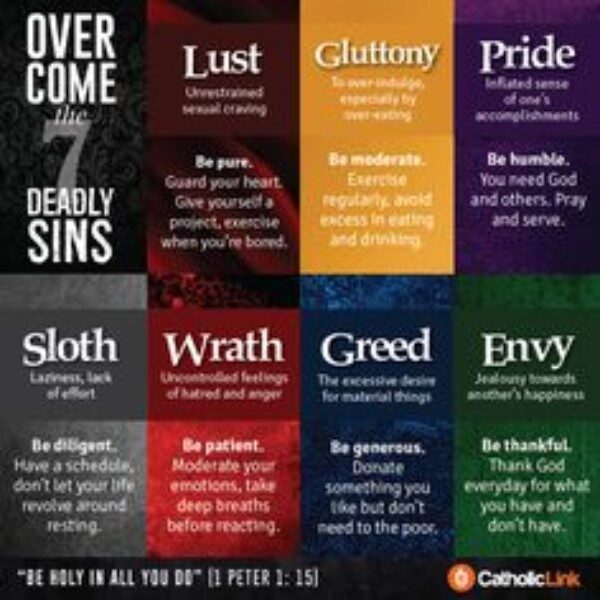
What are the seven deadly sins?
The seven deadly sins are pride, covetousness, envy, wrath, lust, gluttony, and sloth.
What is the difference between a mortal sin and a venial sin?
A mortal sin is a grave sin that destroys charity in the heart of the person who commits it and turns him away from God. A venial sin is a less serious sin that does not destroy charity but weakens it.
What are the consequences of committing a mortal sin?
The consequences of committing a mortal sin are separation from God's grace, spiritual harm, and the risk of eternal punishment.
How can I be forgiven for a mortal sin?
Mortal sins can be forgiven through the sacrament of reconciliation, also known as confession. Through this sacrament, the sinner confesses his or her sins to a priest, receives absolution, and is restored to God's grace.
How can I avoid committing mortal sins?
To avoid committing mortal sins, it is important to:
- Pray regularly
- Attend Mass
- Receive the sacraments
- Read the Bible
- Follow the teachings of the Church